


As a new DC Mayor and DC Council face budget spending pressures and slow revenue growth, one idea that has begun appearing is a Business Activity Tax, or BAT. The Fair Budget Coalition urges the creation of “a Business Activity Tax (BAT) to ensure all businesses pay their fair share of DC’s business taxes,” citing an estimated $500 million in extra revenue at a 2% rate. Likely next Mayor Janeese Lewis George has expressed openness to a BAT, and the D.C. Council has directed the Chief Financial Officer to report on the feasibility of a BAT by January 2027.
The D.C. Fiscal Policy Institute writes that a BAT “would make business taxation fairer and more racially equitable while raising significant revenue for the District.” The D.C. Tax Revision Commission considered a plan to impose a 0.9% BAT (including a 0.5% rate on nonprofits) and use the revenue to reduce other business taxes, but ultimately did not produce a report of recommendations in large part due to opposition to the proposed tax.
No other state imposes a BAT, nor is the concept familiar even to tax experts. Its authors intend it, in part, to sidestep the Bishop court decision but downplay the legal risks of attempting to do so. If the BAT worked as designed, it would reduce other existing business taxes and leave little if any extra revenue for new programs, but some proponents cite it as just such a net revenue source. Whether or not the BAT is viable in the District of Columbia, policymakers should revisit D.C.’s uniquely confusing mix of business taxes.
D.C. Already Has 5 Major Existing Taxes on Businesses
Despite rhetoric that D.C.-based businesses are undertaxed, they currently are responsible for paying five major existing taxes (with the amounts raised in FY 2024):
1. Corporate Franchise tax ($932 million).
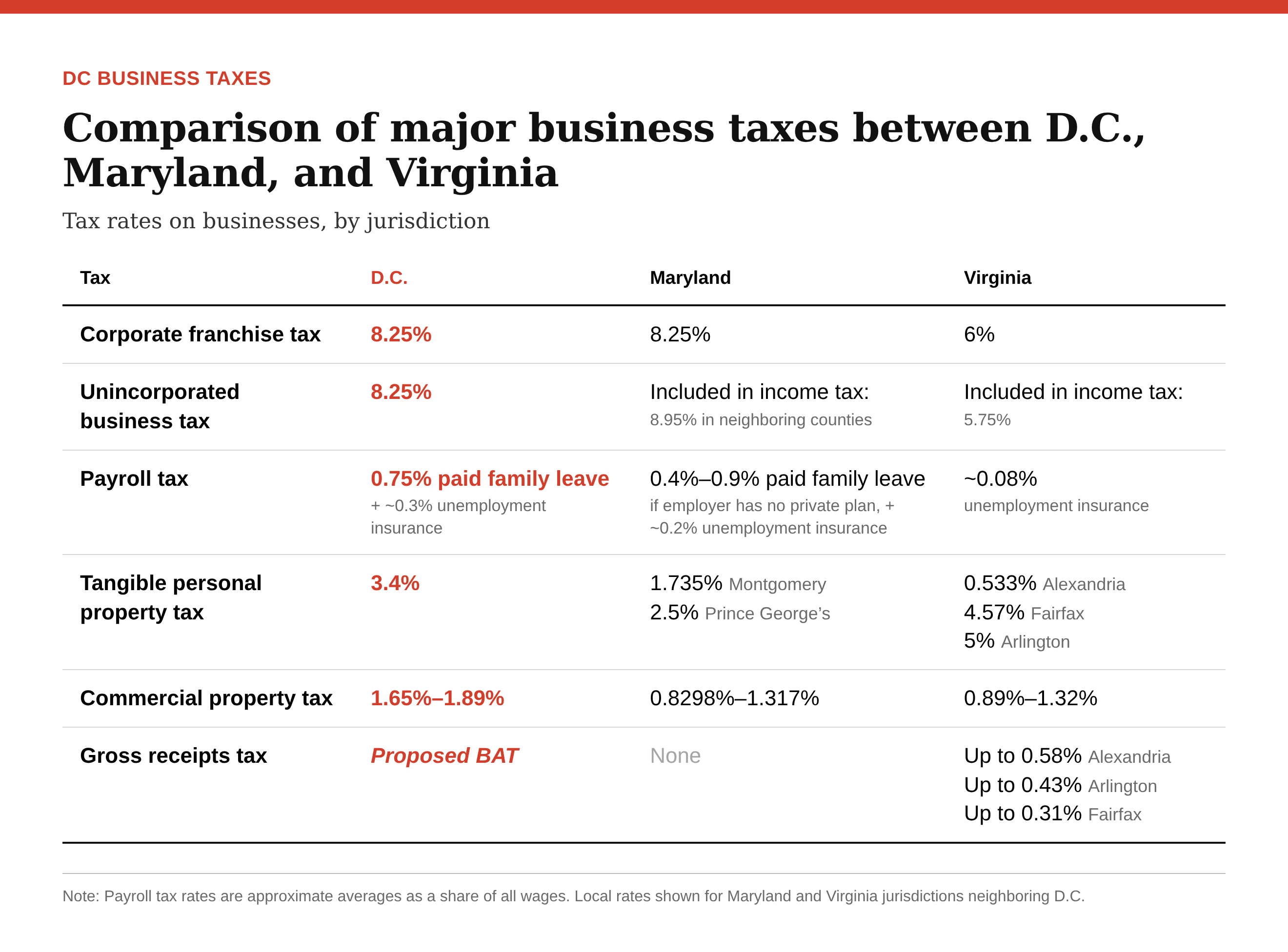
This corporate income tax is a tax on profits (revenues minus deductible expenses) at a rate of 8.25%. 44 states have such a tax, with rates ranging from 2% to 11.5% and an average of 6.6%. Maryland has a similar tax also at 8.25%, as does Virginia but at a 6% rate.
2. Tangible personal property tax ($83 million).
At one time, all property was subject to the property tax, including household furnishings and business inventory. Assessors would enter homes and shops to make estimates of the value of what they saw, an intrusive process that gradually retreated to today’s property tax on real property and a remnant of tangible personal property tax mainly on business property.
This tax on business equipment and movable furnishings is imposed at a 3.4% rate on property exceeding $225,000 (amount set in 2008 and not adjusted for inflation). All businesses and nonprofits, even those with property below the threshold, are required by law to fill out the form and report their property. As a result, 60,000 businesses file but only 1,500 (or 2.5% of businesses) owe anything, and 91% of the collected tax comes from just 300 firms. The forms require all property to be sorted into 94 categories on one of 7 major depreciation schedules, many of which differ from federal depreciation tax treatment, and no asset can be depreciated below 25% of acquisition cost. 36 states, or localities within those states, have some form of TPP taxation. In all but Georgia and D.C., however, the exemption level operates as a threshold with businesses under it not required to file at all. Maryland exempts $20,000 of TPP and taxes it at lower rates (Montgomery County at 1.735%; Prince George’s County at 2.5%), while Virginia taxes TPP locally at varying rates (Alexandria at 0.533%; Arlington at 5%; Fairfax at 4.57%).
3. Unincorporated business franchise tax (UBT) ($200 million).
Most U.S. businesses are not organized as C corporations, but instead as sole proprietorships, partnerships, limited liability companies (LLCs), or S corporations. Most states do not directly tax these pass-through entities; instead, its owners or members pay individual income tax on their proportionate share of profits. (In recent years, most states, but not D.C., have adopted elective entity-level taxes on pass-through businesses to allow the business owners to avoid the federal cap on the state and local tax deduction. These taxes provide an offsetting credit against individual income tax, so do not increase state revenue.)
D.C.’s UBT dates to 1947, copying a New York law to collect tax from businesses that could organize as corporations but were not so as to avoid the corporate franchise tax. For this reason, except for a 1975 attempt cut short by the Bishop decision (more below), nonsalaried professionals that have historically (or are legally required to be) organized as partnerships or sole proprietorships such as accountants, lawyers, lobbyists, and real estate agents have been exempt from UBT. These business owners, if D.C. residents, instead pay individual income tax on their profits. Non-professional businesses pay the UBT but receive a dollar-for-dollar credit (until 2026, a deduction) against their income tax. The UBT therefore is somewhat of a vestige since Bishop, reaching no income that the individual income tax couldn’t already reach. Non-resident business owners are exempt per the Home Rule Act ban on taxing nonresident income, as applied by Bishop.
4. Payroll tax (~$400 million to $600 million, as the rate changed significantly in recent years).
D.C. businesses pay two major payroll taxes to fund benefits programs for workers: one for unemployment insurance and one for the universal paid leave program.
The unemployment insurance payroll tax operates as part of a federal-state program that exists in every state. In D.C., businesses pay payroll taxes that vary widely from 1.9% to 7.4% (“Table VI”) depending on a business’s past claims activity, plus a 0.2% administrative assessment, all imposed on the first $9,000 paid in each worker’s wages. As a percent of all wages, D.C.’s unemployment insurance tax averages 0.3% and collects $119 million per year to pay benefits. Maryland and Virginia have lower UI taxes: Maryland’s range from 0.3% to 7.5% on the first $8,500 in wages and average 0.2%; Virginia’s range from 0.1% to 6.2% on the first $8,000 in wages and average 0.08%.
Beginning in 2019, D.C. businesses pay a payroll tax to fund the universal paid leave program providing sick leave, family leave, and parental leave. The tax was originally set at 0.26%, sufficient to pay benefits and build a reserve fund, but in 2019 was sharply increased to 0.62%, and again in 2024 to 0.75%, to generate revenue to balance the rest of the city’s budget. D.C.’s budget still superficially describes the tax as the paid family leave tax even though most of the revenue is now transferred to the general fund for other purposes.
5. Commercial property tax ($1.5 billion).
D.C.’s heavy taxes on commercial real estate downtown and in other key areas has historically been a cash cow, generating 37% of D.C. property tax revenue from 2% of the properties. Since the pandemic, though, the sector has become a major cause of D.C.’s recent revenue woes as D.C.’s office market vacancy rate has actually grown since the pandemic to 22 percent. Between 2020 and 2025, slow demand for commercial office space caused D.C.’s 572 largest buildings to fall in value from $66 billion to $56 billion, and as it shows up on annual tax assessments it drags down tax revenues by $200 million a year.
As recently as 1975, tax rates on residential and commercial real estate were equal, but today the differences are very sharp. Residential property in D.C. faces a 0.85% tax on assessed valuation (with homes paying somewhat less in actual tax as a result of a homestead deduction) but commercial property faces tax rates of 1.65% (assessed value less than $5 million), 1.77% (assessed value of $5 million or more), or 1.89% (assessed value of $10 million or more). In addition, property transfers are taxed with a 1.45% deed recordation tax and a 1.45% deed transfer tax. Maryland has equal tax rates on residential and commercial property, with rates varying by jurisdiction between 0.8298% to 1.317%. Virginia has a split roll of higher taxes on commercial property than residential property, with rates ranging from 0.89% to 1.32%.
Other taxes and fees. In addition to those five main taxes, some businesses are also responsible for:
Business license fees ($12 million). Businesses and non-profits must pay periodic flat dollar fees to the Department of Licensing & Consumer Protection to do business in the District. The recently implemented BEST Act will reduce these fees for small businesses and entrepreneurs.
Ballpark fee ($51 million). This set dollar amount ($5,500 to $16,500 depending on business size) is used to pay bonds taken out to build the ballpark. The fee was recently renamed the Sports Facilities Fee and extended to the RFK project.
Bag fee ($1.7 million). Businesses must charge 5 cents for disposable bags and remit 4 cents to the city.
Sales tax collection. While this $2 billion tax is economically borne by those purchasing goods or services, businesses are legally responsible for collecting and remitting it.
All told, business-paid taxes total approximately $3.5 billion in 2024, a sizable share of the then-$19 billion budget. When including the share of sales tax paid on business inputs, various excise taxes, and income taxes paid by business owners on business income, total state and local business taxes in D.C. total $5.9 billion, or $11,100 per employee. This is 10th highest in the country, and compares to Maryland at $8,300 per employee and Virginia at $7,800 per employee.
The Home Rule Act Bans Commuter Taxes, and the Bishop Case Bans Workarounds
The Home Rule Act § 602(a)(5) bans “any tax on the whole or any portion of the personal income, either directly or at the source. . . of any individual not a resident of the District.” In 1980, the D.C. Court of Appeals held in Bishop v. District of Columbia that D.C.’s Home Rule Act restriction on taxing nonresident income is a broad one, preventing D.C. from expanding its Unincorporated Business Tax to the income earned by nonresident professionals.
D.C. had taken this step in 1975 after three failed attempts to convince Congress to allow D.C. to collect income tax on Maryland and Virginia commuters. Virginia lawyer Richard Bishop (no relation) sued to have the UBT expansion to nonresidents declared illegal. D.C. argued its 1975 law was a business tax, not an income tax, but the court (first a three-judge panel, then the full court) was not convinced. The 8 to 1 majority held: “The professional tax, by its very terms, is a tax on net income…. Appellee would have us hold that this tax is a tax on the right to earn income in the District, measured by the amount of income earned, and nothing more.”
The decision mirrors court decisions in most states that hold that how tax operates, rather than the label used by the legislature, matters more for evaluating a tax’s legality. A tax “on business,” measured by individual income, is actually an individual income tax. Any attempt to work around the Home Rule Act restriction would fail if in practice it was still a tax on individual income of Maryland and Virginia commuters.
Thus, since Bishop, the UBT has been limited to D.C.-resident business owners. But what if a business tax truly was a business tax, but just happened to capture precisely the individual income D.C. sought to tax? One sentence of the Bishop court’s opinion opened the door for what has become the BAT proposal: “That argument would be persuasive if the incident of this tax were the right to do business.” Income taxes are based on profits (revenue minus expenses), but taxes based on franchise value, going concern value, or gross receipts would arguably not be subject to the Home Rule Act restriction on gross or net income taxes. Successfully structuring such a tax could reach what was not allowed in Bishop.
How a DC Business Activity Tax Would Work (in Theory)
The BAT concept sets out to produce what the Bishop court invited: a tax on the right to do business that is truly measured by business activity. But the goal is also to produce what the Bishop court rejected: a tax that reaches the commuter income that cannot be taxed by the Home Rule Act.
To attempt this potentially impossible combination, the BAT must (superficially, at least) be a tax on all businesses, but with subtractions (deductions and credits) to hold harmless all but the targeted commuter income. At its core, the BAT consists of four interconnected elements:
The BAT is a tax on the right to do business, as Bishop invited. It is not a tax collected by business but legally imposed on individuals, like the income tax or sales tax. While it may economically be passed on to others, it legally is imposed on the business itself.
The BAT is a tax on all businesses, corporate and non-corporate, profit and non-profit. It would apply both to existing taxpaying businesses but also those who currently have no liability under the existing franchise tax and unincorporated business tax (primarily, non-corporate businesses with non-residential owners).
The BAT is a tax on gross receipts at a certain rate. A tax on profits (receipts minus expenses) would simply duplicate the existing system and in any event could not be applied to non-corporate businesses with non-residential owners because of Bishop. A flat dollar tax on every business (similar to the Ballpark Fee) would not raise much revenue unless set at levels likely to burden local businesses. A flat dollar tax per employee (as recommended by the 2013 Tax Revision Commission) or an indirect tax on commuter income (such as a congestion charge like New York City’s) might survive Bishop scrutiny but invite other policy tradeoffs. This leaves a gross receipts tax as the designer’s preferred policy option.
The BAT is structured to reduce and offset other existing business taxes. Recent BAT proposals would subtract purchases, rent, and capital investment, and then credit BAT liability against the franchise tax and unincorporated business tax. Without these subtractions, the BAT would be a significant tax increase on existing D.C.-based businesses rather than a mechanism for targeted untaxed income earned by non-residential owners of non-corporate businesses. However, such subtractions also reduce the potential net revenue from a BAT.
If all these components are done together, the resulting tax may avoid Bishop scrutiny as it reaches commuter income while holding existing D.C. businesses harmless. However, this legal theory remains untested, and the underlying purpose of avoiding Bishop remains a vulnerability.
The D.C. Fiscal Policy Institute has prepared calculations of a 2% BAT for two example businesses, one an existing business that would be held harmless thanks to the proposed subtractions and credits, and the other a non-corporate business owned by non-residents who would pay D.C. tax for the first time:
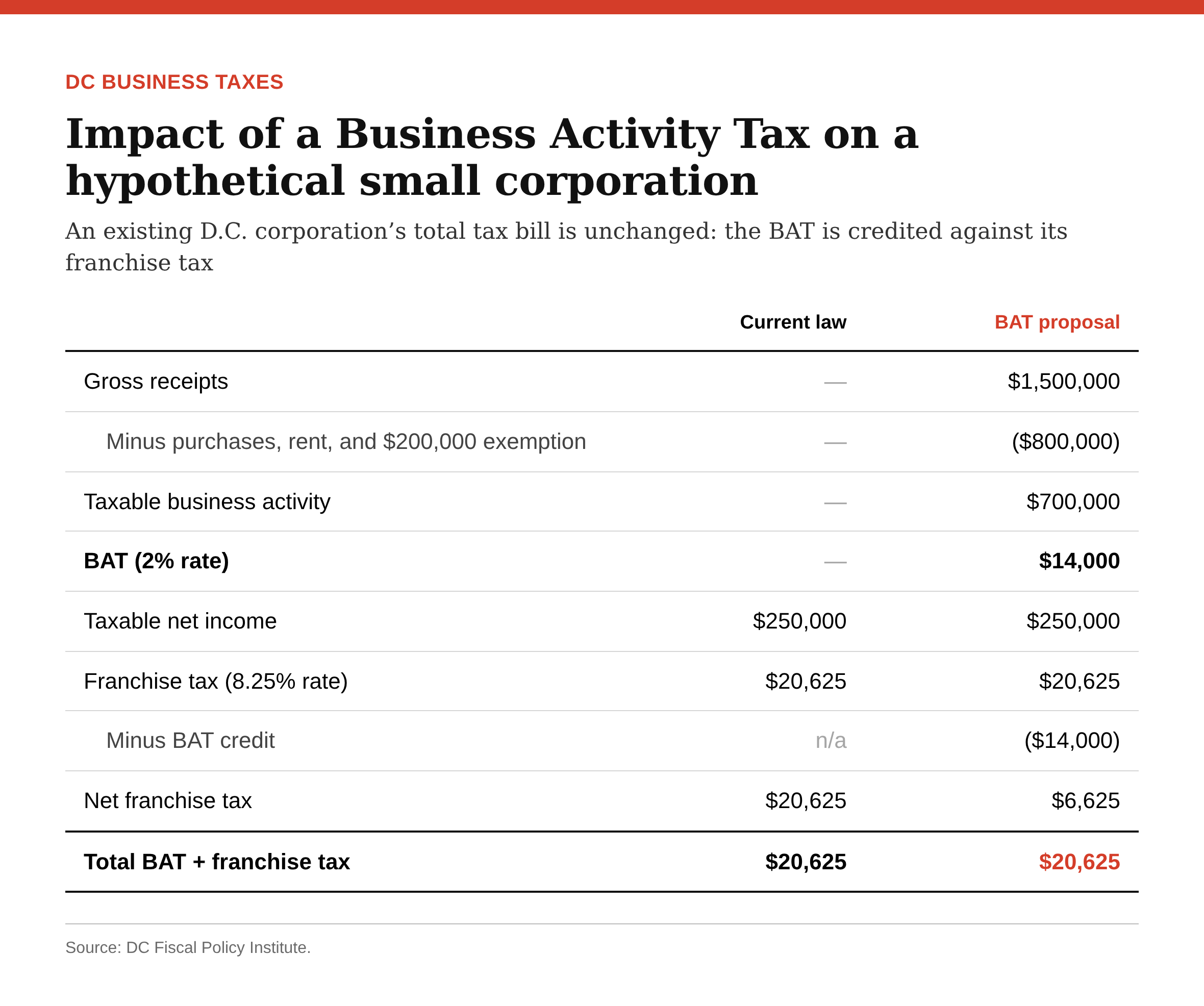
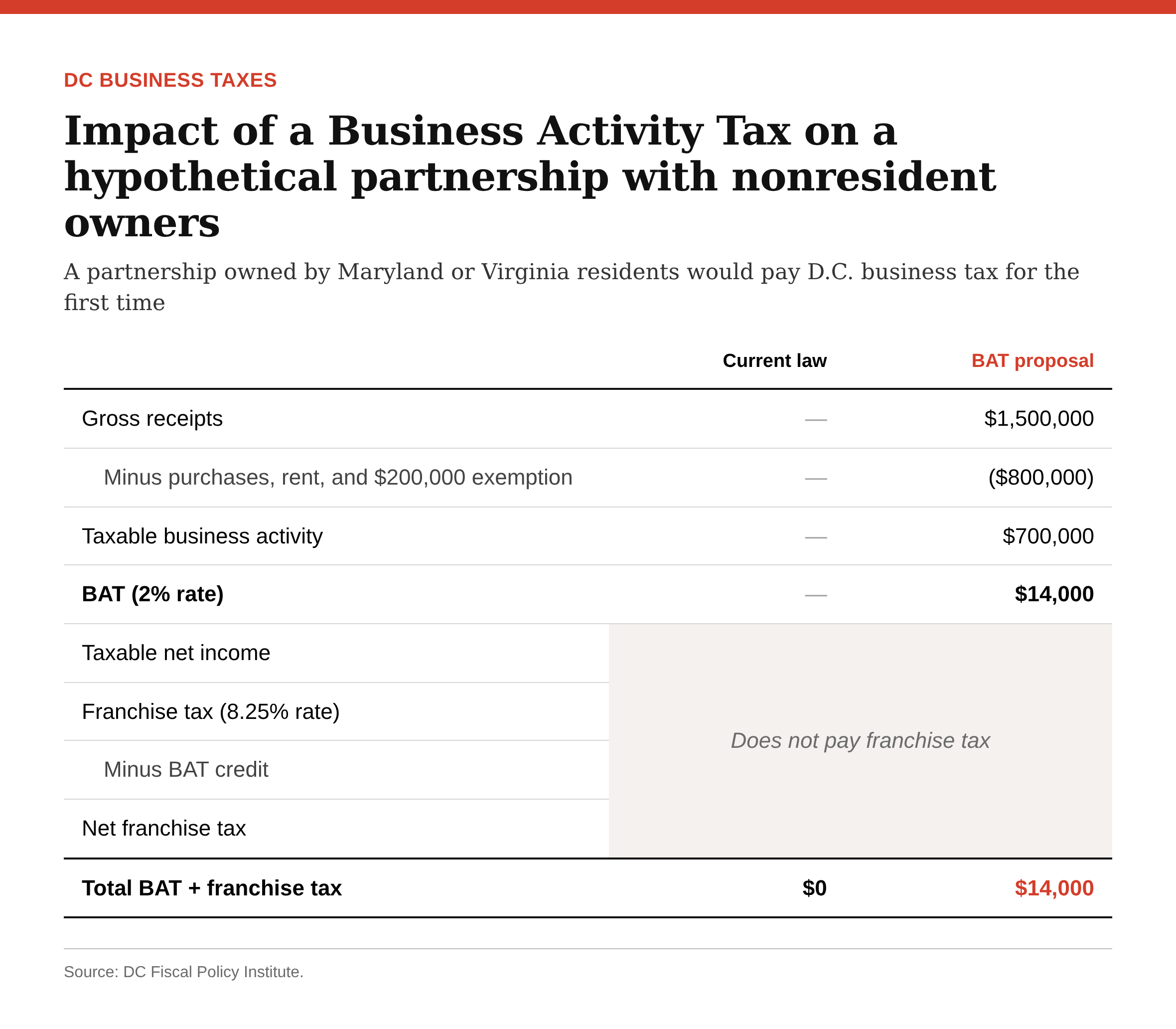
The DCFPI analysis cites a 2023 D.C. Office of Revenue Analysis calculation of a 2% BAT raising $388 million per year, which would include the credits against the franchise tax and the unincorporated business tax but not repeals or reductions of other business taxes. Because the BAT as designed would aim to hold existing taxpayers harmless, most of this revenue would be from non-resident professionals like accountants, lawyers, lobbyists, and real estate agents. After adjusting to remove exemptions for interest and dividends paid and upwardly adjusting GDP, DCFPI estimates a 2% BAT would generate approximately $500 million per year. The analysis, however, uses 2020 business filing figures and assumes zero dynamic changes (such as from business locations or modifications) from the implementation of the tax.
DC’s Tax Revision Commissions Have Considered BATs, Weighing Bishop and the Flaws of GRTs
D.C. establishes a Tax Revision Commission every decade or so to make recommendations to the Council, and each recent one has studied a BAT. The 1998 Tax Revision Commission recommended that the Council enact a BAT at 1.5% rate while abolishing three of the other business taxes completely (the franchise tax, the unincorporated business tax, and the personal property tax) and ending business license fees, which together would have been roughly revenue-neutral. The 2013 Tax Revision Commission dropped a BAT concept and instead recommended all D.C. businesses (including non-profits) pay a $100 per employee per year service fee; this remains the most significant unimplemented recommendation from the 2013 report.
A BAT again became the core concept considered by the 2024 Tax Revision Commission. Staff initially prepared a 1.4% BAT on revenue above $200,000, minus purchases, rent, and capital investment. The revenue-neutral tax swap would completely repeal the unincorporated business tax and the personal property tax, and reduce the commercial property tax rate by 10 cents. After feedback expressed concern about the BAT rate and the need to reduce the payroll tax, staff prepared a revised version with a 0.9% BAT (0.5% on nonprofits) on revenue above $200,000, minus purchases, rent, and capital investment, and creditable against franchise tax or unincorporated business tax liability. That revenue-neutral tax swap would increase the non-filing threshold for the personal property tax, potentially repeal the unincorporated business tax, and return the payroll tax to 0.26%. The lack of consensus on the Commission toward the BAT, and the lack of a non-BAT fallback, ultimately led to the Commission producing no recommendations.
One reason for the BAT reluctance of the 2013 and 2024 Commissions is that gross receipts taxes are rare because they are disfavored as economically problematic. GRTs tax unprofitable businesses as much as profitable ones and can pyramid, or heavily burden businesses arbitrarily based on how vertically integrated they are or how many transactions they have. Grocery stores, for instance, have high gross receipts and numbers of transactions but low profitability. Aside from narrow GRTs on insurance premiums or bank shares, such a method of taxing business is the exception not the rule in state and local finance.
Nine states currently have GRTs, with rates mostly ranging between 0.25% and 0.75%. However, the tradeoff is much more obvious for 7 of those states which do not have one of the other major taxes (income or sales) at all. Only Ohio and Virginia have a GRT while also having both an income and a sales tax, and the GRT rates in those states are no higher than 0.58%. A D.C. BAT proposal at a higher rate, and that keeps income and sales taxes, would be unique in the competitive context.
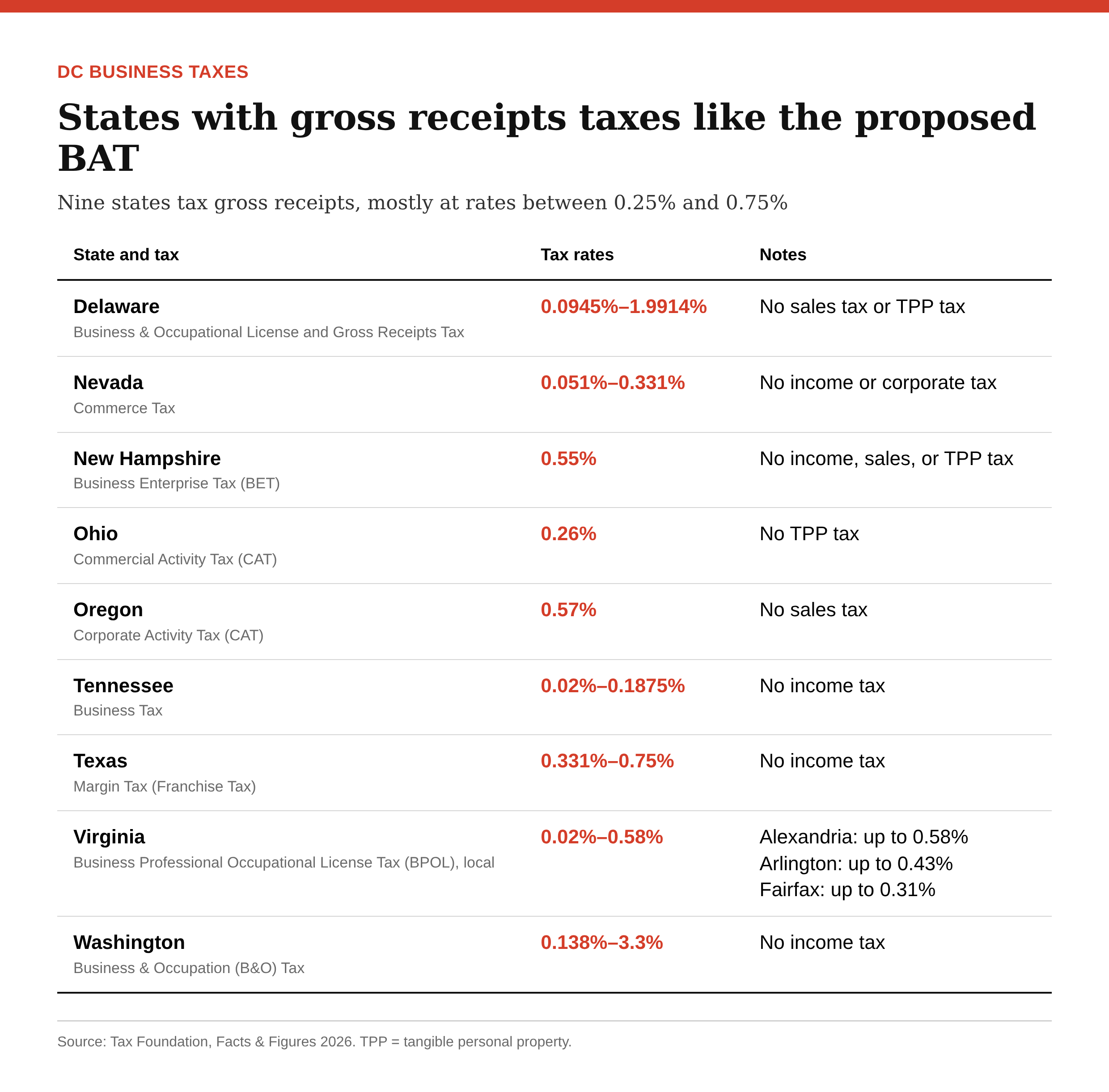
The 2024 Commission especially looked at the New Hampshire Business Enterprise Tax (BET), which would be structurally most similar to the proposed BAT structure. The BET, imposed at a 0.55% rate, subtracts purchases, rent, and capital investment to attempt to avoid the pyramiding inherent in GRTs and essentially more resemble a value-added tax (VAT). However, New Hampshire’s experience has also been one of cutting its BET rates: once 0.75%, the BET has been reduced four times since 2015 to keep the state competitive. New Hampshire also has neither an income tax nor a sales tax.
Conclusion
The proposed Business Activity Tax promises both to raise hundreds of millions of dollars in new revenue and to avoid increasing taxes on existing businesses, but those goals may be difficult to reconcile. Its legal viability remains uncertain, its revenue estimates assume businesses will not change their behavior, and gross receipts taxation risks imposing new burdens on businesses regardless of profitability. Earlier Tax Revision Commissions recognized these tradeoffs and considered a BAT primarily as part of a revenue-neutral overhaul that would eliminate or reduce other business taxes.
With D.C. businesses already paying some of the highest taxes in the country and the District struggling to grow its commercial economy, policymakers should be careful not to just layer on another tax.
