

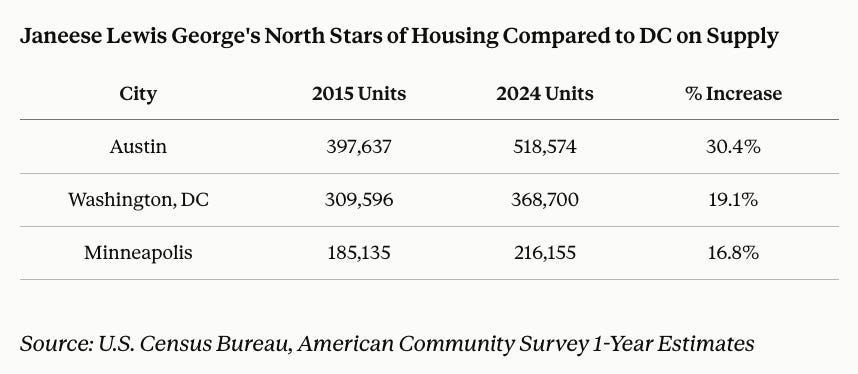
Janeese Lewis George name-checked Austin and Minneapolis in burnishing her Yes In My Backyard credentials during the mayoral nominee’s successful Democratic primary campaign, another admission that housing supply advocates have won the day in left-of-center circles.
Like the Mamdani campaign to which she invited comparisons, Lewis George actively courted the YIMBY vote down the stretch. Zohran Mamdani’s approach in practice has been a mix of encouraging moves on overall housing affordability, like upzoning and permitting reform, along with counterproductive slopulism like the rent freeze. Paul Williams of the New York mayor’s transition team called a version of Lewis George’s social housing plan unworkable for increasing housing supply, and a preponderance of evidence points to supply being the most important thing you can do to broadly drive down housing cost.

Rendering of the Washington Commanders’ future home of RFK Stadium among new mixed-use residential on the Anacostia River.
Lewis George has taken bullish positions on housing production in areas such as zoning to help earn primary endorsements from GGWash and DC YIMBYs. The draft RFK Campus Master Plan, which enters the final two weeks of public comment period, could illuminate the style of YIMBY that Lewis George will bring to the mayor’s office. Not so much her statements between now and Aug. 14, but more so beyond that with an eye to communications and actions through mid-2027 when we hit zoning review.
Much like anyone with a pulse in politics after 2024, JLG hammered the word affordability in her campaign. The District of Columbia’s rent-to-income ratio has dropped from its peak last decade, but as the nation’s capital gets walloped with job losses and economic contraction, further decrease is critical for providing relief to current residents and persuading new ones to come pay taxes here. Housing makes up close to one-third of the average household budget in Washington, D.C., and sits right around the rent-burdened line of 30 percent.
Facilitating downward pressure on housing costs is perhaps the most direct and impactful way to address affordability. Austin’s metro area has the nation’s lowest rent-to-income ratio and Minneapolis lands at fourth. JLG’s North Stars are both good ones and also do represent different levels of ambition, as Minneapolis city numbers would be roughly maintaining the relatively strong existing pace from the Bowser Era, while Austin levels would represent a bold acceleration in supply.
To hit any of those marks, Lewis George will likely need to manage coalitional tensions around zoning, city control, and labor with some of the parties that got her here, as she did on her RFK redevelopment yes-vote. This dance should provide clues as to whether we truly have a supply-pilled incoming administration that boasts any shot at her five-year goal of 72 thousand homes.
Degree of city control for Kingman Commons
Kingman Commons is the one parcel for residential in the entire draft RFK Campus Master Plan where DC hasn’t chosen a developer and leaves many details to be decided, including what kind of housing and public vs. private ownership. It’s the smallest of the RFK plan’s three residential districts, capped at approximately 1,300 of the site’s 5,000 to 6,500 total units that overall have 30 percent designated as affordable.
Riverfront is projected at around 3,100 units and Plaza at about 2,200, both more than double the ceiling of Kingman Commons (renamed from Kingman Park District). Both sit inside the Washington Commanders’ 28-year ground lease and those two are no longer a decision for the mayor or Council.
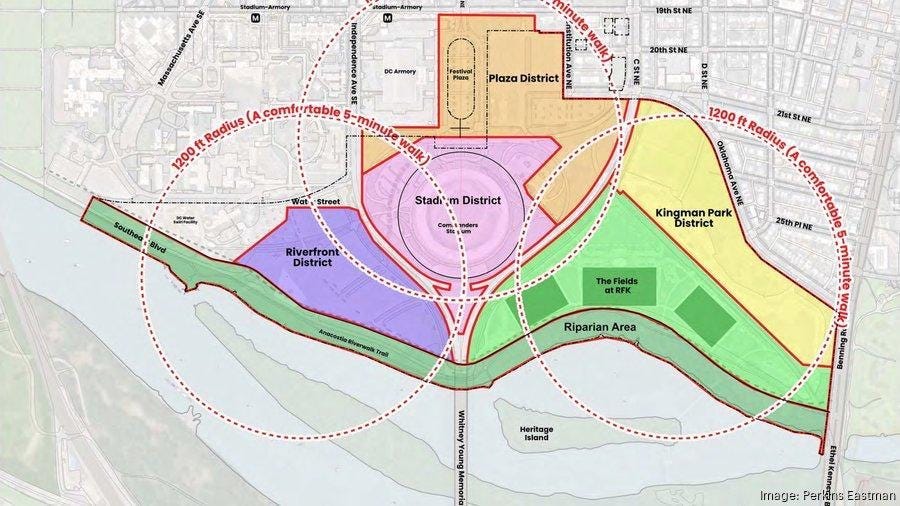
An RFK site rendering that features earlier versions of a few names: Kingman Park District is now Kingman Commons, Riparian Area and Anacostia Riverwalk are not Anacostia Commons, and the light green plot with The Fields at RFK is now the Recreation District."
Lewis George’s Green New Deal for Housing Amendment Act was viewed as an alternative to Mayor Bowser’s public-private approach to development, and didn’t make it out of Council. That bill’s DNA lives on in her current campaign platform advocating for two-thirds social housing with the remaining third of market rate housing meant to subsidize it. This includes tenant leadership boards given a say over building management and community rules. Again, a housing expert tapped to Mamdani’s transition team said he told JLG’s team that this plan would not lead to an increase in housing supply.
Look for clues on the new mayor’s approach from the forthcoming Request for Proposal in terms of affordability requirements, whether the District takes a public equity stake giving it more ongoing control, and whether it favors a mission-driven or nonprofit developer over a field of private bidders.
Stadium-adjacent zoning flexibility
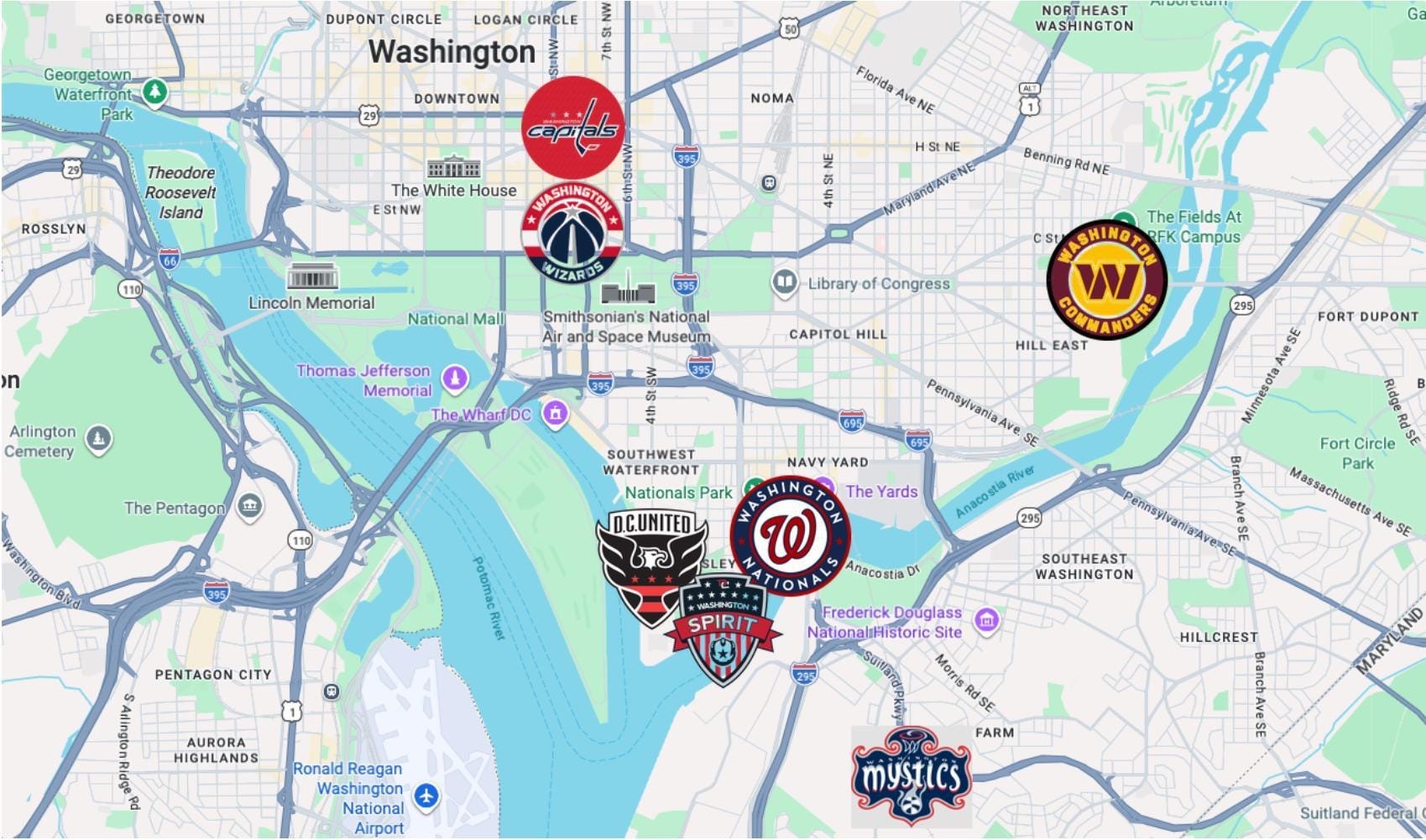
DC doesn’t have to look far for evidence that stadium-adjacent zoning can seed a housing boom. Navy Yard’s transformation into the DMV’s fastest-growing residential corridor tracks closely with the Nationals Park opening, and Capital One Arena did something similar a decade earlier for Chinatown and neighborhoods close to downtown. We saw the Council and Mayor Muriel Bowser both seize the wheel upon realizing the Capitals and Wizards weren’t bluffing about Potomac Yard, and it’s because these teams do create important downstream effects in the District. It’s critical to leverage economic engines like these with tailored processes. Zoning relief, like Los Angeles is starting to deploy for their 2028 Olympics hosting gig, can then become a repeatable playbook for housing production.
The votes Lewis George has been faced with since joining the Council in 2020 lack any sort of great analog for the Ward 4 Councilwomen’s approach by the river upon becoming mayor, outside of being a Yes vote on redeveloping the RFK site.
Her voting record does however suggest an affinity to the type of procedural friction that constrains housing in other downstream ways. It features opposition on the 12-1 passage of the Eviction Moratorium Public Safety Exception Emergency in April 2021, 10–3 final passage of the RENTAL Act in September 2025, and 9–4 passage of the TOPA reconsideration amendment in October 2025. While those are datapoints for our priors, the campaign posture has been fairly pro-upzoning this spring and summer. The outcome of the parking garage flashpoint from public comment could be instructive but might also be tough for mapping onto a clean YIMBY read. RFK master plan adoption is expected by the end of 2026, zoning text and map amendments get filed in early 2027, and Zoning Commission action follows sometime in mid-to-late 2027.
The likely new mayor’s North Stars of Austin and Minneapolis got it done by loosening procedural friction. Since the supply-pilled YIMBYs have transformed the conversation, perhaps zoning deference has made its way from abundance folks to being adopted firmly in the DC progressive zeitgeist. Lewis George did campaign on the missing middle in housing and directly referenced RFK as a target for that. At the very least, the zoning approach down by the new site of the Commanders will provide another directional signal on the degree to which the city’s housing stock is subject to countervailing procedural friction.
Labor and affordability tradeoffs
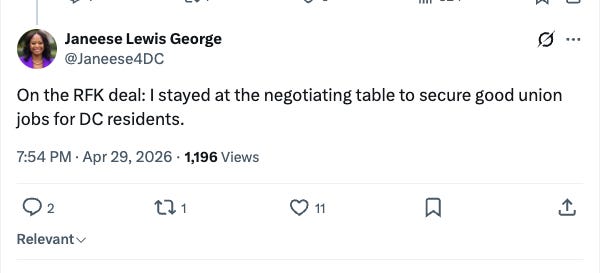
The stadium and its adjacent hotels already carry a Project Labor Agreement, along with a 51% DC resident hiring requirement and a $15 million Certified Business Enterprise carveout. What’s not locked in is how much of that framework extends to the site’s housing districts.
The DC Fiscal Policy Institute implored extending PLA to mixed-use district construction, and this did not make it to the text of the Robert F. Kennedy Campus Redevelopment Emergency Amendment Act of 2025. The cost premium jumps from negligible to upward 20% depending on sector and methodology in PLA studies, but it gets complicated and that would be for another very long article.

Nationals Park fell short of its labor goal of 50 percent of journeyman construction hours performed by DC residents. More recently the Frederick Douglass Memorial Bridge, which crosses the Anacostia near Nats Park and downriver from RFK, wrapped in 2021 with more than 60 percent of its apprentices being DC residents per the Baltimore-DC Metro Building Trades Council. It’s safe to assume the new mayor will want that outcome from enforcement and monitoring to continue with quite a different beast of a project.
It will be interesting to see how Lewis George and the Council close the gap DCFPI flagged, and whether she’s willing to reckon publicly with what PLA coverage could mean for unit costs and construction timelines. Her North Stars of Austin and Minneapolis assume a pace of building that a more extensive PLA could slow down. This is among the genuinely tough tradeoffs faced in an executive governing role.
Which kind of YIMBY?
The comment period for the draft master plan closes Aug. 14, just past the one-year mark since the Council’s first RFK vote. None of the three questions above will be resolved by that deadline. Zoning text doesn’t get filed until early 2027. The debate over how the PLA extends to housing continues. The Kingman Commons procurement process hasn’t concluded and won’t for some time.
What these early signals from the RFK site offer is a read on how Lewis George balances the many labor, zoning, and public-private dynamics facing DC in the waning years of the 2020s.
It will indicate whether the YIMBY banner will be raised with an acknowledgement of markets, or if YIMBY and affordability were both just bumper stickers to slap on the back of whatever else the incoming administration already wanted to do. These instincts will shape many housing and business development projects in the city, and hint at the prospects of the mayor and Council avoiding enough ideological traps to truly crack the code on affordability.

This may only tangentially related to the central thesis here but IMO one major issue involves what presents to me as a constitutional aversion to hard tradeoffs and choices. It is fine and good to get excited about high upside ideas, particularly when courting a constituency. The key is whether she will be willing to *give up* anything tangible to prioritize it.
That widespread dynamic bubbled all the way up to the Biden admin where prioritization felt like a lost art. If Dems want to beat the spineless allegations, well, clearly reckoning with priorities could be a signal of strength. There’s been receptiveness for a while to the idea there are no tradeoffs or none if you do one easy trick, but I’d think primary voters will eventually start to sour on that when cost of living does not in fact go down.