


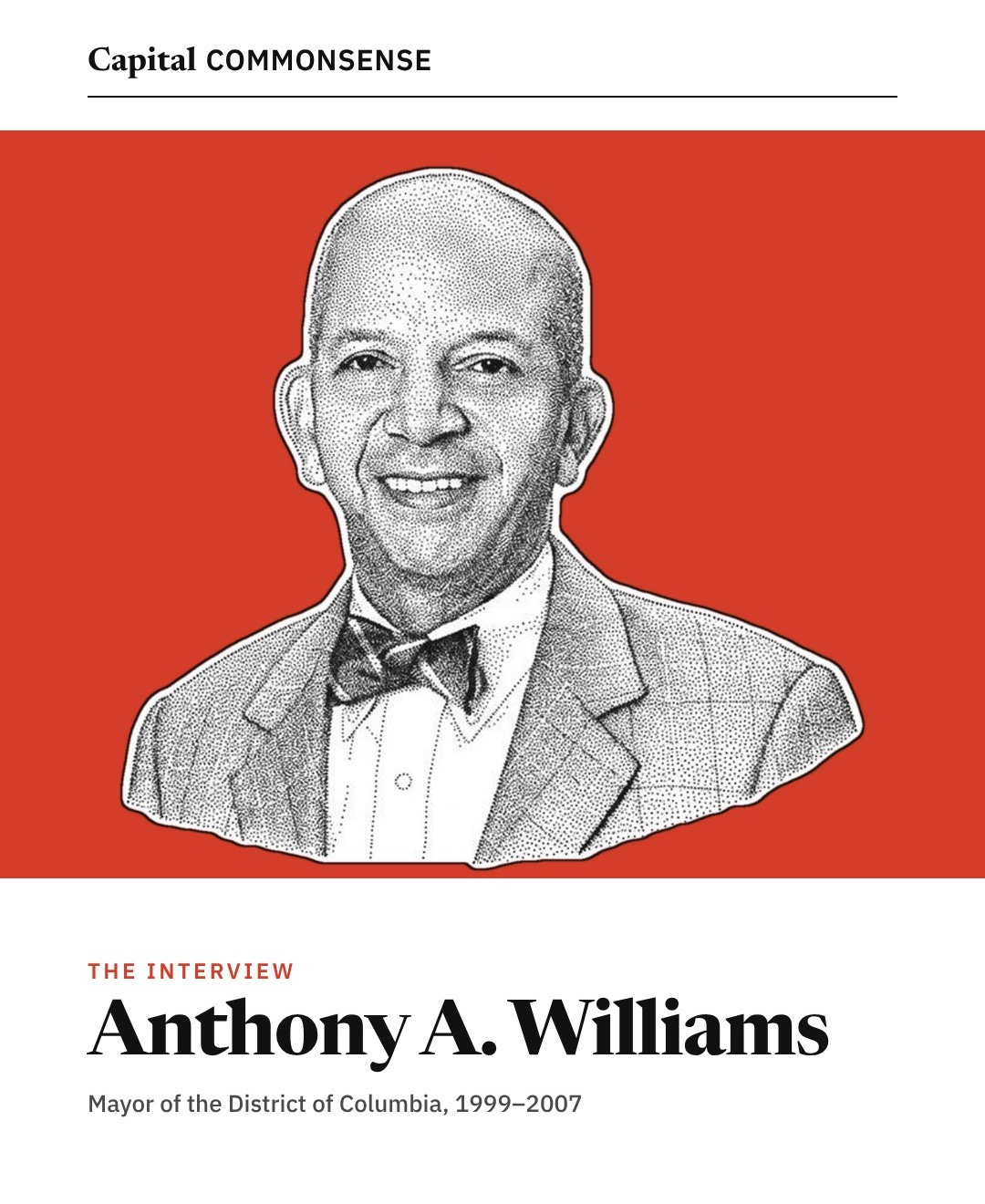
Ashley Schapitl: Mayor Williams, thanks again for doing this. I’d like to start with your perspective from the tax hearing. You spoke so eloquently about how much of the expansion of D.C.’s social safety net over the last 20 years was made possible by achieving your goal of 100,000 new residents and bringing new people and new business to the city. How do you think about the success story of the 2000s and 2010s, as Councilmembers look at how to diversify and reinvigorate our economy after a tough stretch with the rise of remote work and DOGE?
Mayor Williams: Well, first of all, thank you for having me on Common Sense. Let me lay out some major premises. One is that D.C. is different from other cities. It’s a very attractive, beautiful city with a great history. It’s the capital of our country. It’s a city that has a predilection for growth. If you get out of the way, the economic engine we’re able to build and energize has produced tremendous growth over the years.
Look at the D.C. budget. When I was around, it was about $5 billion; now it’s $20 to $22 billion. That’s an indicator of huge growth. It’s like bleed air off an engine: the core engine produces the taxes and the spinoff that create that budget. And 80% of that budget goes to social services.
Premise number two, the point I made to the Council: over the last 10 or 12 years, about 80 to 85% of the enormous growth in public goods came from growth in the economy, not from taxation.
Another premise is compounding. People understand present value. Take all your factors, inflation, risk, and look over a 20-year period. You’re going to gain enormously more public good from growth in the economy than by messing with this core engine, breaking it, and finding yourself with a problem.
My last premise was that if you promise everything to everyone, you’ll find yourself unable to do anything for anyone. That’s where we were in the ‘90s. We had an underpowered government budget, partly because of federal restrictions, but also because of our own impairment of revenue inflows, sending the wrong signals, bad management. I could go down the list. You have to reverse all that to get the economy growing again.
What does that mean? It means you have to be very judicious and cost-conscious about the choices you make. Why would you start programs with one-time funding and then continue the funding? I don’t understand that. Why would you keep funding programs that were special to COVID?
When people say, “This is a critical program, and we need taxes for it,” that’s the biggest budget canard in history. It’s what’s called the Washington Monument ruse: “If you cut my budget, I’ll have to deconstruct the Washington Monument.” No. What about the other $21 billion in the budget?
What I was telling the Council is: we’re not trying to be Texas. What people want to see is that you’re taking a comprehensive approach to the difficult decisions facing us, that you’re making those decisions, and that you’re leveraging them to put us in a better place. Because be assured, we’re going to face difficult decisions. The real question is whether we make stupid difficult decisions or wise difficult decisions.A wise difficult decision is like a garden. You prune the garden today, and it grows back more robustly in the future.
Ashley Schapitl: One of the things you’re best known for is bringing baseball back to the city. It shows how in tune you were with what it took to attract private-sector investment and business to the District. What do you think are the most important things for the new mayor and the Council to consider on economic diversification and attracting investment, learning the lessons you did in the early 2000s?
Mayor Williams: The important thing is to look at your balance sheet. Look at your assets as part of your balance sheet; revenues are a big part of your assets. What do I need to do to protect, preserve and sustain, let alone grow, these critical revenue streams? We like to demonize high earners, but we need to treasure them. They’re paying [about] 70% of the government, and they don’t ask for a lot of services in return. They’re like our oil wells: leave them alone and let them produce. Why is this hard? What signals can we send to bring more investment to the city? I’m very confident that if we send the right signals, more investment flows to the city: more jobs, more amenities, and the public goods we’re looking for.
On the budget side, I would take a deep look at Council oversight and invest in serious oversight. I’ve told them [the Council] this: they need highly competent, well-paid professional staff to dig into these agencies, the way Congress has professional staff to dig into the federal budget. We’ve got to dig into these agencies with real oversight and pay attention.
Number two, I would spend time not just on the budget impacts of legislation. Legislation can be dumb but balanced in the budget. The real question is: is it economically feasible? Does it hurt our economic competitiveness? We need to ask that question. Maybe the city auditor needs to opine on it, or a Council committee, or the CFO. I don’t care. Somebody needs to be saying that this legislation, while it can be paid for with new taxes, is not economically sound.
A ship can go down by the head. It can go down by the stern. It can go down perfectly balanced. You can have a perfectly balanced budget while the city is losing economically year by year. It’s like a business: a business can have a balanced budget and still be in an economically unsound position.
Ashley Schapitl: The Council was focused on the particulars of each individual tax policy without stepping back and saying: Our population growth has fallen off a cliff since 2019. How do we get those people back?
Mayor Williams: Thank you. Absolutely right. A major signal, which is what I was trying to tell them, is this: Our people aren’t saying “cut the top income tax rate by 5%.” We’re saying, send a message that you’re looking at expenditure reductions as part of an overall package, short-term and long-term, to get the city back in balance. Taxes could be part of that package. But it can’t be the first thing you go to without any initial analysis on the expenditure side.
Ashley Schapitl: I think your point about COVID-era spending is particularly important. You often hear the Council talk about needing to find money to continue COVID-era programs, like rental assistance, and trying to fill the hole left by federal funding.
Mayor Williams: Absolutely.
Ashley Schapitl: That’s certainly been a big cause of the year-after-year one-time funding.
Mayor Williams: The other point I made to the Council is about inequality. There’s what I’d call iconic inequality reduction. I make myself feel good because on paper I’m reducing inequality by taxing high earners more. Yes, that addresses inequality in an iconic way. But if you’re taxing high earners more and the money goes to programs that are flatlining in actual effectiveness, have you really reduced inequality? No. You’ve made yourself feel good, but you’re not really reducing inequality.
What a lot of people like me, who live in the District and pay taxes in the District, were saying is: spend the money on things that actually produce a result. If joblessness isn’t really changing, poverty isn’t really changing, truancy isn’t really changing, I can go down the list. Let’s stop, take a break and reevaluate how we’re deploying our funds.
Ashley Schapitl: Another area to discuss is the collapse in investment in the housing sector, and the struggles of affordable housing with non-payment and everything else we’ve heard about. From your perspective, what are the most important signals the new mayor and the Council can send to get housing investment going again?
Mayor Williams: This is another area where growth matters. The District is susceptible to growth. And capitalism, properly regulated and delimited, look what it’s done around the world over the last 30 years to reduce poverty. It’s a profound engine for addressing inequality if you let it run the right way. I’m not talking about Ayn Rand, just let it run. I’m saying that in a blue-state setting, it can produce powerful good.
What I’m trying to say is that we have the ability in D.C. to send the right signals, work with the investment community, with stakeholders and providers, and with tenants, like we’re doing with the Federal City Council and Housing Unity D.C., and move toward a situation where the economy produces natural affordability. You’ll produce far more housing by getting supply and demand to meet naturally than by trying to fill in gaps. Not that I’m against filling gaps. I’m just saying we’ll get more mileage out of the former.
Ashley Schapitl: So much of what kicked off the housing boom that started under your mayorship was that there was demand for housing because people were coming in.
Mayor Williams: Absolutely.
Ashley Schapitl: Getting back to the city meeting the goal of 100,000 additional residents that kicked off under your mayorship: when you set that goal, what did you think was most important for attracting the young professionals and families who have helped reinvigorate the school system and grow the tax base over the last 20 years? Was it better schools, lower crime, better services, some combination? What mattered most for getting people to move to the District rather than Northern Virginia or Maryland?
Mayor Williams: I thought D.C. is an inherently beautiful city, with amenities and a history that can’t be reproduced anywhere else. If you restore respect for the city by showing you’re dedicated to a government that works, and you stay focused on the same policies, it pays off. It’s like Warren Buffett talking about how investment compounds. I think good policy compounds.
You start building core agencies back. There’s a Washington Post article that talked about this. Something I started, Adrian [Fenty] doubled down on, and a series of mayors through Muriel [Bowser] have built on it, and it’s compounded positively. People give me a lot of credit, but if I didn’t have good mayors following me who were dedicated to customer service and government effectiveness, and we all had our failings, it wouldn’t have worked. It compounds powerfully.
In government, especially with work rules, it’s hard to make changes. You really have to prioritize and focus. But if you stay focused and always pivot back to your core two, three or four things, when you look back five or six years later, you’re making headway.
Ashley Schapitl: As an ANC commissioner, I notice that at the Council level there’s a lot of talk about issues from a national perspective. But what I hear about at the ANC level is very basic stuff. Did my trash get picked up? Are the garbage cans at the park being emptied every day?
Mayor Williams: Nobody elected you to be Secretary of State. They elected you to take care of potholes. That’s true for the mayor and true for the Council. We’re not here to solve all the world’s problems. One, we don’t have the bandwidth. Two, if you try, it can be anti-competitive.
Ashley Schapitl: That was really noticeable to me at the tax hearing. There was talk about how ordinary and capital income are treated differently at the federal level, and about the California billionaires tax. I was thinking, none of this is our responsibility. You can’t fix the federal tax code in a city of 700,000 people. No Washington resident expects the Council to fix these much bigger-picture problems. They just want the basics to work.
Mayor Williams: I agree. You have to be very careful about what you try to do on a local government budget. On a national level, I do think there should be more progressivity in taxation. But that’s a national issue, not a local one.
Ashley Schapitl: That was very notable to me because I support higher capital income taxes at the federal level. But when you’re a city of 700,000 people and someone can move a mile across the bridge and still keep their job, it’s a different calculation.
Mayor Williams: Absolutely, it’s different. And there are two kinds of bandwidth when you’re running a city. One is your revenues. The other is your capacity as a government. We keep adding new programs to face very difficult challenges when we’re not showing people we can do basic things really well. I hear people complaining about the same things I was dealing with, and we’re back to complaining about them again. Why are we adding new things when we need to pay attention to the basics? I don’t want to pick sides, but I give the mayor credit for saying, let’s stop and focus on the basics.
Ashley Schapitl: A lot of people in my ANC district scratch their heads when they hear about things like a new childcare program. They say, I support that in theory, but my trash didn’t get picked up last week. My last question: if you could wave a magic wand and encourage the Council and the new mayor to do three specific policy things next year to send a good signal to business, attract investment and reverse our population decline, what would they be?
Mayor Williams: One, I would work with the advocates and stakeholders in education to double down on it as a top priority. We’ve made great headway.
Ashley Schapitl: I’m so glad you brought up the schools, because that’s one of the real bright spots across the city.
Mayor Williams: We need to leverage that now with our middle schools and high schools, and with real work on truancy. These are problems I had, and we still have them. We need to address them. That’s number one.
Number two, come to a grand bargain on housing, along the lines I talked about, where people are paying their rent again. This is critical. It’s an important message to send to the world.
Number three, send a message to the world that whatever happens with the Trump administration, we’re dedicated to continued improvements in public safety. That’s an important signal.
And lastly, show that we’re looking at both sides of our fiscal picture as part of a comprehensive package, short-term and long-term. Not just our revenues, their incidence and fairness, but the huge exposure on our expenditures, and that we’re making tough decisions to bring them back in line. Those would be powerful signals to the world.
Ashley Schapitl: I’m glad you brought up rent non-payment. I first heard about it a couple of years ago. As you know, a lot of developers come to ANC meetings. In December 2024, a developer came to ours asking for an extension on their PUD because they couldn’t find financing. They told us they were struggling to maintain operations and conditions in another of their buildings, because almost four years after the pandemic, only 75% to 80% of residents were paying any rent at all. They said you just can’t operate housing this way. It was taking 12 to 18 months to process non-payment cases through the Landlord and Tenant Branch, and they were at their wits’ end. And the problem is basically no better two years later.
Mayor Williams: We want more [entrepreneurs] in our city. We want more minority developers in our city. Some of the developers hardest hit by rent non-payment were startup minority developers. How do you start a development company? You buy land and you rent. If people don’t pay your rent, congratulations, you’ve bought a business that doesn’t work.
Ashley Schapitl: Well, thank you so much for your time, Mayor Williams.