


After nearly 50 years, Floriana is moving from the District to Old Town, Alexandria. I wanted to hear more about the reasons behind the move and what Jamie Branda had to share about the challenges facing the District’s small businesses, particularly its local restaurants, after decades working in the industry, both as a server and owner. Our conversation has been lightly edited for length and clarity.
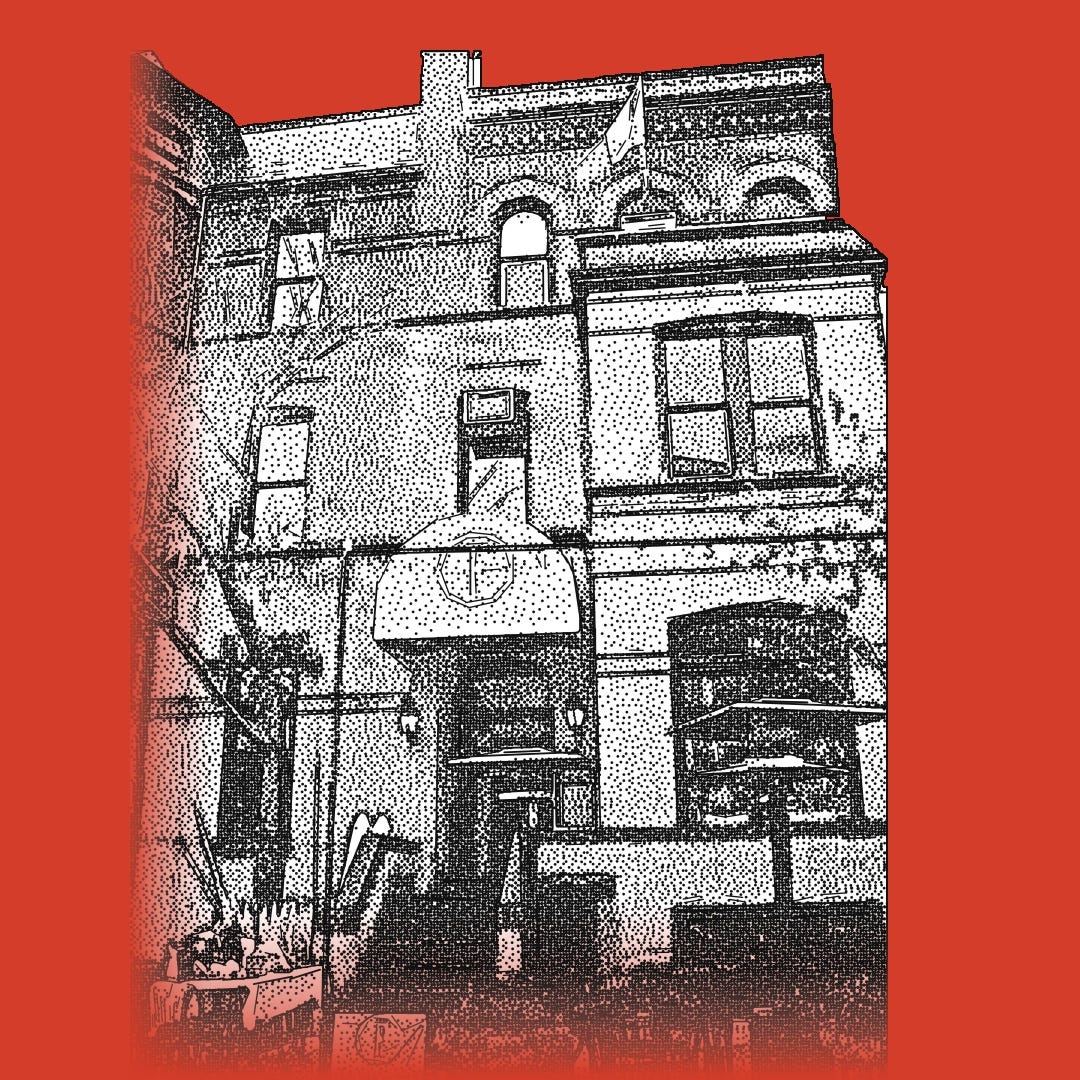
Ashley: Thanks so much for doing this. The last time I was at Floriana was during snowcrete. The food, the service, everything was incredible. It was all the more impressive given it was day three of the storm, when no one could even walk down the sidewalk. So my most recent experience was wonderful, and the District is so sorry to see you moving. I wanted to use this conversation to talk about the reasons behind the move, and lessons for the incoming council and mayor on how we can make things better for DC small businesses, particularly restaurants. Anyone who’s lived here for a while knows our neighborhood restaurants are such an important part of the fabric of our communities, and of people’s memories of living in the city.
I’d love for you to talk about the history of the restaurant for those who aren’t familiar. Then the challenges of the pandemic and post-pandemic period for DC restaurants, and what you think leaders coming into office should learn about making things a little easier for small businesses, given how challenging the last six or seven years have been.
Jamie: We’ll start with the history of Floriana. All our signage says “Since 1979,” but Floriana herself actually opened the doors in December 1978. I asked her once why she doesn’t say ‘78, and I’ll say it without cussing the way she did at the time: “Well, we’d be liars. It wasn’t even a full month. You can’t lie to people. People can sense it, and they don’t like it.”
Floriana operated it from December ‘78 until the late ‘90s. We used to be up at Wisconsin and Fessenden, and then we moved down to 17th Street. It was an Italian restaurant for the first 20 years. After it moved to Dupont, they did a rebrand, and for a few years it wasn’t even named Floriana. It was more of an American Cajun concept. That was before my time; I moved to DC in ‘06. Then she said, “No, I don’t like this. We need to go back to doing what we do right,” and re-rebranded it as Floriana.
Her son, Dino Tapper, bought it from her in April 2010. I started working for him as a server in 2012, I think. I had graduated from law school not long before and started a small practice with a buddy from law school, and I lived on 17th Street. So, I’d be with clients or in court all day, then rush home, change into my server blacks and wait tables all night.
Ashley: I also waited tables when I first started out on the Hill. I worked at Union Pub, and then at Tunnicliff’s Tavern in Eastern Market. I’ve always loved the side-hustle culture in DC, where half your servers and bartenders have a different nine-to-five, often in government. It’s such an interesting dynamic in the DC workforce, and it led to so many interesting conversations when I worked in restaurants.
Jamie: I agree. I was also writing and editing late at night for a PR company, and two days a week I was teaching boxing classes, which is where I met my wife. So, I was working four jobs at the time. I was both miserable and really happy. You can do that when you’re young.
Ashley: You can do that in your mid-20s.
Jamie: Exactly. What you said is true, and there’s a romance to it. It’s objectively true that an insanely high share of DC servers have master’s degrees or more, probably more than anywhere else in America. The downside is that most of these people wouldn’t be doing it if they didn’t financially need to. What does it say about the DC economy that I can’t afford to live here as an attorney, or as a highly educated government employee, unless I’m also pulling in an extra $1,000 a week waiting tables? I’m not an economist, so that’s not my place to say. I’ve certainly enjoyed employing some really phenomenal people with really cool “real jobs” over the years.
Ashley: I always tell people that anyone who works in politics should have a service industry job at some point in their life. It gives you a much more complete perspective on the world and on dealing with people.
Jamie: We joke about that a lot in the industry. I have so many friends who aren’t in it anymore, who are off in their big-girl or big-boy jobs, changing the world and all that. And the one thing you hear, and this isn’t new, is that the most important lessons of their lives came from doing this. You can talk to an 85-year-old who worked in the industry, and they’ll tell you the same.
Jamie: To go back to your original question, that’s the history of Floriana. I bought it in August 2016, after being the GM for a couple of years, and I’ve owned it since. Then we opened our Wilmington, North Carolina, location in March 2020, which some people may remember.
Ashley: March 2020. What a time to open!
Jamie: The week we were supposed to have our soft open, we had the mayor coming, all the big movers and shakers. All the food was in and prepped, and everyone was hired and trained. That Friday was supposed to be our soft open, and that Wednesday was when the country shut down.
Jamie: So that was fun. The other fun thing is that to qualify for PPP or EIDL loans, you had to have made your first sale by February 15. So we got zero government help. But that location is going very strong and has become a big part of the community there. We’re very happy with it. I’ve said this before and I’ll say it again: if you asked me exactly how we navigated COVID and survived, I legitimately couldn’t tell you. It was a lot of day-to-day explosions, trying to figure things out and trying to pay rent when you could. I will say I think North Carolina handled COVID pretty well. Roy Cooper was governor, and I thought they did a really good job of being pro-business, while still protecting their citizens.
That brings us to now. We’re opening in Alexandria, and also in Huntsville, Alabama. We’re closing DC, or more correctly, moving DC to Alexandria. COVID was bad. I think DC lost about 40% of its full-service restaurants permanently. DC has a disproportionately high number of restaurants, bars and hotels compared with other American metro areas. We have about 800,000 residents or so, but, and my data here is out of date, as of 10 or 15 years ago we averaged about 2.2 million people moving through the city every day.
Ashley: So, the city could support many more restaurants than the full-time population alone, because of commuters and people doing work lunches, happy hours and so on.
Jamie: Correct, 100%. Then COVID happens, and people aren’t traveling anymore. The vast majority of government people were doing their earnest best to do what was right for America, for DC and for businesses. People had different opinions about what that looked like, but most were trying to get us all through it as well as possible.
Then you have the post-COVID evolutions of what the restaurant industry looks like. DC has probably been hit harder than anybody by work from home. I was downtown yesterday, looking around with a friend, saying, “That’s for sale. That’s for rent. That’s for rent.” This is the Golden Triangle, 16th and K. These are spots that used to rent for $80 to $100 a square foot, and you knew you’d make a ton of money there. Now people say they wouldn’t put a restaurant there no matter what the rent was. Honest to God, some of those spots I wouldn’t take if the rent were free. It’s so hard to operate in DC right now.
Some places in DC are easier to operate in than others. DC has always been a city of neighborhoods, and 17th Street used to be one of the really great ones. But Trio and Fox and Hounds closed after 75 years. We’re closing after almost 50. The Ace Hardware there is closing.
Ashley: Yes, I read about that.
Jamie: The best hardware store in the city. Cobalt had closed at 17th and R. So you have very few of the 17th Street legacy businesses left. There are a few factors. On the post-COVID side, I think there was an attitude in the DC government, and to some extent among DC’s residents, that if you survived COVID, you were fine. The reality is we all took on extra debt with EIDL loans, and those are 30-year loans you pay every month, forever.
Then the supply chain hits. There’s a general rule in the American economy that once a price goes up, it never comes back down. We’re still waiting for flight prices to go back down after 9/11. Producers look around and say, “It’s gotten a bit easier and cheaper to produce this than it was during and right after COVID, but consumers and businesses are still paying that price. So why don’t I just increase my margin?”
So, from 2019 to now, the price of beef is up about 80%. The 2019 average for a pound of ground beef was $3.81 to $4.23. As of August or September, it was $6.79 to $7.16. Of course we have shrinking cattle herds and all that, but that doesn’t explain everything. That price isn’t going back down no matter what happens with the herds. And flooding the market with South American beef for some reason didn’t fix it.
That’s a huge factor for us. We rely on local farms as much as possible. We used one farm for years that eventually got too expensive, and it’s not their fault. It was literally a mom-and-pop, a husband and wife, with everything from beef to chicken to turkeys, all pasture-raised, all living together. The best chickens I’ve ever eaten in my life. They tried so hard to keep prices down, and we were willing to pay more per pound for their stuff. But it got to the point where I asked myself, “Am I going to charge $48 for a piece of lasagna?” That’s tricky, and all of us in DC are dealing with it.
The other factor is that a lot of people bought commercial property when D.C. was in a forever boom, and they’re locked into that purchase price. Our rent, for example, is almost double what it was when I bought the business. My Wilmington location is more than twice the size of my DC location. It’s on the river, with Juliet balconies overlooking it. It’s probably the best restaurant location in Wilmington. It’s 7,000 square feet versus 3,250 in DC, and my rent in Wilmington is half what it is in DC. And the building’s in much better shape.
But landlords can’t afford to drop prices, because they still have to pay a mortgage locked into an economy that doesn’t exist anymore. That’s true of residential property, too. And I’m excluding the massive hedge fund buyers and multibillion-dollar corporations. More restaurant buildings and small commercial properties than people realize are owned by someone with four or five buildings, not someone with a portfolio stretching across 15 states.
Ashley: We hear about that a lot in the housing context, too: the landlords who own half a dozen buildings and how hard they’ve been hit, and what that means for our affordable housing stock.
Jamie: I’m not instinctively a pro-landlord person, and I haven’t been at any point in my life. But that doesn’t mean you can’t look at the economic reality and say, “This is the situation. This is the problem. This is where we want to be. How do we get there?” As far as DC goes, the real reason we’re leaving is that I don’t think, for at least the next five to 10 years, we’ll even be heading in the right direction toward a sustainable service industry.
Ashley: You mentioned beef and other food items. Overall, how much would you say your cost of goods has increased since just before the pandemic?
Jamie: Probably 60% to 80% across the board. It’s a little tough to say, because our menus evolve. If something becomes insanely expensive and it’s not a staple, we just stop buying it and go to something else. Our prices have gone up accordingly, as everybody’s have in DC. I don’t believe in the service fee thing. I have plenty of friends who own restaurants that do it, and I don’t think they’re bad people. But my instinct as a career server, an owner and a diner is that the price should be the price. I don’t like to sticker-shock people.
There’s also this, speaking as a former employment lawyer. The Department of Labor guidance is that when a tip is left, it immediately becomes the server’s property. There are rules about tip shares. I believe the DOL language is “substantial guest interaction.” So, you can tip out a busser who’s clearing plates, chatting with guests and running water, but not a cook who never interacts with guests. That’s been established by precedent over many years. There are still some shady people who try it, and they usually end up losing their restaurants, as they should. Service fees really muddy the water on that.
That brings us to where we are now in DC, where Initiative 82 has passed, and we now have a paid family leave tax. I’m not sure how familiar you are with how the paid family leave tax works.
Ashley: I’m pretty familiar.
Jamie: So you know about the tripling of the rate.
Ashley: Right. And most of the money now goes to the general fund, not the paid leave program.
Jamie: I’ll go through it anyway, so it’s on-the-record. I believe it was July 2024 when they tripled the rate from 0.25% to 0.75%. I don’t know if you’ve seen the email they sent businesses announcing it.
Ashley: No, I haven’t.
Jamie: I’ll dig it up and send it to you. I’m pretty sure I still have it. It went out in mid-July and said the rate was going from 0.25% to 0.75%, retroactive to July 1, which every business owner loves. Nothing is more fun for a small business owner than an uncertain regulatory environment where anything can happen at any time and changes can be made retroactive. Not only can you not plan for it, they may reach back in time and get you, too. Regulatory uncertainty is a problem in any form of governance, anywhere in the world. The last sentence of that email is burned into my brain. I remember where I was sitting when I read it, and I’m sure my jaw dropped. It said the change in rate would not affect benefits disbursed by the program.
Where we are now, Ashley, as you’re fully aware: they’ve slashed paid family leave benefits, but they haven’t lowered the rate they take from us. The amount we pay in paid family leave over a year isn’t huge on its own. But because of Initiative 82, our payroll roughly doubled, maybe slightly less. So, you double every DC restaurant’s payroll, and then you triple the rate of a tax taken from that freshly doubled payroll. Then you have a 50% to 80% increase in food costs. Then rent going up. And now we’re staring down the barrel of Initiative 87.
The big fix going forward, which I think was just on the ballot, and there’s still some wrangling on the council about it, is how many times you can bring the same initiative. How many times can you rewrite it?
Remember, we’re in a system where DC lost 40% of its full-service restaurants in 2020, so this isn’t a bloated industry. Then Initiative 82 comes along and starts killing them. Huge props to Mayor Bowser and to the Council, who looked at this and said it just isn’t working. I can’t remember which councilmember held a town hall and did some studies, and was shocked to learn that DC’s service industry had lost something like 50% of its ground-level payroll: bussers, bartenders, servers, barbacks.
What we were afraid of has come to pass. And now the same outside interest group seems upset that this hasn’t killed the tip system in DC, so they want to go harder. I suspect Initiative 87 will pass, and I suspect that will be about the death of the industry.
I have a lot of friends who voted yes on 82 who are totally shocked at what it’s done. They say, “I thought I was just helping.”
It was framed as, “Of course these people should make more money. They’re hard workers. They were essential workers during COVID.” People weren’t asking, “Wait, is this actually going to make them more money, or hurt them financially?” We knew the answer before, and now we have objective proof. I’ll be curious to see what the incoming council and mayor do with this.
Ashley: Obviously, whether voters approve the initiative is out of the mayor’s and council’s control, although they could campaign against it and say, “Even if I’d have supported this at another moment, this isn’t the time. This industry is in crisis.” But beyond the initiative, Councilmember Silverman has mentioned going back to the original 0.25% paid leave payroll tax as another way to help. After those two things, what do you think would have the most impact?
Jamie: The problem with death by a thousand cuts is that it isn’t saved by a thousand Band-Aids. I don’t know what they could do right now, because there are other enormous external factors. We already have the data on tourism in the U.S. versus the rest of the world. In many ways, DC is that in microcosm. The service industry is recovering pretty well from COVID almost everywhere in America except DC. That’s very stark and very painful. We get emails from RAMW that are basically, “How can we save our people?” Then we get emails from the National Restaurant Association saying, “Look how great things are! We’re really doing it, guys!” That’s hard. It’s part of why we look at other jurisdictions. I talked about this a bit in an interview last night. A little less than a year ago, I went to a restaurant in Chinatown for lunch with a friend. There was one person working front of house, who got us to our table. We ordered everything on a tablet, and then a literal robot on treads drove up and delivered our drinks.
Then it drove away. Water was spilling everywhere. It was a mess, and very funny. They were clearly early adopters. But that moment stuck with me, and I’ve thought about it in light of our decision to move to Alexandria. DC is strongly disincentivizing people from having employees at a moment when, for the first time in human history, outside maybe assembly lines, technology is coming online that can replace a real worker. That’s a really dangerous thing to do.
The point of an economy is the people. When I hear “but the stock market’s doing really well,” I think: for whom? If the American people are hurting, the economy’s bad, no matter what Nasdaq chart you put in front of me. I feel the same about employment in DC. If a few restaurant owners are doing very well because they no longer need human labor, that’s not a good restaurant industry.
Ashley: My last question is more of a fun, big-picture one. What’s the single most memorable, fun experience you’ve had running the restaurant in DC over the last 15 years?
Jamie: That was my last question last night as well. There isn’t one. Floriana has served a lot of really cool, famous, powerful, interesting guests over the years. But I have a great one I don’t think I’ve ever told publicly.
This was during Trump’s first term. A fellow came in and sat at the bar. He seemed a little out of place and nervous. Our bar manager then, Dito Sevilla, got him a drink. Dito is the most loquacious, friendly person; he can make anyone feel welcome at his bar. He really wanted this guy to feel comfortable, and it visibly wasn’t working. He got him a second drink and finally asked, “Are you okay? What’s going on?” The guy said, “I’m so nervous. I’m about to ask my girlfriend’s father for permission to marry her.”
Jamie: We said, “Okay, that’s fair,” but we had to calm him down so he could deliver his message. He said, “On top of that, we’re going to grad school out west, I think San Francisco, and her dad is pretty traditional, a military guy. So I’m also going to ask whether she and I can move in together.” We told him, “Listen, if you’ve treated his daughter well and you’re respectful, you’ll be fine.” I asked my wife’s father’s permission, and he was very old-school, and he was very happy about it. Dito said, “You’ve been so nice to everyone in here. You seem like a respectful, good guy.” So I finally take the guy up to his table, and I seat him next to General John Kelly, whose daughter he was about to be asking about. And I remember thinking, “Oh, I get it. Maybe I should have been more nervous.”
Jamie: There’s an addendum. Kelly had his security detail with him, because he was a cabinet member at the time. We always put the detail at the same table, where they can see every entrance and exit and no one can get past them. And we have a rule that we always feed the detail for free. They all drink Diet Coke. If any restaurant person is reading this, here’s the secret to a happy security detail. If they’re standing out front, the most magic thing you can say is, “You and anyone else on the detail can use our restroom at any time without asking.” Most of them will love you forever.
Anyway, I went up to the detail and said, “Do you guys know him well?” They said, “Reasonably well.” I said, “That guy’s about to ask permission to marry his daughter. What do you think? What’s his demeanor like?” One of them said, “Check whether he has a second glass of wine. He has a rule: if he doesn’t like someone, he’ll only have one glass, because he wants his wits about him. He views them as an enemy combatant. If he has a second glass, that means he likes them.” He had a second glass of wine, and Dito and I were like, “Yes! Our guy did it.”
Ashley: Jamie, thank you so much for your time.
Whoa, Ashley, great interview. Loved the last story he told. We'll have to check out the restaurant in Old Town once it's up and running.