


It’s a big year for D.C. voters. We’re electing a new mayor, a number of council members and, for the first time since 1991, a new delegate to the U.S. House who might have a bit of influence if Democrats retake the lower chamber. But mostly it’ll be anticlimactic. D.C. is overwhelmingly Democratic, so the real contest for mayor was the June 16 primary. A few hyperlocal ANC races are surprisingly competitive, and the exact makeup of the Council isn’t settled, but we know it’ll be overwhelmingly progressive.
One contest is getting real attention, however: Initiative 86, which would prohibit the sale of foie gras in D.C., among other related activities.
On its face it’s niche — there are no D.C. producers of foie gras and only a handful of high-end restaurants serve it. But over the past few days a controversy has erupted over whether the I-86 summary language we all see on our ballots accurately reflects the underlying legislation, which appears much broader and could implicate a number of other food products that are decidedly not “luxury.” And, echoing other recent initiatives, we again see popular DC-based restaurateurs jumping into the fray as a counterweight against the “pro” side.
I’m not necessarily opposed to a narrow ban on foie gras sales, though I’m pretty allergic to ballot initiatives that target D.C.’s struggling restaurant industry, which has been in the crosshairs before and is still attempting to adapt to voter-approved increases to the tipped minimum wage.
So, what’s the problem? After all, D.C. is progressive, and these initiatives need to be approved by voters.
As someone who cares about this city and has been through the battles of past initiatives, I don’t like that outside groups are, pardon the pun, force-feeding us their policy wishlists each election cycle. D.C.’s petition-driven initiatives have been bankrolled almost entirely by outside donors, according to an analysis of public data.1 These are people and groups who don’t have to deal with the fallout of both the process — often highly contentious — and the often-poorly drafted legislation it produces, which skips the deliberation our elected Council is charged with and typically needs significant clean-up afterward
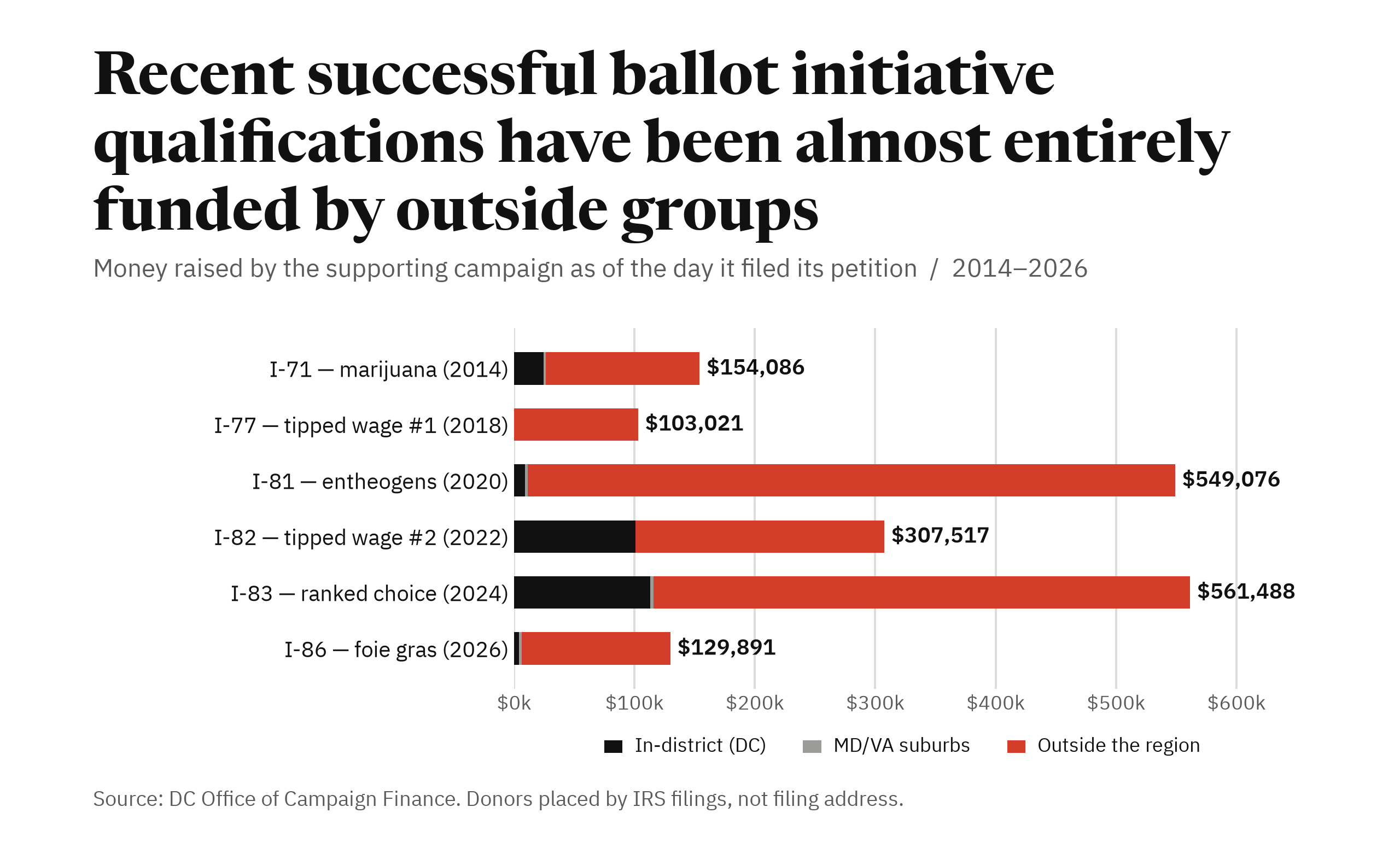
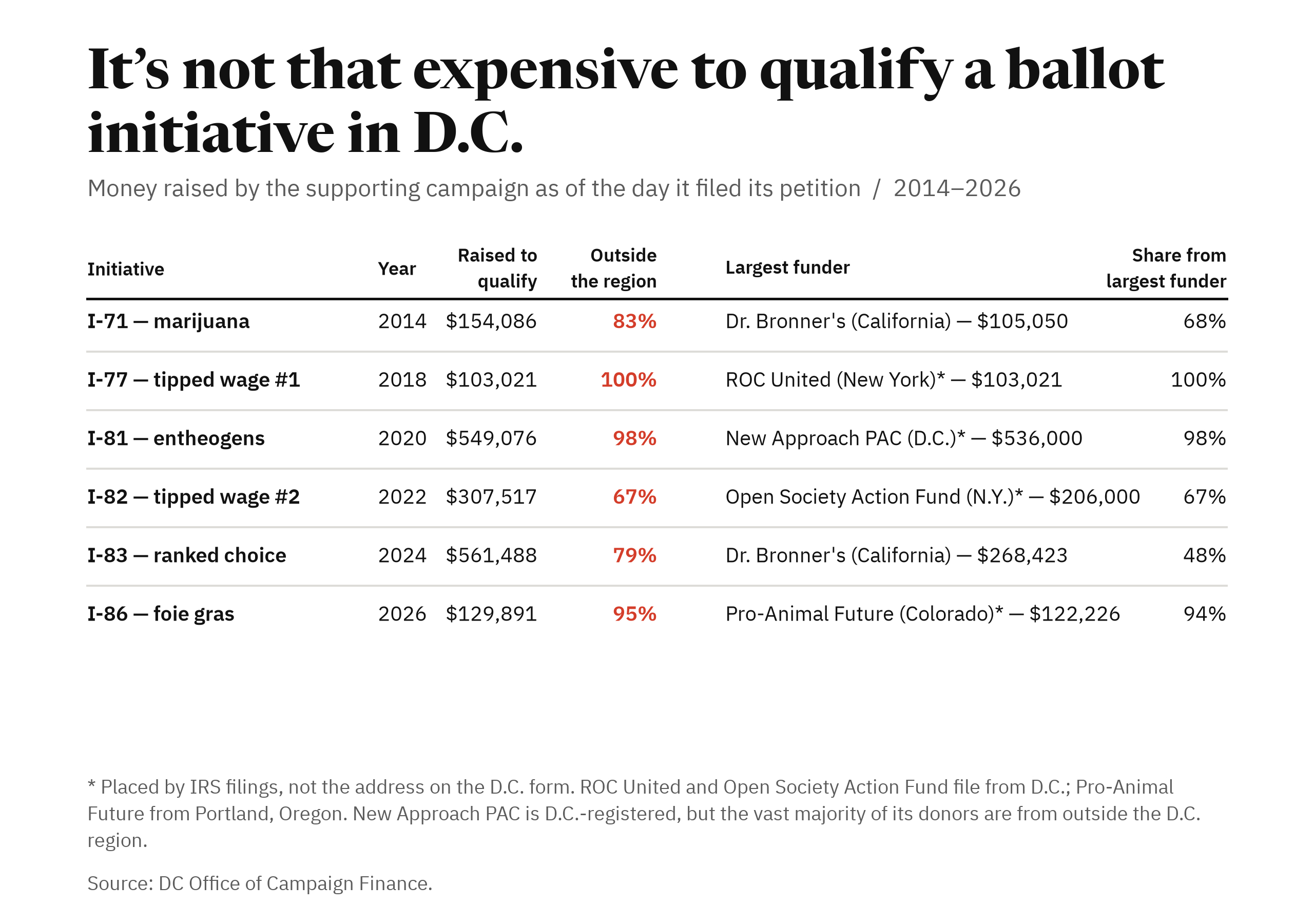
Of course, it’s not surprising that non-D.C. residents would contribute financially to efforts they support in other jurisdictions, but the data show that the funding to get ballot initiatives in front of D.C. voters is not just external, it is extremely concentrated. With the exception of I-83, every petition-driven initiative that made the ballot since 2014 has been majority funded by a single organization.
Take I-86. The group behind it, Pro-Animal Future, was founded in 2022 and is headquartered in Boulder.2 Denver voters rejected its slaughterhouse ban 65–35 in 2024, with unions, agriculture and both parties opposed, and its proposed fur ban failed 58-42 the same night. Denver is also voting on a Pro-Animal Future-pushed foie gras ban this November. A Cheyenne-based foundation whose grants go almost entirely to vegan advocacy gave Pro-Animal Future $475,000 in 2025 — the year they came to Washington — up from $76,500 in 2024.
It’s also not surprising that national interest groups would target D.C. What happens in our humble city — with a population that sits between El Paso and Oklahoma City — gets disproportionate national attention, and that earned media helps with fundraising. Since we are just a city, a few hundred thousand dollars is enough to support signature collection across the 20-odd square miles of space that D.C. residents actually live in. And with registered Democrats making up more than 75% of voters — higher than any state by a wide margin — a measure that tilts D.C. further left is likely to pass. For niche, progressive interest groups, that’s a pretty attractive combination.
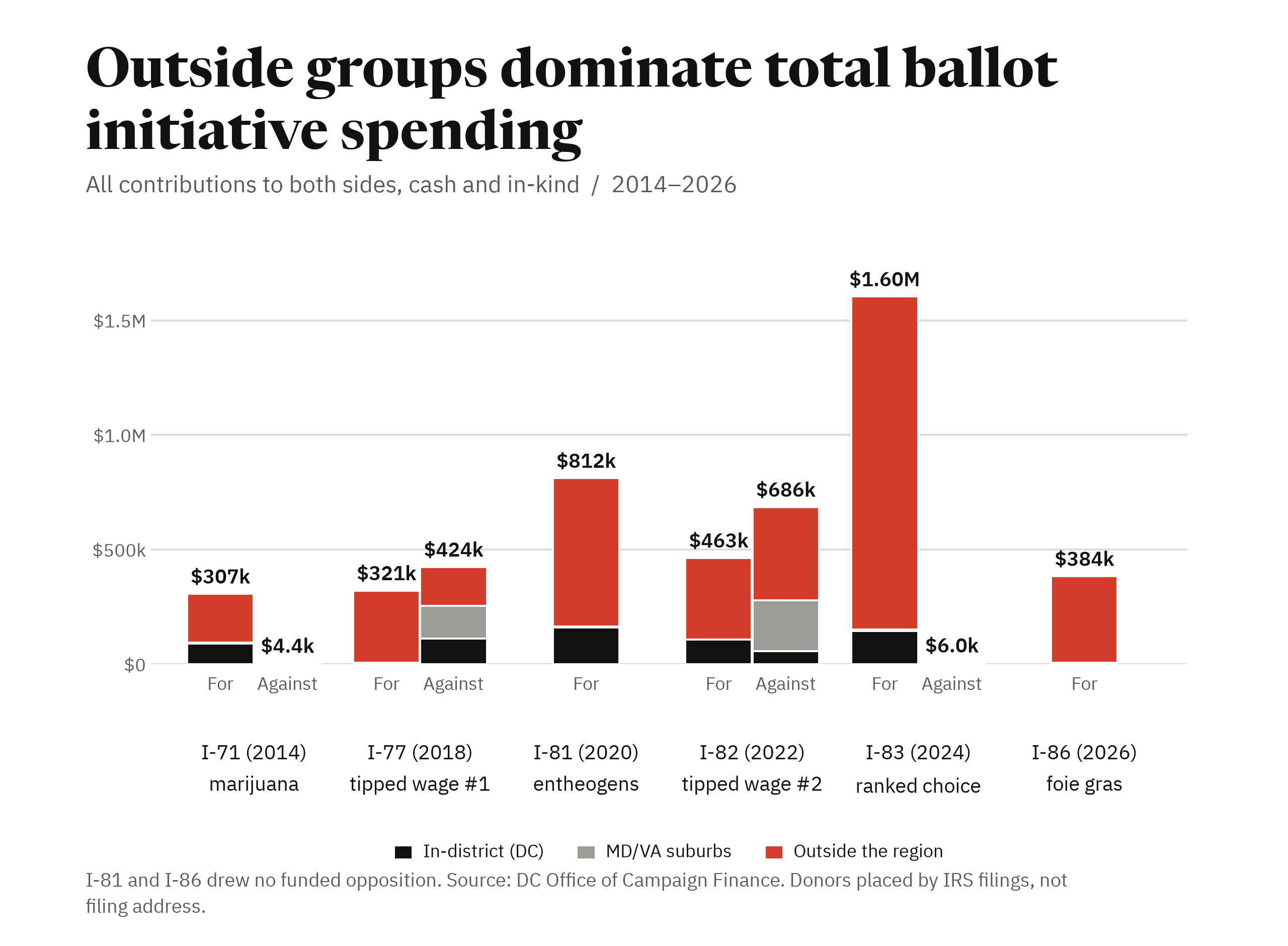
Some of these initiatives have faced opposition. In the case of I-77 and I-82, the “anti” side actually raised more (though it also took a greater local share than the “pro” side). But the money flowing into D.C.’s ballot initiative contests is overwhelmingly from outside our city and region.
History of D.C.’s ballot initiative process
Ballot initiatives aren’t unique to D.C. Many states have them, with varying rules for qualification and scope. D.C.’s initiative system sits in three layers.
The Charter is D.C.’s constitution — Title IV of the 1973 Home Rule Act, written by Congress and ratified by D.C. voters in 1974. Ballot initiatives were not included in the original charter but were added via an amendment that became effective in 1978. D.C.’s charter now establishes what is in and out of bounds (ballot initiatives cannot appropriate funds, and courts have added other limits), signature threshold (5% of registered voters citywide and 5% in at least five of D.C.’s eight wards), when a qualified initiative will be presented to voters (“the next general, special, or primary election held at least 90 days after the measure is received”), what vote it takes to pass (majority), and the standard the ballot summary must meet. Amending the charter would require a Council act, a citywide referendum, then 35 days for Congress to weigh in.
Initiative, Referendum, and Recall Procedures Act of 1979 (§ 1-1001.16) was passed to implement the Charter amendment and set the rules for the Board of Elections’ “proper subject” review, the “true and impartial” summary, and petition drafting and circulation, and established a 180-day signature window. These details could be changed via an ordinary act, subject to a 30-day congressional review.
The Board of Elections’ regulations are the third layer — DCMR Title 3, Chapter 10, covering petition form, signature validity, challenges, watchers, certification and the rules for non-resident circulators.
More than 150 initiatives have been filed since the process opened in 1979, while fewer than thirty have qualified for the ballot. Money is likely a big part of this. The pesky signature gatherers you might run into at Eastern Market on a Saturday afternoon or at the exit of a Metro station are usually paid, and there’s an entire industry that’s popped up to support these efforts.
The ballot initiative process starts with a proposal being filed with the Board of Elections, which rules on whether the measure is a “proper subject” for initiative. The Board rejected a 2009 anti-gay marriage initiative on those grounds and courts struck a 2006 gambling initiative for the same reason.
If the proposed legislation clears, the Board writes a short title and summary, and the proposer has 180 days to gather signatures.
Once those hurdles are cleared, the measure is put to a vote in the next election, per charter rules.
An initiative passes if a majority of the people who vote on that question approve it, and there is no minimum turnout requirement.
Even if a ballot initiative receives a majority of “yes” votes, that’s no guarantee it will become law.
2014’s I-71, which sought to legalize recreational marijuana in D.C., has famously languished for years because Congress – led by Andy Harris (R-MD) – has continually included riders in budget bills prohibiting D.C. from spending money on implementation. What we got instead was gray market outfits across the city, which in some cases have been associated with criminal activity. It took more than 10 years for the Council to finally crack down on so-called “gifting” shops.
2018’s I-77 (the first tipped minimum wage initiative) was passed during the June primary. It received about 56% of the votes cast on the initiative, but overall turnout for the question was under 20%, meaning fewer than 10% of registered D.C. voters approved the measure — 47,230 yes votes out of 479,723 registered voters. That fight split the restaurant industry badly, pitting activists against many servers and local business owners. The Council repealed it 8–5 four months later.
I-82 returned the tipped minimum wage question to voters in 2022, passing with 74% of votes cast. In 2025 the Council slowed and shrank the phase-out of the relevant wage. The groups behind both initiatives have since sought to challenge the Council’s moves, but so far they’ve failed.
2024’s I-83 (ranked choice voting) passed with 73%. The Council funded the ranked-choice part but declined to fund a second provision focused on opening up D.C.’s primaries.
Finally, 2020’s I-81, which decriminalized entheogenic plants (remember those magic mushroom posters?), also passed and took effect as written in March 2021. I-81 is the only initiative D.C. voters have passed since 2014 that hasn’t been blocked by Congress, repealed outright, slowed down or selectively funded.
More on the Way
Massachusetts-based One Fair Wage is behind a live initiative process that could be decided in a special election next year. I-87 would raise D.C.’s minimum wage to $25 by 2029 and eliminate the tipped wage by 2031. It missed this November’s ballot after a lawsuit from a D.C. bar owner stalled its signature drive. If it makes next year’s special election ballot, it will represent the third attempt by an outside group to force a wage hike in less than ten years, in a city where restaurants are still absorbing the costs from I-82 and struggling with an anemic economy.
Then there’s I-88, which would freeze residential rents for two years, with another 12-month freeze any time inflation runs above 5%. It missed this year’s ballot after two property owners sued the Board of Elections and stalled the signature drive. A judge threw out three of their claims in September. If passed and implemented, I-88 would be another blow to D.C.’s housing market which is suffering in part due to the well-known problems in our housing permitting and tenant laws.
The Council is Taking Up Some Reforms
On October 6 the Council voted 10–2 for a bill to overhaul the initiative process — the Fairness and Accountability in Initiative Reform Amendment Act of 2026. The bill would reform the process by limiting each initiative to a single subject; giving the Attorney General and the Council’s general counsel 30 days instead of 15 to weigh in; and requiring a fiscal impact statement before an initiative is accepted. Councilmember (and likely our next mayor) Janeese Lewis George voted present; Councilmembers Parker and Silverman opposed reform. See City Cast DC’s coverage and its earlier explainer.
More is needed
The planned reforms are welcome, but others should also be considered. Unfortunately, most of these will require amending the charter.
Disclose non-D.C. funding. California’s DISCLOSE Act makes ballot measure advertisements name major funders. California also prints the top three funders on the first page of its official voter guide for referendums to overturn a law, though the disclosure doesn’t extend to ballot language. D.C. could require disclosures on advertisements to include the geographical source, but the ballot summary itself is a harder target. The charter requires the summary to accurately reflect the measure’s intent and meaning, and funding disclosures might be considered extraneous.
A participation floor. Massachusetts requires a measure to win a majority on the question itself and to be approved by at least 30% of everyone who cast a ballot in that election. Italy goes further and voids any abrogative referendum where fewer than half of eligible voters turn out, which is why its 2025 referendums focused on labor laws and citizenship failed even after winning a majority of votes cast. A D.C. version that set a minimum threshold on turnout or share of registered voters indicating approval could have stopped I-77, which only 9.85% of registered voters affirmed. This would require a charter amendment.
A higher bar for passage. South Dakota and North Dakota are both asking voters this year to require 60% ballot approval for constitutional changes, and Utah wants 60% for initiatives that would raise taxes. A higher threshold would force ballot initiative advocates to appeal to more Washingtonians. This would also require a charter amendment.
General elections only. I-77 passed in a June primary with under 20% turnout. That November, turnout was roughly 46%. D.C.’s closed primary system means registered Democrats tend to have a stronger incentive to turn out during primaries; the winner of the Democratic primary for ward council seats, mayor and other offices will almost always go on to win the general. Restricting initiatives to general elections – not primary or special elections – would likely improve the representativeness of the electorate. Again, this would require a charter amendment.
D.C.’s initiative process exists so residents can directly exact change when the Council or Mayor isn’t listening. But what it’s become is a cheap, high-visibility venue for national advocacy groups. There’s a place for direct democracy in our city, but changes should be driven by those who call D.C. home, not outsiders.
All campaign finance figures come from the D.C. Office of Campaign Finance, pulled on October 24, 2026, and analyzed with Claude. Two sources were used: the District’s published campaign contributions dataset (308,904 records back to 2003), and OCF’s own e-filing export for Initiative, Referendum and Recall committees. Contribution totals from the two sources agree to within rounding on every committee.
The analysis covers the six citizen initiatives that reached a D.C. ballot since 2014 — 71, 77, 81, 82, 83 and 86 — and both the supporting and opposing committees for each. I-87 and I-88 have not qualified; their figures run through October 24, 2026. Council-referred measures are excluded. Figures include in-kind contributions.
Donors are placed where parent organizations are based. Every organization giving $25,000 or more was located from its IRS filings; the three that file from an address other than their own office are noted beside the table. New Approach PAC, which supplied 98% of the money to qualify Initiative 81, is registered in Washington but raises nationally — its three largest donors are in California, New York and Florida. Money routed through a foundation or PAC was traced to its source through IRS Form 990 Schedule I.
The “money raised to qualify” window uses each measure’s petition filing date; Initiative 77 has no published date, so its last payment for signature work (April 14, 2017) is used instead. Committee spending categories are coarse and the explanations beside them are written by the committees. One $6,675 record in which a committee is listed as its own donor is excluded as a filing artifact.
Turnout figures are from the Board of Elections’ certified after-action reports. The Home Rule Charter provisions cited are § 1-204.102, § 1-204.103, § 1-204.105, § 1-204.106 and § 1-203.03.
Pro-Animal Future appears to have routed its D.C. contributions through its Portland, Oregon, chapter.
In suggesting a higher bar for initiatives, you cite the Dakotas and Utah. If you're going to cite state proposals, you should also cite recent state experience, such as Missouri and other states where Republicans sought to overturn Medicaid expansion and abortion rights.