



DC’s leaders must make health coverage, access to providers, and reliable care work together. This article opens DC’s Deadly Divide, a Capital Commonsense series exploring why health and life expectancy differ so sharply across the District—and what city leaders must do about it. Future installments will examine access to care, agency responsibilities, and specific public-health challenges.
Nearly three decades separated the highest and lowest neighborhood life-expectancy estimates in Washington, DC. An analysis of census-tract estimates for 2010–2015 found a 27.5-year gap within one city. What can nearly 30 years of life hold? Watching your grandchildren grow up, enjoying your retirement with your spouse. Marriages and birthdays. Hard-earned successes and celebrations with the people you love.
A separate 2026 study in the Journal of Urban Health examined 948 US cities using 2010–2015 estimates and found an average neighborhood life-expectancy gap of 11.8 years. Larger gaps correlated most strongly with racial residential segregation, child poverty, and household income—evidence that city leaders must look beyond medical care to the conditions that shape residents’ health.
DC’s government has measured health disparities and promised to narrow them. The 2019 Sustainable DC 2.0 plan set a target of reducing racial disparities in life expectancy by 50 percent by 2032. Yet the Healthy DC 2030 framework labels the neighborhood life-expectancy gap “Monitored only (no target)”—the exact language on page 14 of its executive summary. The racial and neighborhood measures differ, but residents deserve a clear accounting of how the plans fit together and what progress the Bowser administration has delivered. Change is long overdue.
Residents also need an easier way to track progress. Our Healthy DC’s life-expectancy page discusses 2017 ward estimates, while the 2018 Health Equity Report uses 2011–2015 neighborhood estimates. Newer ward figures exist, but residents should not have to piece together scattered sources to understand the gap. DC Health should publish an accessible, regularly updated account of its goals, data, and progress.
Figure 1 maps the 2010–2015 census-tract estimates, showing the divide between neighborhoods only miles apart. A citywide average conceals those differences and offers little guidance about where residents need the most help.
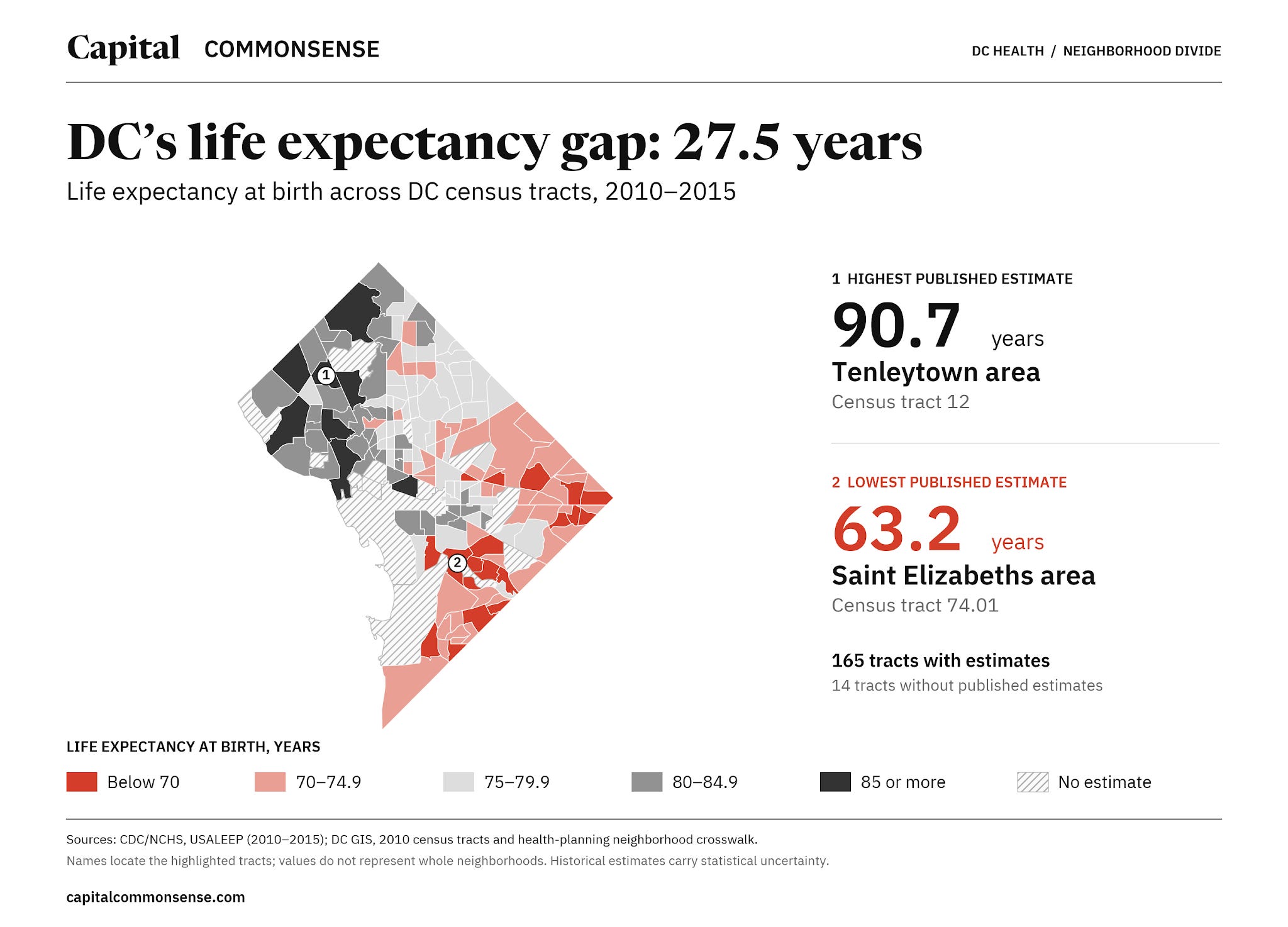
More recent ward-level estimates, covering 2019–2023, put the difference between Wards 3 and 8 at 18.6 years. Wards cover larger areas than census tracts and contain neighborhoods with different social and economic conditions. Because the estimates also span different periods, comparing the two gaps cannot tell us whether the divide has narrowed. The newer figures nevertheless show how much health inequity DC still faces.
A life-expectancy target needs functioning public health and health care services behind it. Prevention efforts, hospital operations, coverage decisions, and oversight of health plans offer concrete tests of whether city leaders can turn investment into better health and reliable care.
In its ten-year progress report, “A Decade of Delivering,” the administration touts “a new hospital east of the river.” But a new building alone cannot guarantee better health outcomes. At an April 2026 Council hearing, officials examined delayed outpatient services and long emergency waits at Cedar Hill Regional Medical Center, built with more than $400 million in District investment. The hospital also received an immediate-jeopardy citation over delayed surgical care; officials said they corrected the deficiency, and the designation was lifted the next day. The Washington Business Journal’s April 6 coverage details the Council’s scrutiny of staffing and patient safety. Hospital leaders reported improvements in emergency wait times, which deserve continued public scrutiny.
Two 2025 audits by DC’s Office of the Inspector General exposed failures elsewhere in the District’s health care system: Human Services did not consistently send required Medicaid termination and denial notices, and Health Care Finance inadequately reviewed managed-care denials and appeals. The Bowser administration must account for which failures it has fixed and which corrections remain unfinished. The incoming administration must take responsibility for completing that work and showing whether patients receive care when they need it.
Consider what those failures can mean for a patient. A Washingtonian recovering from major surgery went to the pharmacy to pick up her medication. There, she learned that her Medicaid had been canceled. She said no one had notified her. While she reapplied, her medication and follow-up visits with the surgeon remained on hold.
Dr. Randi Abramson shared this anonymized account in notes for this article. She works at Bread for the City, a DC nonprofit that provides medical care, food, and legal and social services to residents with low incomes. Within the same 24 hours, she had seen two other patients struggling without coverage: one awaiting Medicaid approval after months of abdominal pain, another who had lost her job and insurance while needing dental and mental health care.
A patient with savings might pay out of pocket while sorting out a coverage problem. A patient without that cushion may have to go without treatment. A delay that one household can absorb can force another to postpone care. That unequal burden belongs at the center of DC’s health agenda.
When I ran for mayor, I asked DC to fix the basics. For the patients Abramson describes, that promise comes down to a prescription filled, an appointment kept, and treatment that continues through a coverage change. The documented failures in notices, oversight, and hospital operations demand accountable leadership and competent management.
My co-author, Dr. Nagesh N. Borse, served as an Epidemic Intelligence Service officer at the CDC and as DC Health’s chief data officer and deputy state epidemiologist. He now holds an affiliate faculty role at George Mason University. He has helped assess this article’s scientific accuracy throughout its development. He also brings a question that runs through our argument: when several agencies share responsibility for a resident’s access to health care, who answers when that care breaks down?
How the divide takes hold
So how did DC’s health divide take shape? A 2022 Health Affairs review traces the connections among structural racism, segregation, and health in the District. The city’s 2018 Health Equity Report describes how income, education, housing, and neighborhood conditions shape opportunity. Together, these accounts explain why improving health requires attention to housing, streets, public spaces, and the conditions in which people live, long before they enter an examination room.
Those conditions follow patients from hospital to home. Abramson describes people struggling to store medication safely, obtain refills, and arrange reliable transportation to care. A missed ride can cost someone an appointment. Unstable housing can make a treatment plan difficult to follow. Residents who navigate these obstacles can help the city identify which changes would make the greatest difference. City government must implement those solutions, and the incoming administration must show which barriers it removes and how residents’ care improves.
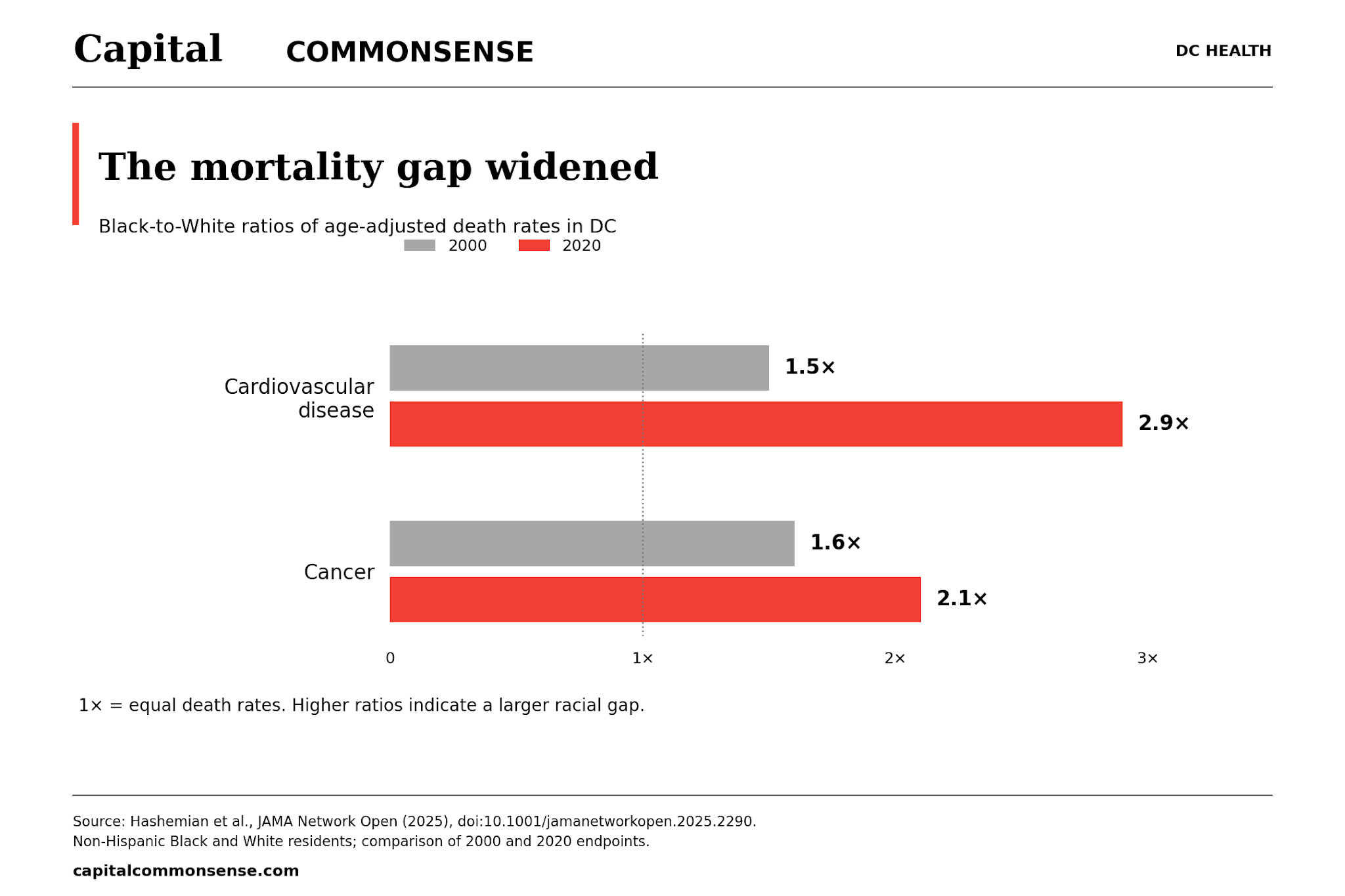
The racial divide also appears in DC’s mortality data. A 2025 JAMA Network Open study examined deaths among non-Hispanic Black and White DC residents from 2000 through 2020. Cardiovascular disease and cancer accounted for more than half of the deaths studied.
Figure 2 shows the ratios between Black and White DC residents’ age-adjusted death rates from those two causes. The widening ratios indicate a growing relative health disparity; they do not, by themselves, tell us whether either group’s death rate rose. DC must track each group’s outcomes and the gap between them, then evaluate whether its interventions improve health and narrow disparities.
Getting from coverage to care
These disparities reflect far more than access to medical care. The evidence here cannot tell us how much of the life-expectancy gap comes from interruptions in treatment. It does identify barriers the District can address now. Start with finding a clinician who accepts your insurance: Qlarant’s 2025 Medicaid network survey, published in 2026, examined the provider directories that DC Medicaid patients rely on for that search.
Among the provider listings evaluated, only 33 percent of primary-care listings, 27 percent of obstetrics and gynecology listings, and 21 percent of dental listings passed all seven accuracy checks. Patients depend on these listings to decide whom to call. Errors can turn a routine search for care into a series of dead ends.
For DC Medicaid patients, finding a clinician still leaves the question of getting an appointment. Qlarant found average compliance with routine primary-care appointment standards of 88 percent for adults and 94 percent for children, below the 95 percent target. Some plans met the pediatric target, and the broader review found general compliance with network-adequacy standards. The Department of Health Care Finance (DHCF) can use those plan-level differences to focus its oversight where patients face longer waits.
Approval for treatment can add another hurdle. A September 2025 inspector general’s audit found that DHCF had not adequately reviewed the District’s Medicaid managed-care denials and appeals. The auditors calculated a 46 percent prior-authorization denial rate for fiscal 2023. In its response to the draft audit, the department calculated a 16 percent denial rate after excluding categorically uncovered services and certain other cases. The auditors said they recalculated the rate after excluding noncovered transactions and reported 46 percent in the final audit. The department agreed to periodic reviews of denials and appeals.
Despite that disagreement, the oversight question remains: did patients receive the care their plans cover? Public reporting needs to explain which services plans denied, why, and whether patients obtained treatment after successful appeals.
Coverage itself can also break down. A separate July 2025 eligibility audit found inconsistent Medicaid termination and denial notices and weaknesses in DC’s eligibility records. It credited the District with completing required renewal work. Human Services and Health Care Finance promised better notice procedures, training, and supervisory review. Residents deserve to know whether those changes now prevent people from losing coverage without proper notice.
Abramson’s notes do not establish why her patient’s Medicaid ended, so her experience cannot confirm a particular audit finding. It does show why a coverage change demands help that reaches the patient before treatment stops.
Keeping treatment on track through a coverage change
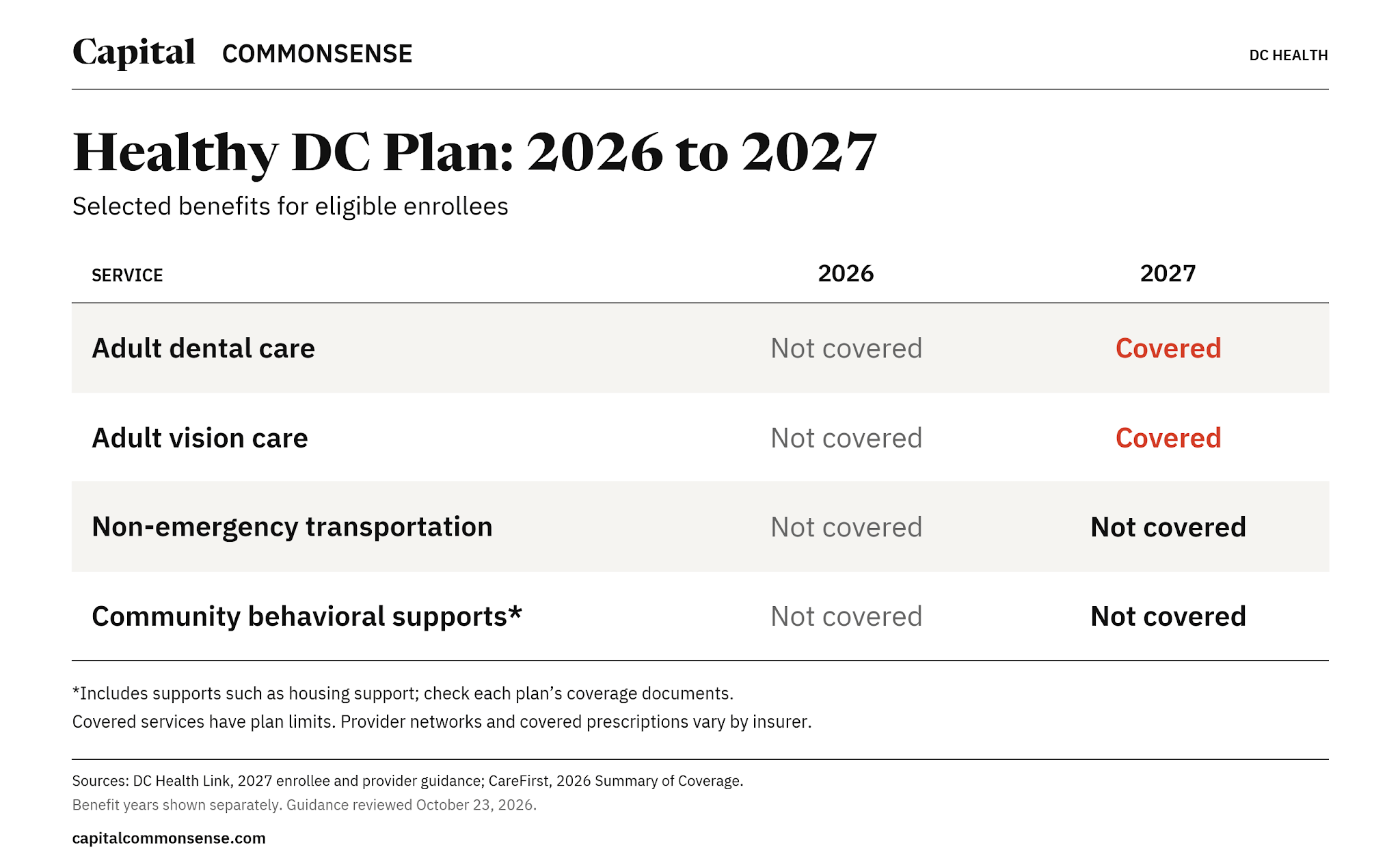
Coverage changes in 2026 make reliable transitions especially important. DC lowered Medicaid income eligibility to 138 percent of the federal poverty level for affected parents, caretaker relatives, and childless adults. The Healthy DC Plan offers replacement coverage to qualifying residents, with automatic enrollment for eligible people transitioning from Medicaid and no premiums or copays for covered in-network services.
For someone already in treatment, a new plan brings immediate questions. Can she keep her physician and fill the same prescription? If a problem arises, she needs someone who can resolve it before she misses a dose or an appointment.
Figure 3 shows how selected Healthy DC Plan benefits change between 2026 and 2027. The announced addition of adult dental and vision coverage in 2027 addresses two gaps in its 2026 benefits. The plan still excludes nonemergency medical transportation, leaving patients who depend on those rides to find another way to reach care.
Bread for the City’s work shows why patients sometimes need help beyond the examination room. Alongside medical care, the organization runs a legal practice that helps people obtain or retain benefits, including Medicaid. Restoring coverage can require legal help before treatment can continue.
DC can draw on that experience by giving residents and community organizations a role in choosing priorities, testing proposed fixes, and judging the results. The city also needs to pay residents for that work and help cover the costs of participating. A parent who must arrange child care or miss a shift to attend a meeting should not have to subsidize the city’s effort to learn.
Who answers when care breaks down?
A public commitment needs both resources and competent management behind it. Boston’s Live Long and Well agenda sets a 2035 horizon for improving longevity and narrowing disparities, and an initial $5 million in grants supports community coalitions. Long-term results will take time to assess. For now, Boston offers an example of how a city can give community organizations funding and a defined role in pursuing its health goals.
But DC cannot simply pour more money into the problem. Cedar Hill’s troubled rollout after more than $400 million in District investment shows why a large appropriation alone cannot deliver reliable care. Our city needs sustained oversight, ethical and transparent procurement, and skilled managers with the experience to run the services residents depend on. Officials must hire qualified staff, vet contractors’ qualifications, disclose conflicts of interest, enforce performance requirements, and hold agency leaders and hospital operators accountable for results. Every funding request should explain the problem, how the investment will address it, who will deliver the work, how the city will verify it, and what officials will do if performance falls short.
Three commitments for the incoming administration
First, set a measurable goal for narrowing the life-expectancy gap, with a deadline and responsibilities across city agencies. DC Health and its Office of Health Equity should develop the goal with residents and use consistent geographic measures to track progress by race, ward, and neighborhood wherever the data support reliable comparisons. The incoming mayor should tie agency work on housing, neighborhood conditions, prevention, and access to care to that shared goal. Because changes in life expectancy take time to emerge, also track interrupted treatment, appointment access, and avoidable hospital use.
Second, keep treatment on track. Health Care Finance, Human Services, and the DC Health Benefit Exchange Authority need a joint process for urgent coverage problems. Give each patient a named contact who can work across agencies and health plans and follow the case through to resolution. Start with people in active treatment during an eligibility or plan change. Report how long cases take to resolve and whether patients receive their medication and follow-up care. That work will require staff, agreements to share information, and clarity about which protections existing law permits. If agencies need additional funding or authority, the mayor must bring those requests to the Council. Residents deserve to understand what a proposed fix would cost and what delays would mean for their care.
Third, use those cases to prevent recurring failures. Within the incoming administration’s first 90 days, the city administrator should publish a plan naming the officials responsible for fixing inaccurate provider directories, failures in eligibility notices, and inadequate review of denials. Each assignment needs a deadline and a way to verify the result. Council oversight hearings can then test whether agencies delivered, including on corrections they have already promised.
Housing, income, and opportunity will continue to shape how long people live. Fixing access to care addresses one part of that larger challenge, and gives residents concrete evidence of whether their government can remove the obstacles it has already identified. The woman who arrived at the pharmacy after surgery needed her medication. Keeping her treatment on track cannot close DC’s life-expectancy gap by itself. But it gives our leaders a concrete place to start—and residents a way to judge whether promises lead to care.
Let’s return to the deadly divide: 27.5 years between DC’s highest and lowest census-tract life-expectancy estimates for 2010–2015, and 18.6 years between Wards 3 and 8 in the 2019–2023 estimates. Nearly 30 years can hold a child’s first steps, a graduation, a marriage, a retirement plan, and the birth of a grandchild. They can hold a career, a second chance, and thousands of ordinary evenings with the people we love. DC’s leaders must treat those years as the stakes of every budget, contract, and promise to improve care. Closing this deadly divide means giving more Washingtonians the chance to live those years.
I would also say you have to look at the impacts of gun violence and the opioid crisis. Homicide is the leading cause of death for young African American men and overdose in DC has disproportionally killed older African American men. Between 2021-2025 DC had 1,017 homicides and 1,971 fatal overdoses. https://dataviz1.dc.gov/t/OCTO/views/DCHealthLiveLongDCDashboardFinal/OpioidLandingPage?%3AshowAppBanner=false&%3Adisplay_count=n&%3AshowVizHome=n&%3Aorigin=viz_share_link&%3Aembed=yes&%3Atoolbar=no
Fish in a barrel