

Earlier this month the Washington Sun’s Martin Austermuhle reported that the District Department of Transportation is proposing to increase the maximum speed of D.C.’s rentable e-scooters from 10 mph to 15 mph. Under the proposal the companies–Hopp and Lime–would need to make their vehicles capable of distinguishing between sidewalks and roads, enabling the new, higher speed only when they’re in the street.
As a frequent bike lane user, I can attest that D.C.’s 10 mph limit for scooters feels pokey. While privately-owned scooters zip along with the rest of us, the DDOT-permitted shared fleets clog up the bike lane, forcing cyclists into traffic to pass. Pedestrians seem to be even more incensed by the scooters, objecting not only to sharing sidewalk space with riders but to the obstacles that parked scooters represent–a concern that is particularly acute for residents with limited mobility or vision.
Our 10 mph limit is atypical. New York, Portland, Seattle, Austin, and Chicago all set a base of 15 mph, with various exceptions. Even Helsinki’s post-reform daytime speed (more on that below) is higher than D.C.’s. As far as I can tell, our e-scooter speed limit is the lowest of any comparable city.
Electric Scooters Are Dangerous
The motivation for the low speed limit isn’t hard to understand. The CPSC estimates that e-Scooter-caused emergency department visits increased 7.5x from 2017 to 2024.
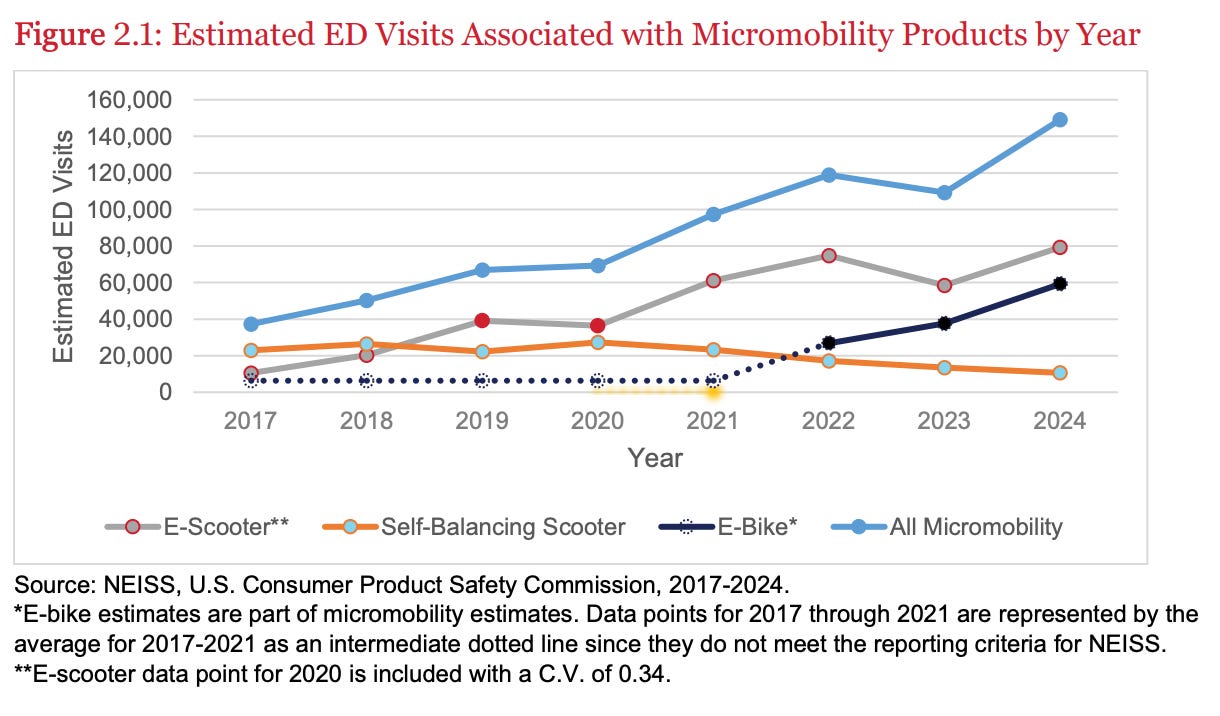
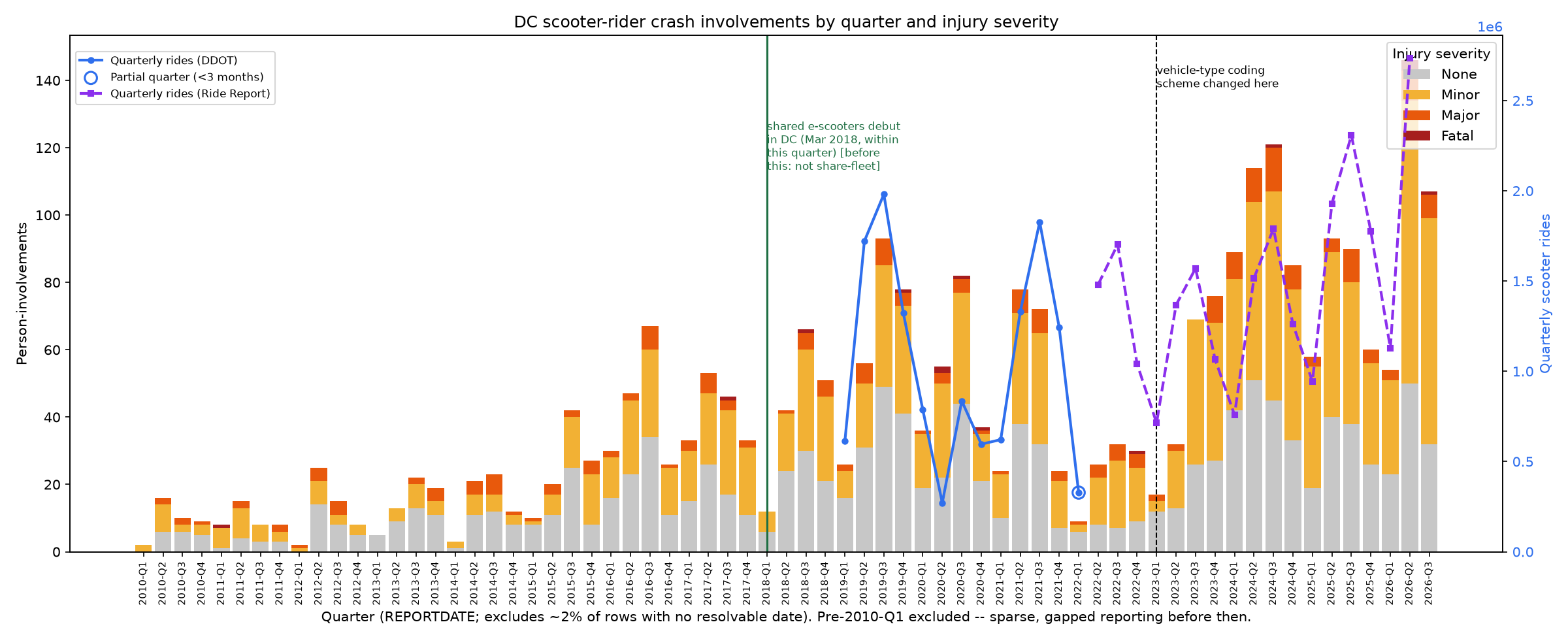
D.C.’s crash data is messy: I don’t see a great way to separate e-scooters from gas scooters, including the pandemic-era boom of delivery drivers. I’ve included Claude’s best effort to clean it up–at the very least, there’s no indication that D.C. is an outlier from the trend the CPSC identified.
D.C. Scooter-Rider Crash Involvement by Quarter and Injury Severity
Although the severity of scooter-related injuries is generally comparable to bikes, the rate of injury is much higher. Estimates of the vehicles’ rate of injuries-per-vehicle-mile-traveled vary, but consistently mark e-scooters as among the most dangerous ways to get around. A 2020 analysis of data in Austin estimated that e-scooters generated between 175 and 200 times as many injuries per mile as cars. And a study here in D.C. showed that scooters lead to emergency department visits about three times as frequently as bikes on a per-mile basis.
D.C. Scooter Injuries Happen on the Sidewalk Weirdly Often
That same study showed that 57% of D.C. scooter-related emergency department visits happened because of an accident on the sidewalk. That’s unusual. Austin’s data has 33% of accidents occurring on the sidewalk. The nationwide CPSC study found that 32% of accidents happened on the sidewalk. This supports the idea that our unusually low speed limit is pushing riders away from roads and onto sidewalks, which may cause an outsize amount of pedestrian annoyance.
Does that mean more pedestrian injuries, too? Probably not, or at least not many. I couldn’t find much on scooter/pedestrian interactions, but Chicago’s e-Scooter Pilot Evaluation found just 10 pedestrians treated in emergency departments across 821,615 trips — about 1.2 per 100,000, versus the 23.4 per 100,000 it reports for riders. The pedestrian injury rate seems to be dwarfed by the injuries that riders suffer.
Sidewalk Detection Works and Changes Behavior
I was initially skeptical of the plan to vary speed limits between sidewalks and streets. Normal GPS systems can’t reliably provide that level of precision. But to my considerable surprise, the technology to enable scooters to detect whether they’re being ridden on the sidewalk or road has already been deployed by Spin in Santa Monica, achieving apparently-satisfactory sidewalk detection through a mixture of GPS, accelerometers, and cameras. Better still, Santa Monica did this work using an experimental setup designed to test its impact on user behavior.
Normally, when one of Santa Monica’s Spin scooters detected it was being ridden on the sidewalk it would beep, send a push notification to the rider’s phone, and reduce its maximum speed. During the experiment these mechanisms were disabled for half of an experimental fleet of 100 scooters. The scooters for which the feedback mechanisms remained active recorded 22% less time and 26% less distance spent on sidewalks, and 5% more time and 8% more distance on streets (though the last of these did not achieve statistical significance). Both groups used bike lanes about the same amount.
These are modest changes, but the study authors note that most trips begin and end on sidewalks by necessity because that’s where scooters are parked, which may make the effect on rider behavior seem more slight than it otherwise would be.
Speed and Availability Restrictions Lower Injury Rates
It’s worth understanding the cause of those gigantic injury numbers I cited above. In study after study, the causes of scooter injuries are dominated by inexperienced riders suffering falls. The share of first-time riders is particularly striking: 33% of the injuries in the Austin study arose during the victim’s very first ride. It was 36% in the D.C. study! Scooter injuries are also disproportionately associated with alcohol and off-peak use.
That combination is why Helsinki structured its scooter reforms the way it did: reducing top speeds to 12.5 mph normally, to 9.3 mph after midnight, and disabling scooter rentals after midnight entirely on Friday and Saturday nights. After this change the city’s per-trip injury rate was cut by more than half.
Do We Want to Push Scooter Riders into the Street?
Santa Monica’s example suggests that we can use technology to nudge scooter riders off the sidewalk. What would happen next?
No one has measured injury rates by street versus sidewalk. That would require knowing how many scooter-miles are ridden on sidewalks versus roads, and nobody tracks that comprehensively. But there is evidence that the injuries that happen in the street are more severe.
It doesn’t take a genius to guess why. Amidst all the bad news about scooter injuries, one element is relatively scarce: cars. A 2025 Rutgers study found that 23% of e-scooter injuries involved a car, versus 33% for e-bikes. In the D.C. study, just 12% of the studied scooter injuries involved an automobile, versus 67% being chalked up to infrastructure or “other fall”. It seems reasonable to ask if that balance would change if D.C. riders spent more time in the street.
Who Would We be Pushing into the Street?
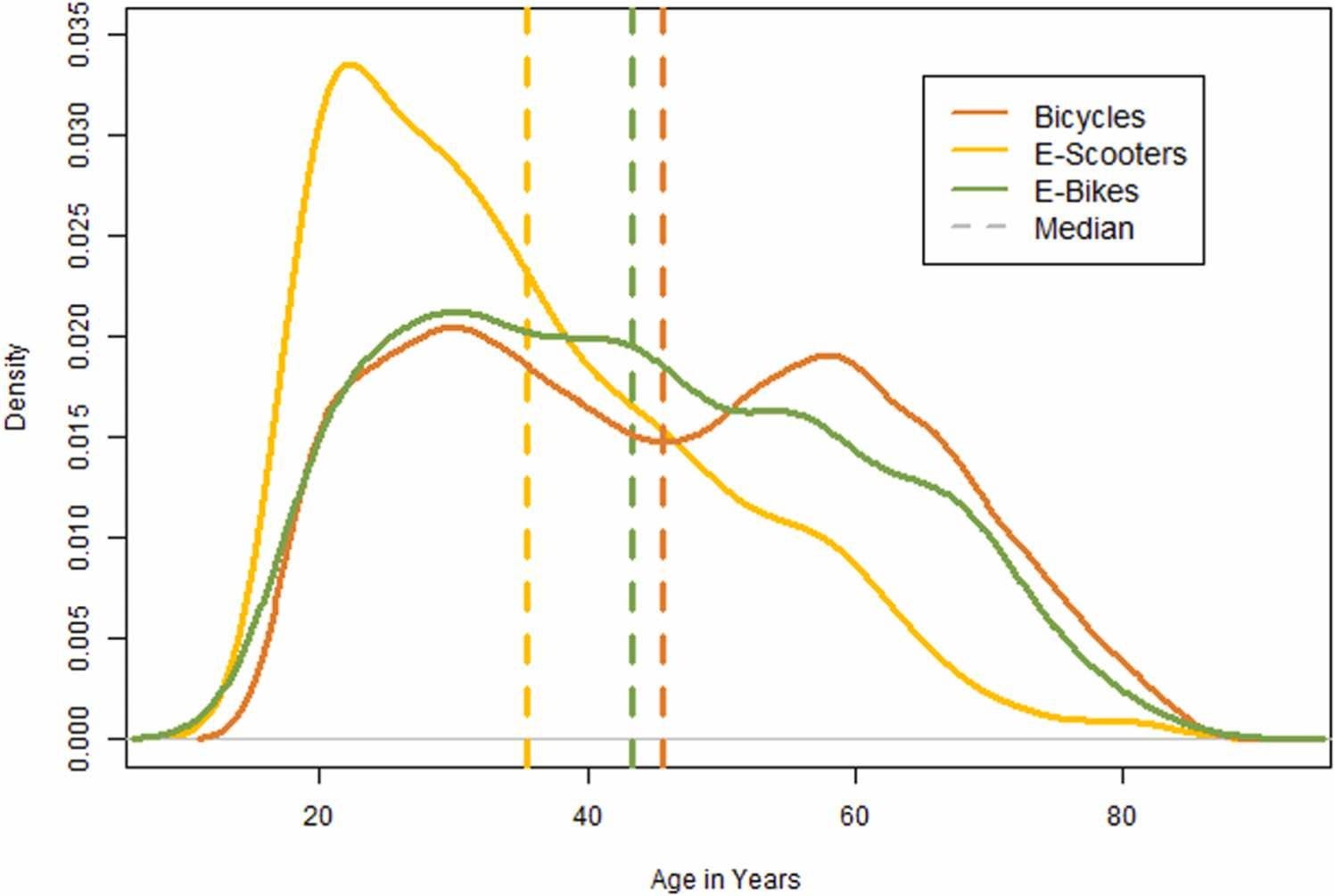
We can move scooter-riding into the street by increasing speed. The increase in speed will mean more injuries, and the move off the sidewalk will mean more serious ones, likely because more cars will be involved. Who would be suffering these injuries?
The Rutgers study provides an answer, illustrated below: mostly younger people. The study also confirms that the involvement of cars correlates with the injured person being admitted to the hospital.
Changing the scooter injury mix in this way could be particularly unfortunate given the dismal rate of helmet use seen in the literature. The D.C. study showed less than 2% of injured scooter riders were wearing a helmet, versus 66% of cyclists. Here I should note that the D.C. study only looked at injuries among people who were at least 18 years old–that’s also the age that Hopp and Lime require of riders, though if you’ve been outside in D.C. at all in the last eight years, you know that younger kids ride their scooters frequently.
Studies examining youth scooter use seem to exist in a separate epidemiological world, but there’s evidence that e-scooter injuries are accruing to Black and Hispanic youth, and especially boys, at disproportionate rates. That reality sits uneasily alongside DDOT’s celebration of 11% of D.C. micromobility rides being taken under the program’s subsidy for low-income participants.
What Does This Add Up To?
D.C.’s scooter program is unusual: it’s got a very low speed limit, which encourages sidewalk riding. That probably keeps injuries lower than they otherwise would be. And that’s good, because scooters are a dangerous way to get around on an injuries-per-mile basis. Sure, bike statistics benefit from bigger denominators: higher speeds and subpopulations with longer commutes; plus a culture of ingrained helmet use. But even discounting that, scooters seem like a kind-of-lousy transportation mode that hurts a lot of new riders, reckless kids, and people coming home from a night out, when they probably shouldn’t be driving a vehicle.
DDOT can nudge riders off of the sidewalk with a speed boost. And it’s not crazy to set a top speed more in line with what other cities use. But that increase in speed will mean more injuries for riders. And the move off sidewalks is likely to make those injuries more severe.
D.C. should try to limit the damage with policies that have worked elsewhere: limiting speeds not only based on where the vehicle is ridden but when, focusing on nightlife hours and first rides. Cities like Austin, Seattle, Helsinki, and Chicago have implemented bits and pieces of these measures. D.C. should grab as many good ideas as we can. Right now, DDOT’s proposed rule doesn’t include any provisions targeting first rides or nightlife hours.
(Of course, to know if it’s someone’s first ride, you have to be sure the person riding the scooter is the same one who’s signed into the app. But that’s a topic for another post.)
There’s Still Time To Weigh In
DDOT will be accepting comments on this rulemaking until October 4. Capital Commonsense readers can share their perspective by writing to Jason Rubinstein, Policy Analyst, Policy and Legislative Affairs Division, Office of the Director, DDOT, 250 M Street SE, 8th Floor, Washington DC 20003 or publicspace.policy@dc.gov.
If you refer to the NPRM on “Shared Fleet Devices (Notice ID N146433), 73 DCR Vol. 73/36, published September 4, 2026” he’ll know what you’re talking about.
I read the sidewalk data as suggesting less about the speed limit FWIW and more about the relative level of pedestrian saturation within DC relative to most other places, e.g. Austin.
A common theory is that much of the bad behavior and cost to the scooter companies is from kids using low income access (eg an EBT card) to ride the scooters. Do we know the difference in accident rates from different access modes?