


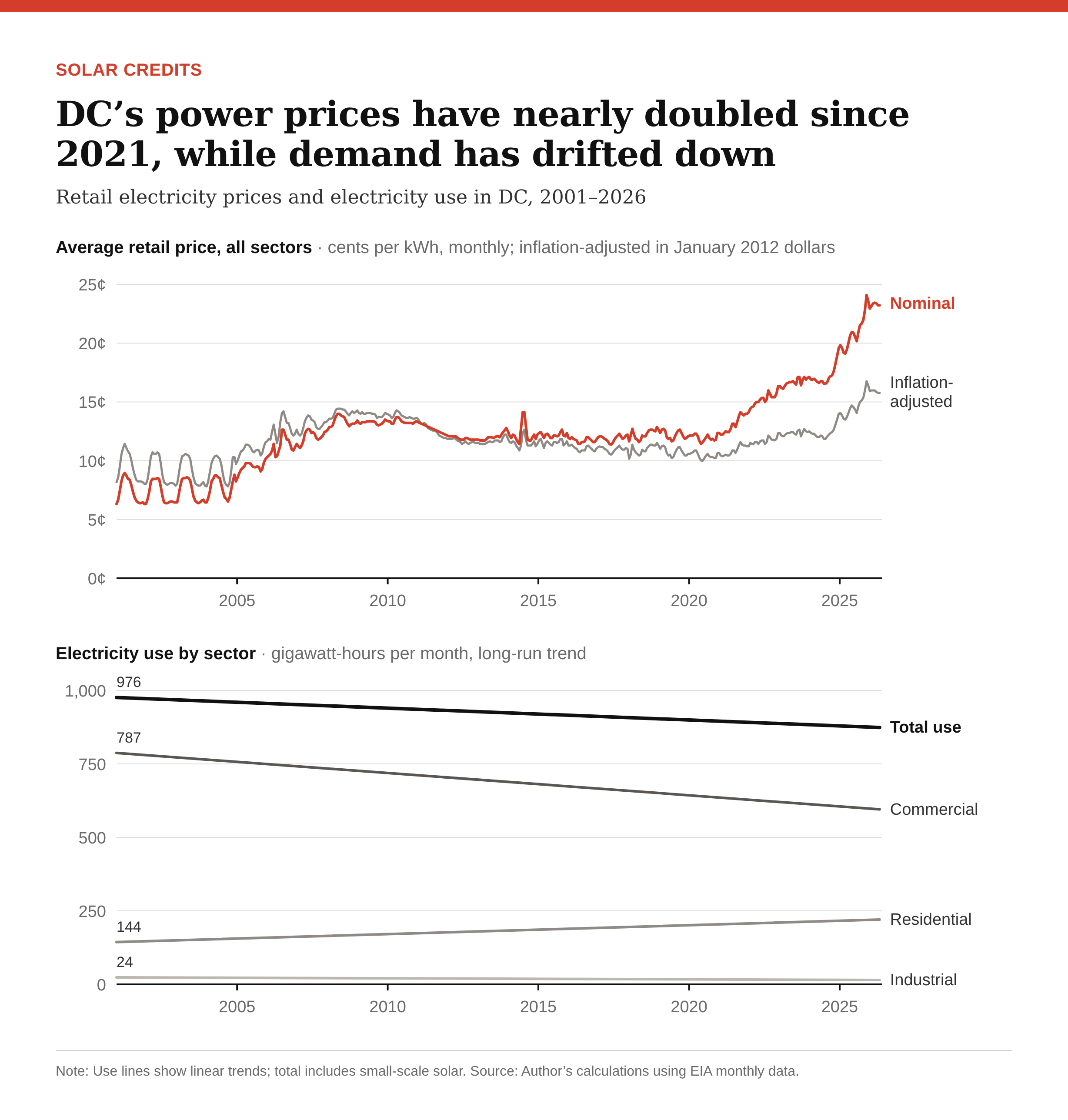
Electricity is vital for modern living. As we all understand by now, prices have risen significantly in the last five years, with rapid acceleration in the past few years exceeding already high inflation. As Figure 1 shows, power prices in DC have nearly doubled in the last five years. This trend is particularly disturbing because overall power demand has not increased in DC over the last 25 years, as also shown in Figure 1. As increasing prices for other necessities squeeze residents and businesses,rising power prices are exacerbating an already challenging economic environment. Slowing or reducing the cost of electricity must be a key priority for the incoming mayor and city council, while still meeting essential climate and efficiency goals.
Figure 1: Electricity Use and Prices in DC1
DC’s Limited Options
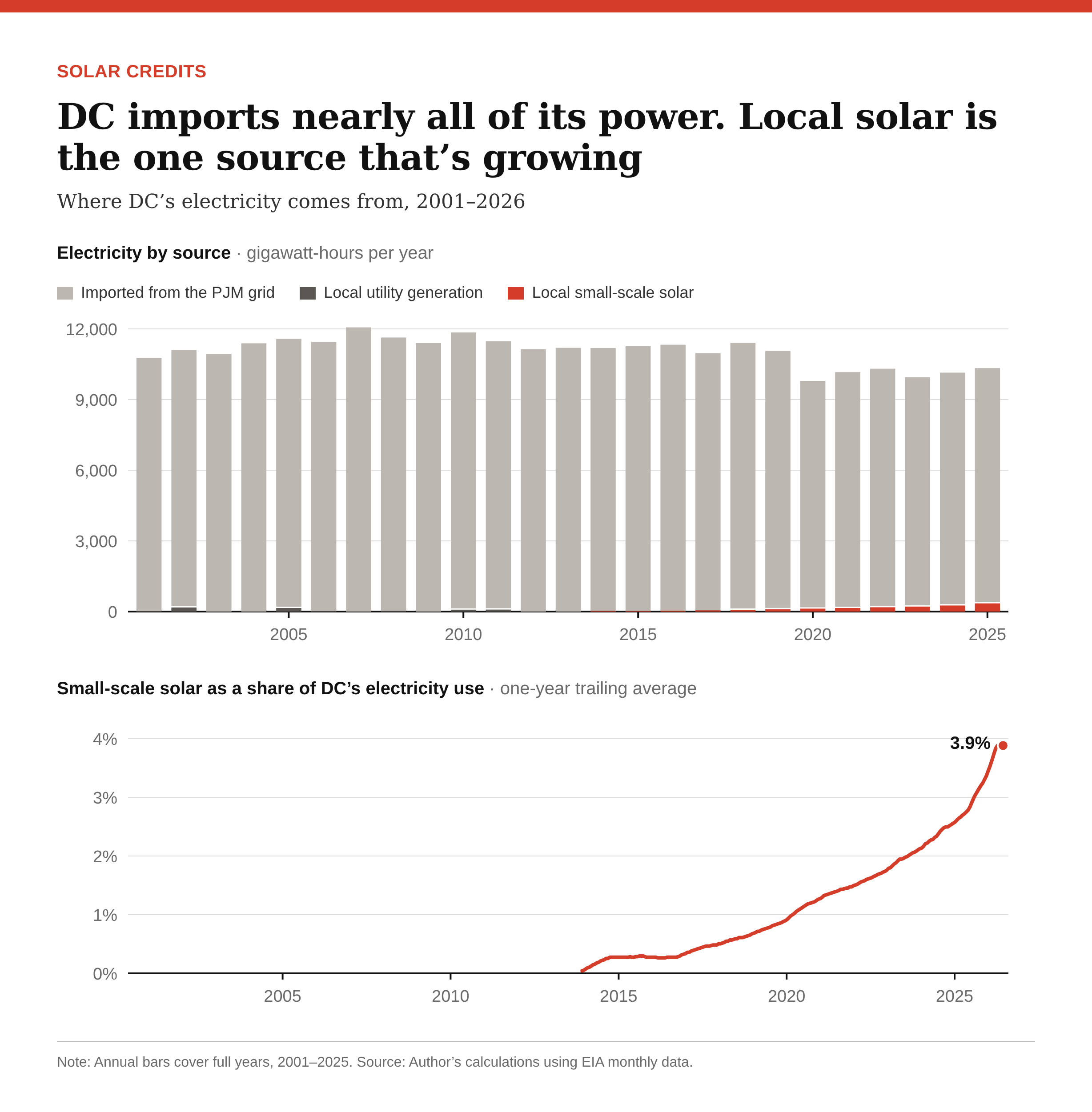
Policy and market factors determine much of these increases. The market factors are challenging for local government to control. Rooftop solar and community solar offer a vital hedge for DC electricity customers. These systems reduce the need to receive increasingly expensive power from PJM. They reduce impacts on local transmission and distributionassets and increase overall system reliability. Most importantly, DC can control the impact of these systems on electricity prices.
Figure 2: DC Power Sources2
Local Solar Market
Our energy policy requires a specific amount of local solar as part of a broader renewable energy mandate. To ensure compliance and provide a subsidy, electricity generated from local solar bestows a credit, called a solar renewable energy credit (SREC), on system owners. Electricity providers, like Pepco, the primary source for most homeowners, or other retail providers, mustpurchase these SRECs to match the percentage of the power they sell that the renewable energy standard requires. That percentage will increase to 15% by 2041 and stands at 4.3% today. DC law sets the price of a credit through a complex mechanism involving market dynamics and price maximums. Currently, the price of a solar credit is about 37 cents/kWh but has been as high as 43.5 cents/kWh since 2023, meaning District residents pay solar owners 1.5 to 2 times the retail price of grid electricity. This price is artificially established by the maximum price in DC law.
Figure 3: REC Costs for All Sources3
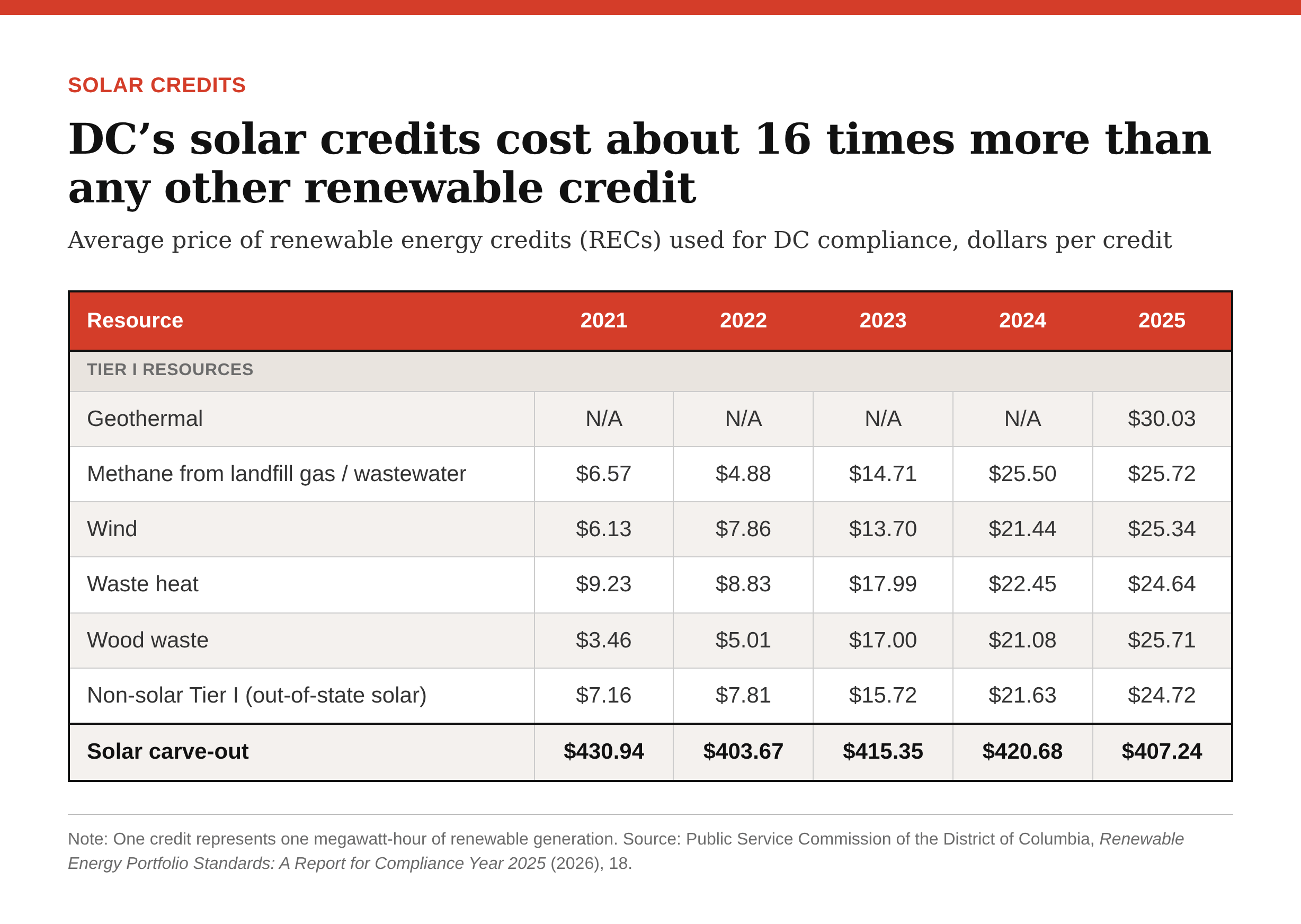
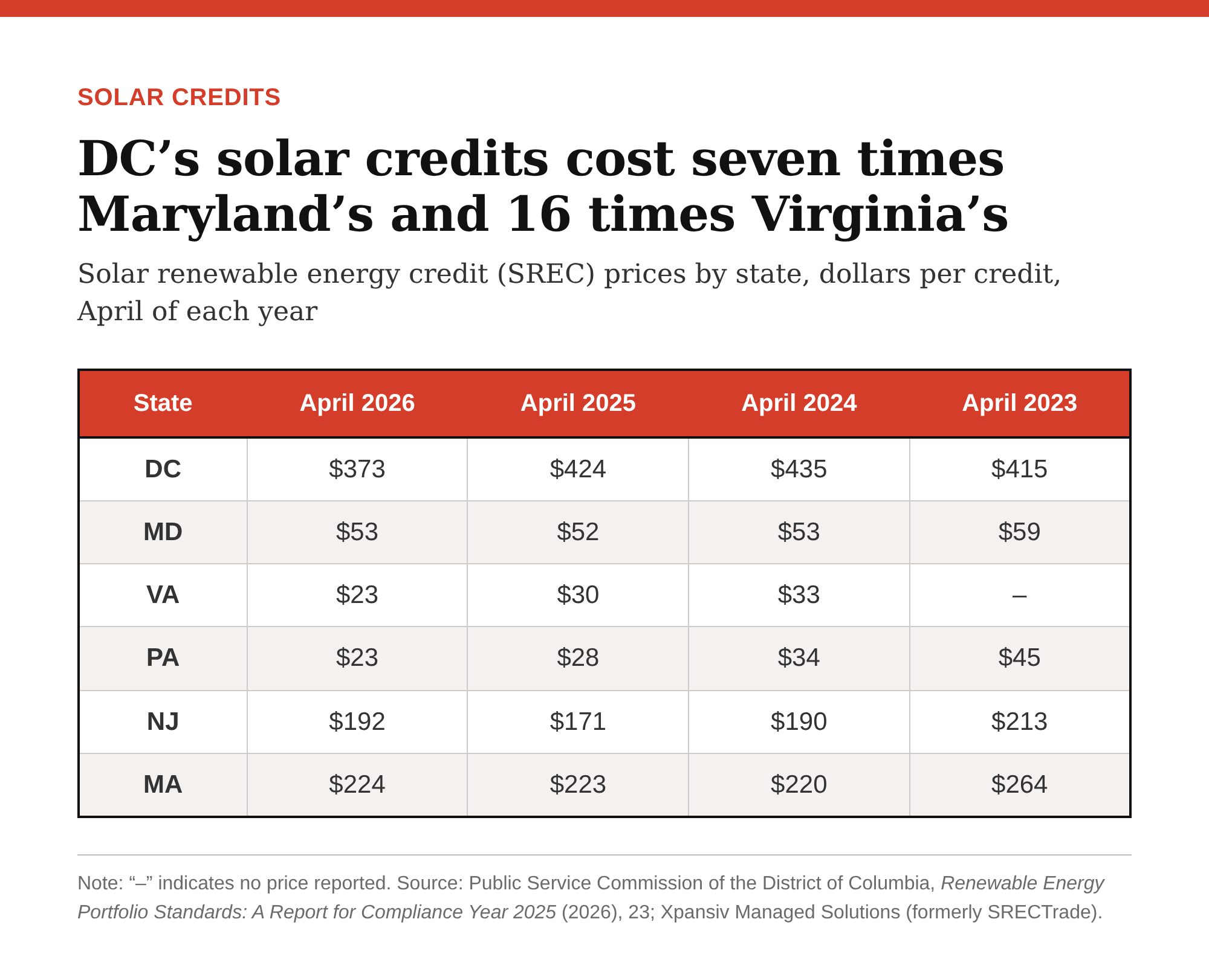
It is about seven times higher than comparable credits in Maryland, more than 10 times higher than in Virginia and Pennsylvania, and far higher than renewable energy credits for grid renewable resources like wind and solar farms.
Figure 4: Solar REC Costs4
Here’s the problem. Pepco does not ultimately pay for these credits. It charges this cost back to all of its DC customers. Other retail providers similarly pass through the compliance cost. In 2025, DC power customers paid other DC homeowners, community solar facilities, and even some Maryland solar owners about $155 million to comply with DC’s local solar carveout through the purchase of SRECs. This subsidy is unnecessary.
Until recently, solar has been among the cheapest new generating options for most of the country. Although more expensive than large, utility-scale solar installations, rooftop solar systems have generally been good choices. The calculus has become more difficult in the last year because federal subsidies for individual rooftop solar systems ended, and Trump Administration tariffshave imposed additional costs on most solar systems. Nonetheless, the technology is still largely cheaper than current retail electricity prices, which is the cost a customer would pay for electricity without a rooftop solar system.
This is the key measure for determining whether solar makes sense for most homeowners. Will you save money? In the District, in almost all cases, a solar system provides cost savings without any SREC subsidies.
Consider the cost of electricity from a rooftop solar system to a homeowner for two scenarios: an outright purchase and a purchase financed through a home equity loan. I assess the equivalent electricity price for a system in 2022 and today over a conservative 25-year lifespan. Figure 5 shows the equivalent cost of the electricity the local solar system produces for a homeowner. This calculation assumes no SREC payments. The system is 8 kW and produces roughly 9,800 kWh a year, all of which the household uses. The cost includes an inverter replacement, annual maintenance, and a 10% share of the bill (fixed charges) that solar cannot avoid. The 2022 system includes the 30% federal tax credit available at that time.
Figure 5: Rooftop Solar Cost Comparison5
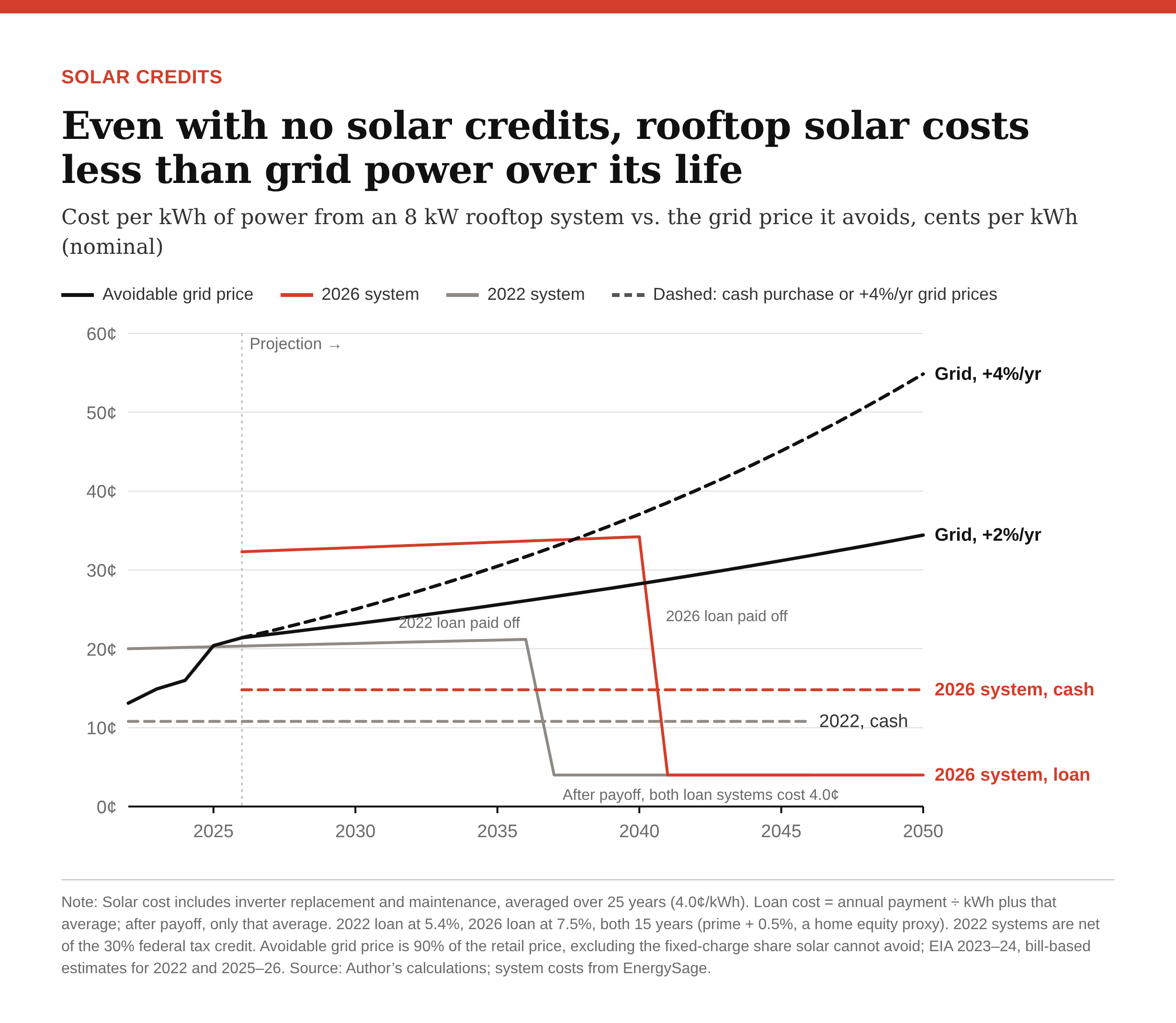
Comparing this figure to the avoidable price of retail electricity shows thatsolar systems are beneficial in the long run in all cases. The equivalent price for power from an outright purchase of a system shows immediate cost savings for systems installed in 2022 and today. A system financed through a home equity loan, assumed at 7.5% over 15 years today, would be more expensive in the early years but would eventually show benefit as the loan is paid. Even in 2022, a loan-financed system at 5.4% would have shown savings by the fourth year.
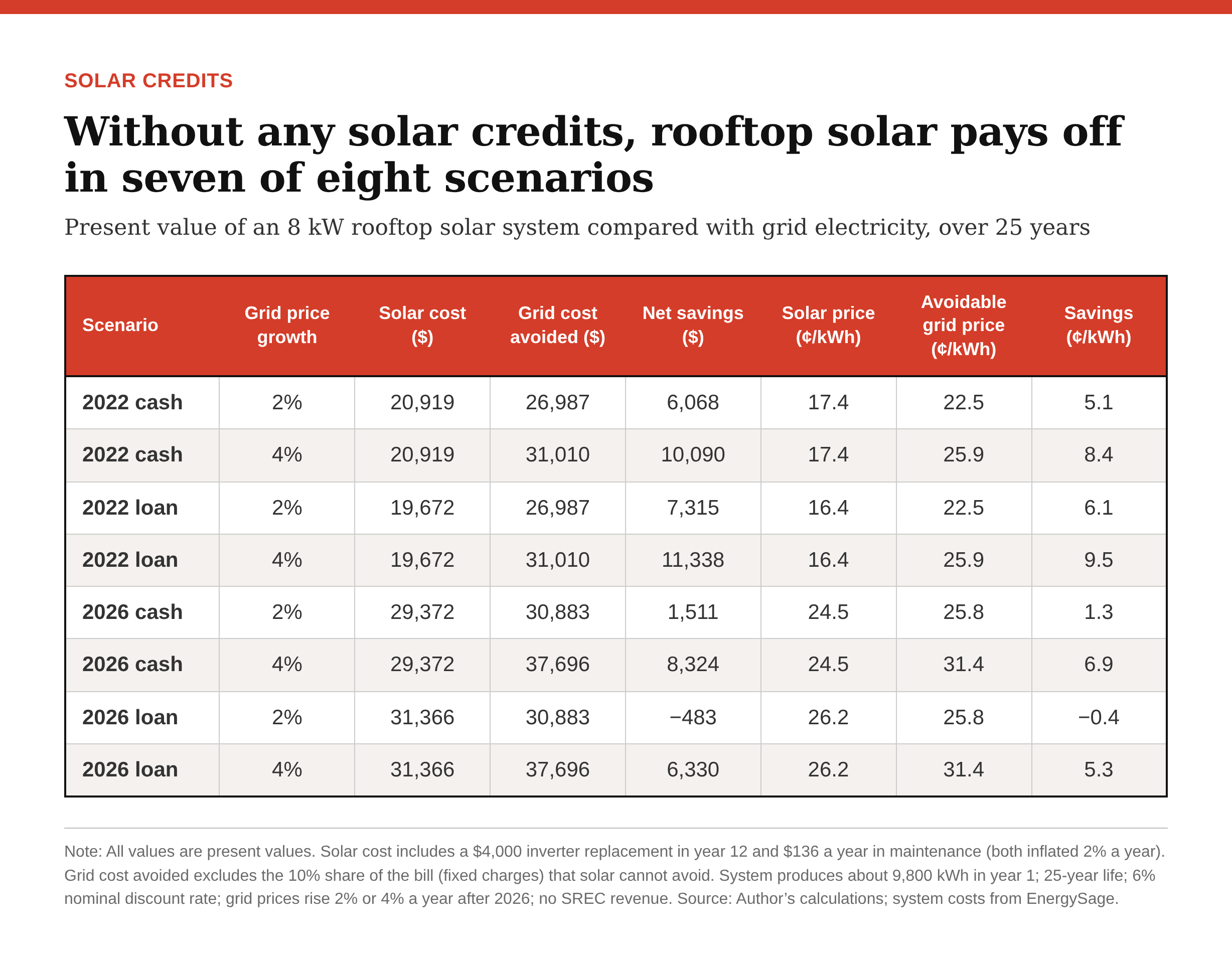
In other words, the cost of the loan to pay for the system would be less than what a homeowner would pay for the electricity their solar system replaces over the life of the system. The savings increase if one assumes prices increase 4% a year on average. Considering present value, seven of the eight systems considered show savings, as shown in Table 1. The exception, a loan-financed system today with prices rising 2% a year, roughly breaks even.
Table 1: Present Value of Solar Compared With Grid Electricity 6
SREC Level Unnecessary
This analysis shows that the benefits of rooftop solar exist without any SREC subsidies, assuming a modest inflationary increase in electricity prices. Adding the SREC subsidy at the current level on top of the inherent benefit is an unnecessary redistribution of costs from all DC electricity customers to a small percentage of homeowners and businesses in the District. In the one case where solar costs more than grid electricity, the difference is less than a cent per kWh, not tens of cents per kWh, which is the value of the current SRECs. In the worst case, a loan-financed system installed today, a SREC of approximately 10 cents/kWh would be needed at first, declining to about 6 cents/kWh over the 15-year loan, for the system owner to be cash flow positive each year.
In other words, DC SRECs are too high by a factor of 4 to 10. Reducing SRECs by even one half would immediately save DC customers over $75 million. Reducing the credit by a factor of 10 would save over $135 million. Savings would increase over time, because the solar mandate requires even more solar while the maximum price of the credit decreases only slowly.
Local solar is a benefit to DC, but the current program costs too much. Simply reducing the SREC by half, or ideally by a factor of ten, would keep solar systems a viable replacement for expensive grid power and reduce an unnecessary cost on all DC power users. Correcting the SREC price would provide immediatesavings to DC electricity customers and still offer a viable alternative to ever-increasing retail power prices.
Author’s calculation using EIA monthly data.
Author’s calculation using EIA monthly data.
Public Service Commission of the District of Columbia, Renewable Energy Portfolio Standards: A Report for Compliance Year 2025 (2026), 18.
Public Service Commission of the District of Columbia, Renewable Energy Portfolio Standards: A Report for Compliance Year 2025 (2026), 23
Author’s calculations for Figure 5 and Table 1. System cost: EnergySage (2026) for 2026; 2022 U.S. average of EnergySage quotes
Ibid

I have a well off friend who does not live in DC and has a house with thermal energy. He told me he sells his “recs” to DC via a broker. I haven’t been able to verify this, but is DC paying people who produce green energy around the country?