


If one were to poll District voters and ask them whether they believe threatening your building manager with a butcher knife and punching them in the head warrants being evicted from the property in a timely manner, I think that the vast majority would agree that the answer is yes.
This question is currently under consideration by D.C. Superior Court, and the outcome could have implications far beyond this case—and potentially put the safety of Washingtonians at risk.
The D.C. Council, Bowser Administration, and Office of the Attorney General have all come down on the side of “yes.” Acts of violence should warrant a fast-track eviction. The Public Defender Service for the District of Columbia is pushing for the answer to be “no.” D.C. Superior Court will hear arguments on this question later this month.
I first became aware of this case back in August, when Washington Sun reporter Martin Austermuhle posted about the Public Defender Service’s intervention and efforts to significantly broaden the case’s implications.
We’ll get to that after walking through the law and history, as the context is important. A single eviction case would not normally warrant an examination in this outlet but, as you’ll see, there are much broader implications for public safety pending the outcome.
What Happened and What’s the Legal Standard?
In March 2026, according to his landlord’s complaint, the defendant walked into the leasing office of his Navy Yard apartment building, screamed at the manager, brandished a butcher-style knife, and punched the manager in the head. He then kicked at the office’s door while shouting threats, and later resisted arrest. The day before, the complaint states, he had menaced the same employee in a similar manner.
Securing a criminal conviction and taking back an apartment have long been treated differently in the American legal system. A conviction rightly requires proof beyond a reasonable doubt because an individual’s freedom is at stake, whereas an eviction is a civil case over the right to live in—or possess, in legal parlance—a particular property. Civil cases are ordinarily decided by a preponderance of the evidence, or more likely than not. This is a lower standard than proof beyond a reasonable doubt. Many states apply that civil standard to evictions based on criminal conduct and do not make landlords wait for a criminal case to finish.
For example, just across the Potomac, Virginia law treats a criminal or willful act that threatens health or safety as a violation that cannot be cured (or fixed), allowing a landlord to terminate the tenancy without waiting for a conviction. The landlord must prove the violation by a preponderance of the evidence, and the initial hearing must be held within 15 days of service. Federal rules for public housing are similar. A housing authority may evict for criminal activity once it determines the activity occurred, whether or not the person was arrested or convicted and without meeting the criminal standard of proof.
This intuitively makes sense. If a person punches building staff or a fellow resident, management would not want that person to continue residing in the building—even if the conduct does not result in a criminal conviction—given the need to protect staff and residents and ensure their peace of mind at work or home.
D.C. was an outlier in this regard. For decades, a landlord in the District could evict for criminal activity in a unit only after a court had already determined that the illegal act occurred. In practice, that meant waiting for a conviction, while the accused tenant stayed next door to the neighbors and staff they allegedly threatened.
What the Council did in the RENTAL Act
The RENTAL Act, effective December 31, 2025, brought D.C. closer to its neighbors for the most serious cases by amending the Rental Housing Act. The push for this change was driven by an uptick in violence toward building staff and other tenants during the pandemic.
The Washington Post had previously reported on the increasing difficulty of keeping buildings safe for all residents, focusing on a property manager who was assaulted while trying to keep order in the building.
“Arms flew at [Keith] Carr. The force sent him down the stairs toward the basement. Then the young man was on top of him, the landlord said, swinging and kicking. Carr broke free and sprinted through the back entrance to his car. According to video footage from the building’s camera, his alleged attacker came out the front door, returned with friends, smashed the front glass door and chased after Carr. “It seems like they were running back to finish me off,” he said.”
When the alleged illegal act would constitute a “dangerous crime” or a “crime of violence” as defined in D.C. law, and was not committed in self-defense or defense of another, the landlord must first consider in good faith reasonable ways to preserve the housing of non-offending occupants, such as barring the offender or transferring the lease, and may then serve a 10-day notice to vacate.
The Court must then hold an expedited hearing within 20 days of the complaint being filed. If the Court finds by a preponderance of the evidence that the tenant or occupant engaged in such a crime, it must enter a final judgment for possession and issue a writ of restitution.
The Council shaped this policy deliberately. Mayor Bowser’s original bill would have allowed eviction after an arrest. The Housing Committee narrowed that approach. Committee Chair Robert White said its version would let courts move quickly in cases involving violent crime charges rather than mere arrests.
Then, before the full Council voted, a substitute amendment removed the requirement that a prosecutor’s indictment be attached to the notice, citing concerns about undue delay, and allowed cases to proceed on the landlord’s allegation. White’s memo described how this change would work: Landlords would allege a crime of violence to qualify for an expedited hearing, and a judge would decide by a preponderance of the evidence whether it in fact happened.
What District Government Says the Law Means
The D.C. agency charged with implementing the Rental Housing Act and any amendments to the law, the Rental Housing Commission, has read the statute the same way.
In proposed rules published in April, the Commission concluded that the Council intended a separate process for dangerous or violent crimes that does not require a prior judicial determination. Under that reading, a notice may rest solely on the landlord’s allegation, and the Landlord-Tenant Branch must hold an expedited hearing on the allegation and any defenses using a preponderance standard.
The Commission also addressed the most serious self-incrimination concern. Its proposed rules would require the notice to tell tenants they may defend themselves at a hearing but have the right to remain silent, and that anything they say in their defense may be used against them in a criminal case—a Fifth Amendment safeguard was written into the proposed rules.
What the Court Did
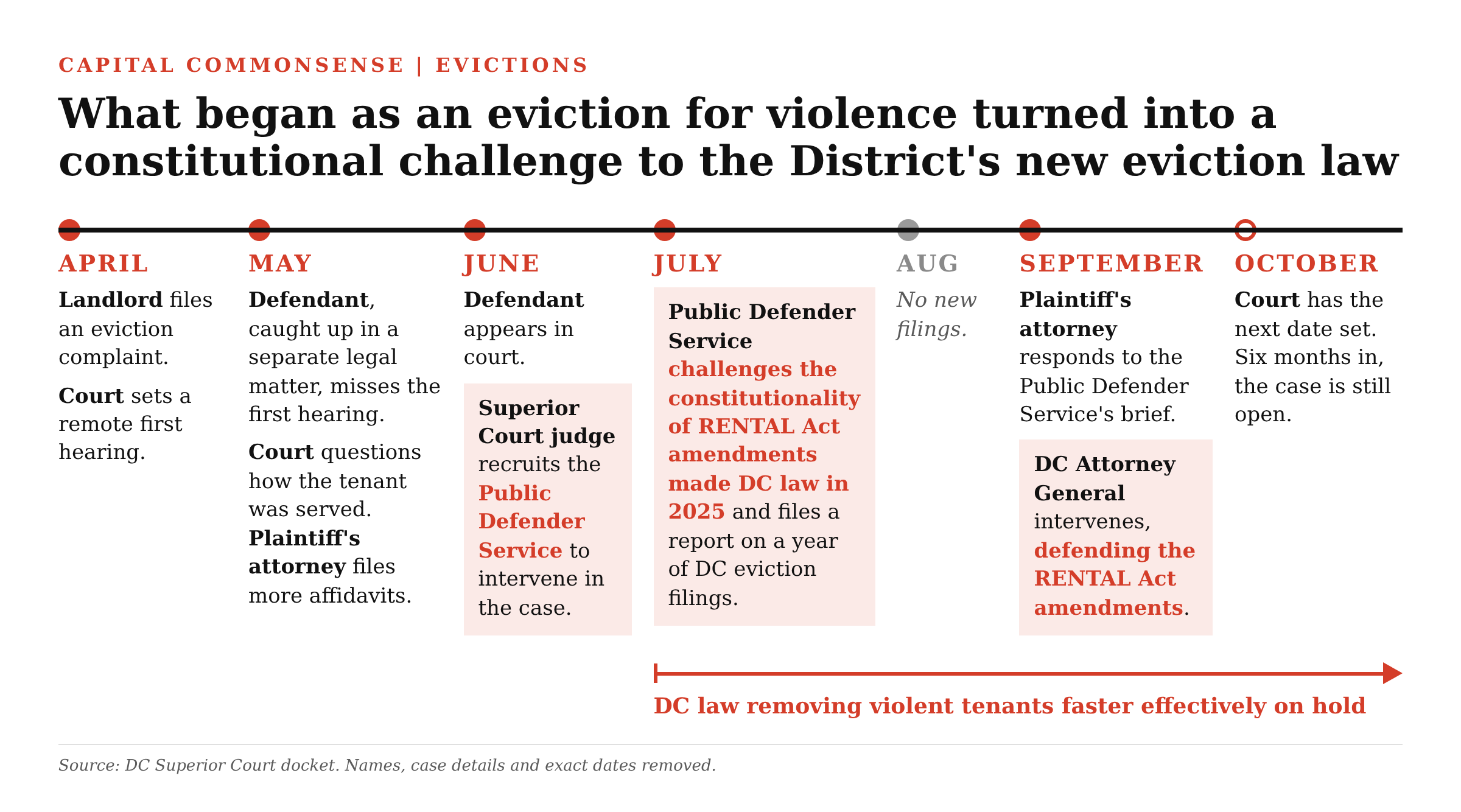
At a June hearing, the landlord’s counsel asked Judge Shana Frost Matini for a judgment based on the complaint and the police affidavit supporting the tenant’s arrest. The Court declined, noting that the tenant had a right to challenge the evidence against him and could not cross-examine a police affidavit. The Attorney General’s office later agreed that the law requires an evidentiary hearing before any judgment.
Then, according to the case summary, Judge Matini raised a Fifth Amendment concern on her own: The tenant had a pending felony case, so defending himself in the eviction could mean giving up his right to remain silent in the criminal case. She remarked that the new amendments had put the Court in a very uncomfortable position. The hearing notes described her remarks:1
THE COURT WILL REFER THIS MATTER OUT TO LEGAL SERVICE PROVIDERS FOR INVOLVEMENT. THE COURT INDICATES THAT WITH THE RECENT AMENDMENTS IT HAS PLACED THE COURT IN A VERY UNCOMFORTABLE POSITION.
She then referred the case to the Public Defender Service (PDS). The Court’s subsequent order says PDS agreed to appear “at the undersigned’s request.”
The court also notes that…the Public Defender Service for the District of Columbia has agreed, at the undersigned’s request, to seek to appear as amicus curiae for the purpose of filing an amicus brief to address constitutional issues raised by the RENTAL Act.
Amicus briefs are usually filed by outside groups that ask to participate. Here, Judge Matini recruited the outside group. But, according to the Attorney General’s brief, her invitation was limited to advising the tenant about his Fifth Amendment rights and brief whether the case could proceed while his criminal case was pending. It was PDS that added arguments under the Seventh Amendment and the Fair Housing Act.
PDS’s July brief then goes far beyond this individual case and asks the Court to hold that the fast track does not dispense with the old requirement of a prior court determination at all. So, PDS is urging the Court to adopt a reading of the law that the Council’s legislative history, the Rental Housing Commission’s proposed rules, and the Attorney General’s office all reject. If the Court accepts it, a trial judge would effectively rewrite a law passed by the Council, signed by the Mayor, and supported by the Attorney General.
(The individual at issue here pleaded guilty to attempted assault with a dangerous weapon and a misdemeanor stalking-order violation. He was sentenced and waived his right to appeal.)
Under that reading, the 20-day hearing would resolve nothing, and eviction could follow only after a full trial. That is the opposite of Council intent and the conclusion the District’s rule making agency. The brief relies on the Council’s rejection of the arrest-based version of the bill, but does not address the later amendment that dropped the indictment requirement, or White’s memo, which the Attorney General’s brief quotes, explaining that change.
In light of the guilty plea, PDS now argues that the defendant, whom it describes as having a mental disability, may still have a defense under the federal Fair Housing Act. So even the prior criminal determination that PDS says the law requires is now in place, and the case continues. A statute that promised a hearing within 20 days of filing has produced a motion hearing set for late October, more than six months after the complaint was filed.
On September 28, Attorney General Brian Schwalb intervened to defend the RENTAL Act. His office’s brief argues first that Judge Matini should not decide the constitutional questions at all. The defendant’s guilty plea, sentencing, and waiver of appeal have made the Fifth Amendment issue moot. He never demanded a jury or raised a disability defense. And, the District contends, ruling on issues the tenant never raised would violate the “party presentation principle” the Supreme Court enforced in United States v. Sineneng-Smith (2020), a case in which the Court faulted the Ninth Circuit for inviting amici to brief constitutional problems the parties hadn’t raised. The brief puts it bluntly:
“Although the Court invited PDS’s participation, the Court’s invitation was only to ‘advise’ Chambers on his Fifth Amendment privilege and brief the Court on whether or how it could proceed in Chambers’s case while he has a pending criminal proceeding. Nonetheless, PDS took the opportunity to raise broader issues with the RENTAL Act and advocate for an interpretation that would govern future cases. That hijacking of this case is simply incompatible with the party presentation principle or the limited role that the Court originally envisioned for PDS.”
If the Court does reach PDS’s arguments, the District says they fail. The statute’s text, the legislative history culminating in Councilmember White’s amendment, and the Rental Housing Commission’s proposed rules all show the Council deliberately let landlords start fast-track cases on an allegation, with a judge deciding by a preponderance of the evidence whether the crime occurred. Requiring a prior conviction, the District argues, would effectively rewrite the law.
As of publication, a separate case filed by the landlord alleging more than $30,000 in unpaid rent is currently pending, with a virtual initial hearing not scheduled until 2027. The virtual hearing would occur roughly one year after the complaint alleges the tenant last paid rent. (Frankly, it’s no wonder housing investment in the District of Columbia has collapsed under these conditions. In subsequent articles, we will explore the backlog of rent nonpayment cases at Superior Court, which is more complex than the issue of evictions for act of violence.)
The defendant’s current attorney at Equal Justice Under Law provided the following statement on the issues at hand. PDS did not respond to a request for comment.
“Equal Justice Under Law fundamentally believes that our courts should treat rich and poor alike, but far too often, the legal system advantages the wealthy while disadvantaging those living in poverty. Our city’s affordable housing crisis is one example where wealth-inequality in the justice system can be abused to harm people living in poverty. In our view, the Constitution guarantees equal access to the courts, meaning that underrepresented people and communities are entitled to be heard without presumptions drawn against them before they walk into court. When it comes to evictions for alleged criminal activity in the past, we think it important to balance allegations about past danger with the important right of each person to their home—mere allegations of past dangerousness should not, by themselves, leave someone on the street.”
Why it Matters
The outcome of this case reaches beyond one apartment or one property. A source familiar with Superior Court proceedings indicates that evictions for acts of violence are largely stalled while this case is pending. The Attorney General’s brief similar notes that at a May hearing, a magistrate judge said fast-track eviction cases were being assigned to Judge Matini.
Judge Matini’s eventual ruling will formally bind only this case unless the D.C. Court of Appeals takes it up. But as long as the question is pending, the Council’s change has been effectively on hold.
I would be remiss if I did not affirmatively state that being evicted is an incredibly difficult circumstance for a person to confront and in a perfect world there would be no need to evict anyone from their housing. But confronted with the choice between removing an individual who committed a serious act of violence and ensuring the safety of the residents and staff of this apartment building, I think the District needs to prioritize the 95% of citizens doing the right thing.
What’s Next
The Council also has an opportunity to clarify the law and affirm that it meant what it said when they passed the RENTAL Act. The pending Housing Investment Protection Act (Bill 26-758), which the Mayor proposed in July and which would delete the statutory language PDS relies on, provides a venue to do this.
As a general matter, case descriptions were based on the docket and hearing transcripts quoted in the parties’ filings, but there may be subtle nuances I am missing having not observed the proceedings in person.