


William Ostertag collapsed while exercising in his apartment building’s gym on November 3, 2024. He was 28. A staffed fire station stood less than 250 feet away.
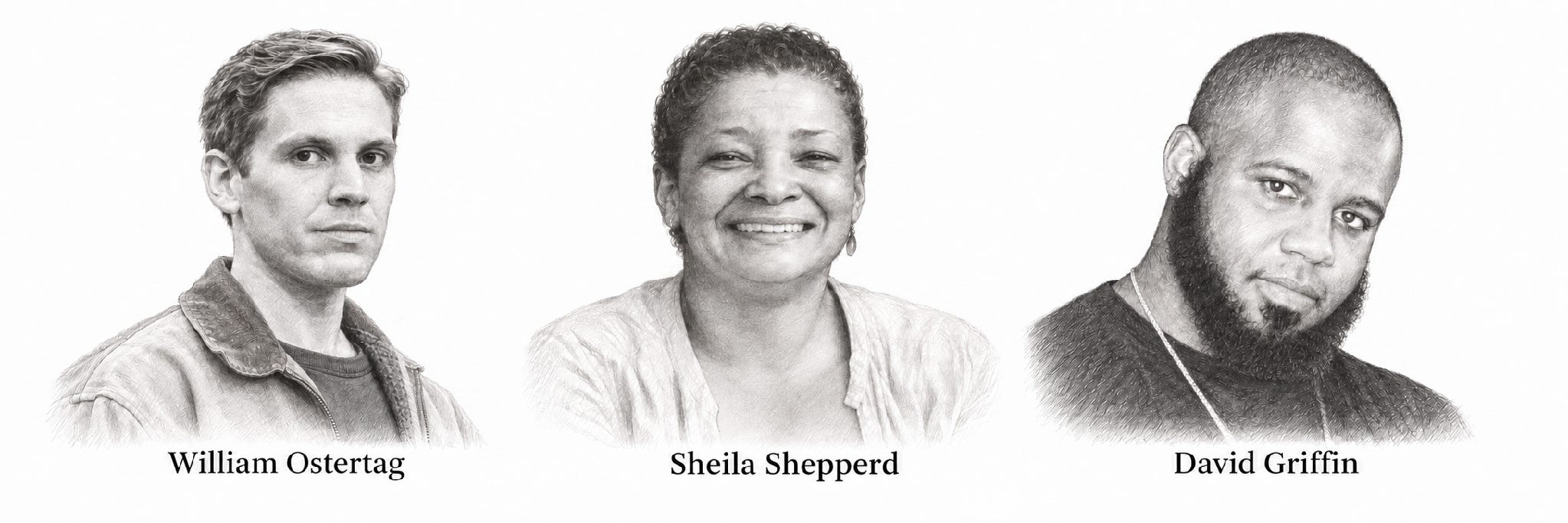
Image adapted from photos published by STATter911 and local television station WJLA. Photo credits: Ostertag family / STATter911; Billie Shepperd / WJLA; Griffin family / WJLA.
The first 911 call came at 6:13:59 p.m. Dispatchers assigned a basic life-support ambulance less than two minutes later. At 6:18:35, the dispatch record noted that a nurse would perform cardiopulmonary resuscitation (CPR). Dispatchers assigned advanced life-support units at 6:21:46, nearly eight minutes after the first call. Nearby responders registered on scene 32 seconds later.
Dave Statter reconstructed those times from dispatch and medical records. Responders restarted William’s heart, but he never regained consciousness. He died 11 days later. The records cannot establish whether earlier care would have saved him. They do show that several minutes passed between the first mention of CPR and the assignment of advanced life-support units, even with a staffed fire station less than 250 feet away.
His mother, Stephanie Clemans, sued for the recordings. Statter reported in February 2026 that she finally had them. More than a year after William’s collapse, his family had secured evidence that could help them understand how the city responded that evening.
I told this story over and over again on the campaign trail. William was a friend of one of my best friends, Eric, who later became our campaign’s policy director. But the warnings about D.C.’s 911 system long predated my campaign.
Dave Statter, a former television reporter, firefighter, emergency medical technician (EMT) and dispatcher, has covered fire and emergency medical services (EMS) on STATter911 since 2007. In 2020, he wrote that months of monitoring emergency radio traffic had yielded about 200 documented incidents.
The cases that Statter and other local reporters have documented show how far back these problems reach. Before William’s family sought answers, other families had endured crews sent to the wrong location, critical updates that went unnoticed and dispatch problems during a computer outage. City watchdogs, meanwhile, repeatedly identified weaknesses in supervision and the handling of errors. By the time I told William’s story on the campaign trail, residents and investigators had already given the city years of warnings.
The next mayor must make D.C. 911 reform a day-one priority. When a parent calls because their child cannot breathe, or someone calls after an elderly neighbor collapses, the city’s response can determine whether that person lives or dies. Every one of us could become that caller. We should not have to lose someone before we insist that the system works.
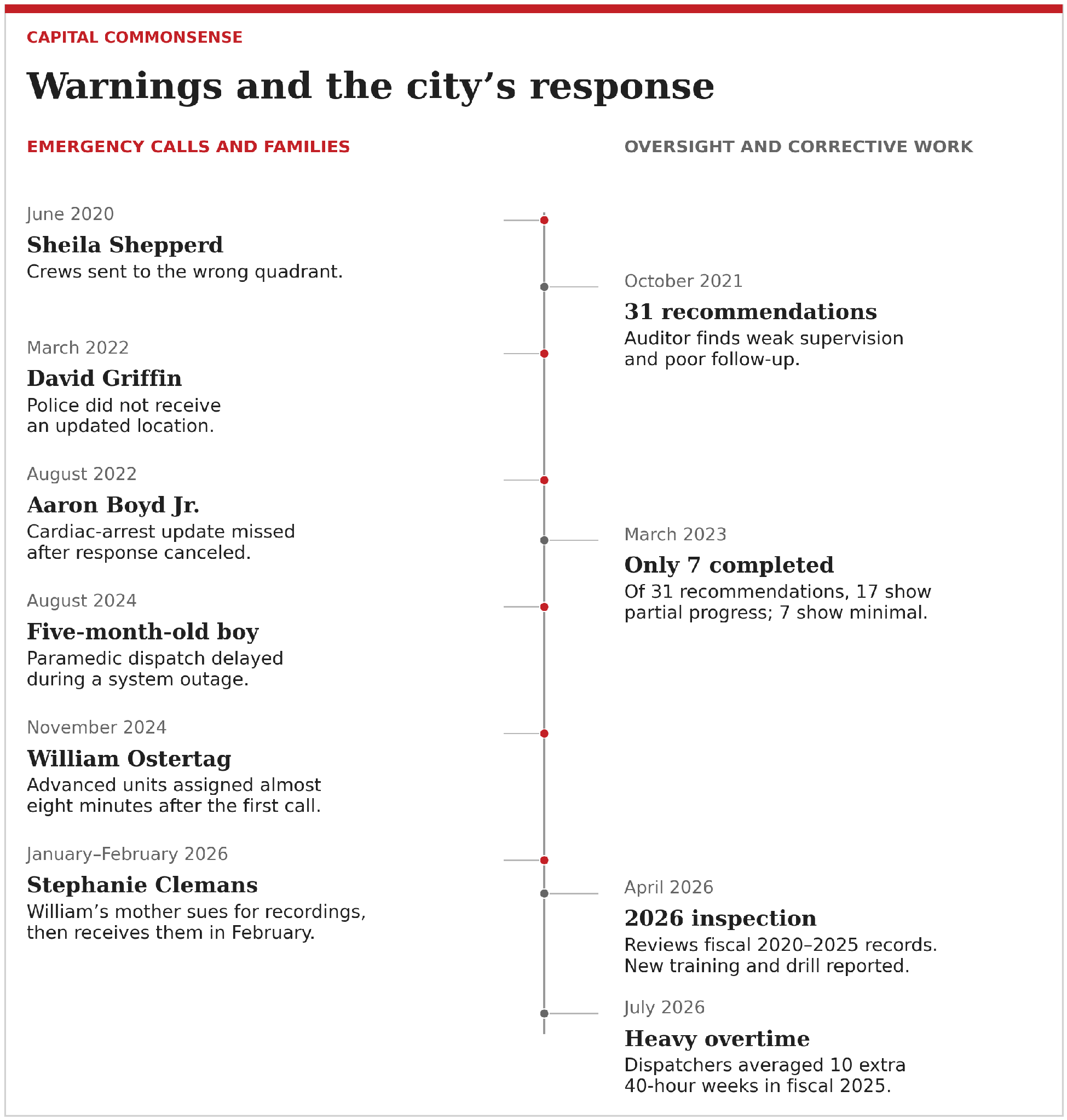
Figure 1. Families’ emergencies alongside years of official warnings. The Inspector General’s 2026 inspection covered fiscal 2020 through the third quarter of fiscal 2025; the Office of Unified Communications (OUC) reported further changes in 2026. Sources: WJLA, STATter911, The Washington Post, D.C. Auditor and D.C. Inspector General.
The city has raised pay, added training and begun new reviews of calls. Those efforts matter. But residents still need to know whether the problems described in these reports have been corrected. Older findings cannot tell us whether a recent change worked; that requires a follow-up. I want the next mayor to make those results public and take responsibility for the work that remains. Here is what I would ask of the officials running the system.
Who runs DC 911
D.C.’s Office of Unified Communications handles 911 call-taking, dispatch, 311 and public-safety communications technology. Police and Fire and EMS operate separately, under the same deputy mayor’s public-safety portfolio.
Police and fire communications shared a facility beginning in 2001; OUC took over management in 2004. OUC’s dispatchers must get accurate information to police officers, firefighters and paramedics, even though those crews answer to separate agencies.
Director Heather McGaffin’s April 2026 testimony reported that OUC answered 97 percent of calls within 20 seconds and earned training accreditation. The Inspector General credited improvements in vacancies, training and wellness while finding persistent management weaknesses.
Why McGaffin should be replaced
The next mayor should replace Heather McGaffin. The director of a 911 center is responsible for making sure supervisors catch dangerous mistakes and that the agency learns from calls that go wrong. When those safeguards fail, a caller whose child has stopped breathing can lose minutes they do not have. The repeated weaknesses documented at OUC are serious enough to warrant a change in leadership.
The 2021 audit identified inadequate supervision and management follow-up. The 2023 review found that OUC had overstated progress. The April 2026 inspection, covering fiscal 2020 through the third quarter of fiscal 2025, again found supervision gaps and a failure to analyze call reviews systematically for recurring problems. Without that analysis, managers can miss a pattern of errors and leave the next caller exposed to the same failure. These reports span more than one director’s tenure. But McGaffin joined OUC in 2020 and became deputy director in 2022; she has been part of the leadership responsible for correcting these problems, not a newcomer just learning about them.
McGaffin has relevant dispatch and management experience, and OUC has improved answer times and training while reducing vacancies. Keeping her would allow her to finish the changes she has begun. The older reports do not establish whether the new supervisor training or outage exercise worked. Even so, I believe the repeated management failures during her years in leadership warrant a replacement. The next mayor should start the search during the transition and have independent reviewers check the work already underway. Her successor should have to answer for the same failures if they continue.
A national search should seek a director who has reduced dispatch errors and can show how those results were measured. Candidates should demonstrate that they can keep experienced employees, cover every shift and turn findings from failed calls into changes that hold up on the dispatch floor. The search committee should check those claims with frontline staff, medical leaders and independent oversight officials. Finalists should work through a staffing exercise and an anonymized dispatch failure, explaining what they would change and how they would test it.
An experienced operator should lead OUC during the search. Outgoing managers should document unfinished work and provide the records behind any claim that a problem has been fixed. The mayor should also review senior managers’ performance and use the applicable personnel process to replace those who fall short, while keeping qualified staff on every shift. Employees who report a dangerous mistake need a supervisor who will do something about it.
1. Acting when a patient gets worse
Aaron Boyd Jr. was three months old when someone found him in a hot car on August 9, 2022. An update said someone had removed the baby from the car; the emergency response was canceled. A later update reported cardiac arrest. WJLA found that the critical information went unnoticed for roughly eight minutes. Aaron died. OUC expressed condolences and announced an investigation.
When a caller reports that a patient’s condition has worsened, staff must reassess the response, with a supervisor intervening if dispatch stalls. William’s call, two years after Aaron’s, raises the same concern about acting on urgent information. As the timeline below shows, 3 minutes and 11 seconds passed between the first CPR note and the assignment of advanced life-support units. The Fire and EMS medical director should set the rules for responding to those updates; OUC’s director must make sure staff understand and follow them.
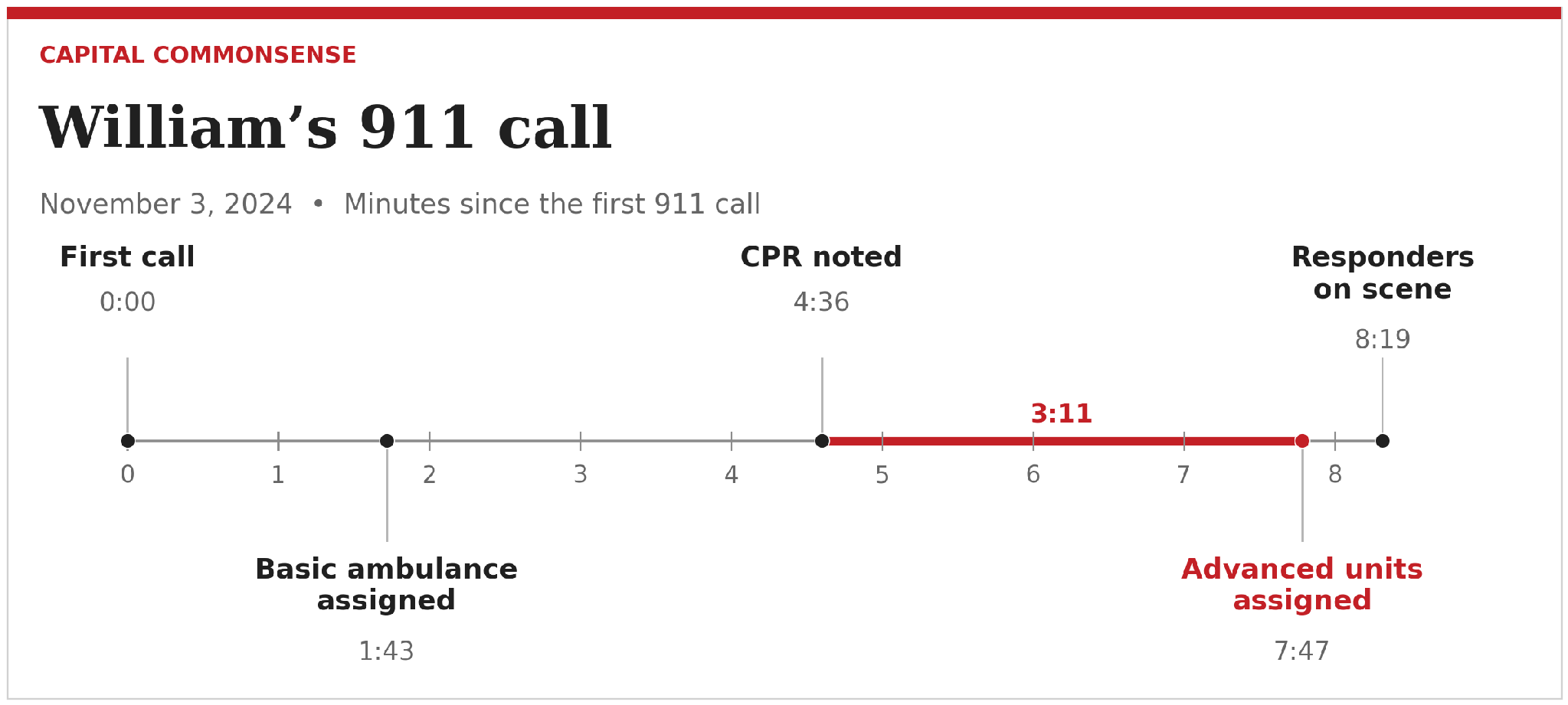
Figure 3. William’s call: 3 minutes 11 seconds passed between the first CPR note and assignment of advanced life-support units. Source: Dave Statter’s reconstruction of dispatch and medical records.
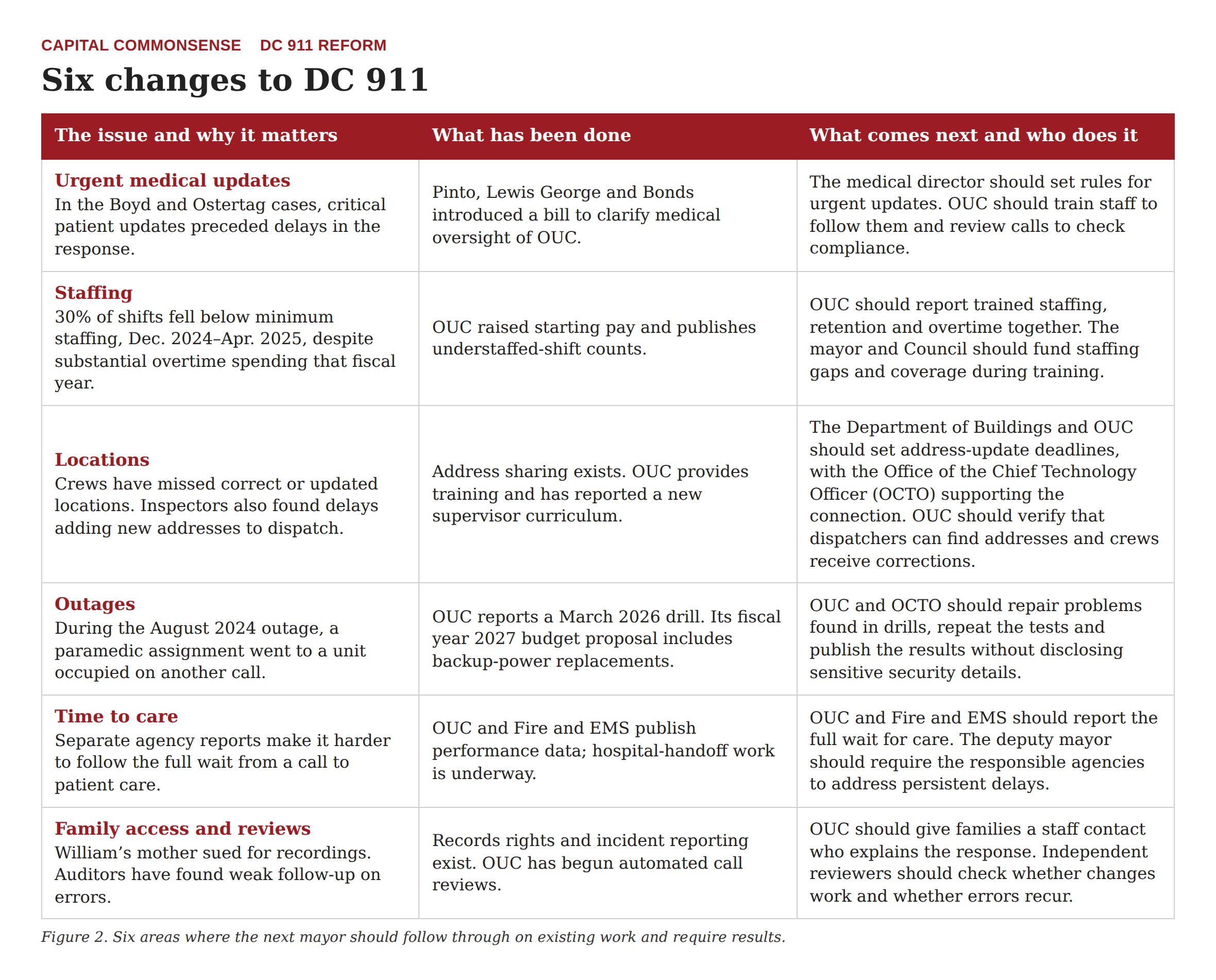
Brooke Pinto, Janeese Lewis George and Anita Bonds introduced B26-0599 in February 2026 to make the Fire and EMS medical director’s authority over OUC’s clinical decisions explicit. I support that proposal. To carry it out, OUC needs clear instructions for reassessing a patient whose condition has worsened and for getting a supervisor involved when dispatch stalls. The medical director should review actual calls to see whether staff followed those instructions and whether the patient received the appropriate response. That is how the mayor and Council should judge the change.
Austin provides medical oversight across its emergency system. King County links the initial dispatch code to the patient’s eventual disposition, helping reviewers judge whether the response matched the need. OUC and the Fire and EMS medical director should make that comparison for D.C. calls and use the findings to revise training and dispatch instructions.
Singapore’s emergency service describes a cautious response when uncertainty remains, including sending an ambulance for assessment. That practice does not establish that Singapore’s entire system performs better, but it gives D.C. a specific policy to examine. The medical director should define when uncertainty warrants sending a crew and review those calls for missed emergencies and unnecessary dispatches. Call takers need clear instructions for protecting a patient when the person on the phone cannot fully explain what is wrong. A caller should not need the vocabulary of a doctor to get a response that could save a life.
2. Keeping enough trained people on each shift
The D.C. Auditor found that dispatchers averaged ten additional 40-hour weeks of overtime in fiscal year 2025; call takers averaged seven. OUC spent $3.8 million on overtime. Separately, the Inspector General found that 30 percent of scheduled shifts fell below minimum staffing between December 2024 and April 2025.
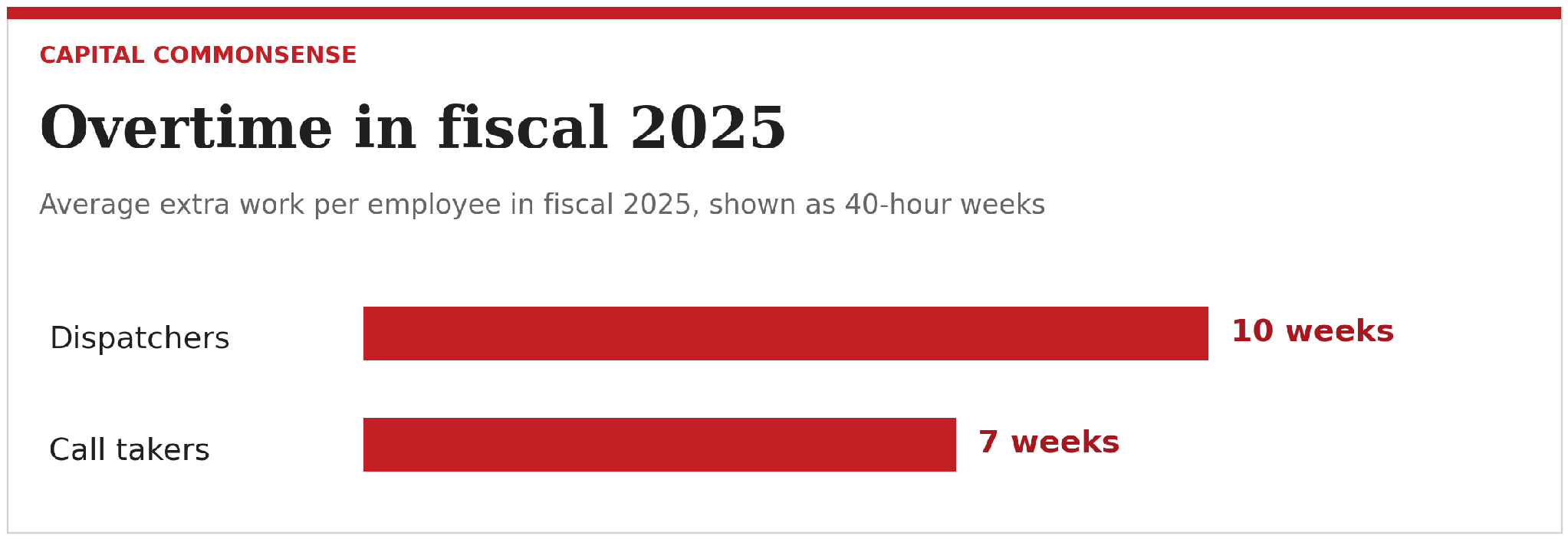
Figure 4. In fiscal 2025, dispatchers averaged the equivalent of ten extra 40-hour weeks of work; call takers averaged seven. Source: D.C. Auditor, July 2026.
That $3.8 million is a cost to taxpayers for work beyond employees’ regular schedules. Overtime can keep an essential position covered, but it is an expensive way to meet routine staffing needs. The inspection’s finding of understaffed shifts during part of the same fiscal year shows why spending alone is not enough. These reports do not establish that overtime caused dispatch failures or that outcomes worsened over time. They do show a city paying for extra hours while struggling to provide consistent coverage. The National Institute for Occupational Safety and Health warns that fatigue can impair attention and judgment, abilities a call taker needs throughout every shift.
The auditor’s payroll analysis estimated that one dispatch seat staffed around the clock requires roughly six employees, using fiscal 2025 regular hours. The analysis lacked training-hour data. OUC’s staffing plan must cover time spent in training and on leave, and allow for the months recruits need before working independently. The city should not build a life-or-death service around how many extra hours its employees can endure.
OUC’s public dashboard already reports shifts below target staffing. Add the number of qualified call takers, dispatchers and supervisors available for those shifts, alongside overtime and retention. Separate vacancies from approved leave and unexcused absences so managers can explain the shortages. The mayor and Council should fund the positions needed to cover the work, including time spent in training. Residents paying for that staff should be able to see whether each shift has enough people who can do the job.
Other cities offer options worth testing. Portland describes a common four-day, ten-hour schedule, protects scheduled days off from mandatory work, limits required workdays to twelve hours and pays full-time training coaches a 16 percent premium. Cincinnati describes paid training, peer support and career paths; Austin offers shift differentials and experience pay. These policies do not prove better retention, and OUC already has recruitment, training and wellness programs. The useful comparison is whether different schedules, protected time off or trainer incentives would help D.C. keep qualified staff.
OUC’s April budget testimony reported higher starting call-taker pay of $61,313 and a career ladder. The new director should find out why experienced employees leave and where applicants drop out, then work with employees and their representatives on changes that address those reasons. Track how many recruits finish training and remain a year later. Compare those results with shift coverage and overtime to see whether the higher pay is helping OUC keep enough trained staff.
3. Getting crews to the right location
On June 5, 2020, thirteen-year-old Maria called after her mother, Sheila Shepperd, collapsed. She repeated the Oglethorpe Street Northeast address three times. Help went to Northwest. WJLA reported a 21-minute wait for an ambulance. Sheila died.
Maria wondered whether she had given the wrong address. The recording eventually confirmed that she had supplied it correctly. A child who gives 911 the right address has done her part; the adults running the system must do theirs.
David Griffin drowned in the Washington Channel in March 2022 while paramedics awaited police assistance. The Metropolitan Police Department confirmed that officers had not received an updated location. He had ten children. His case shows why dispatchers need confirmation that a crew received a corrected location.
OUC already trains its staff and reported a new supervisor curriculum in its April response to the Inspector General. Cases like these should be part of that training. Have supervisors work through conflicting locations and unacknowledged assignments, including calls from people who need interpreters, have hearing disabilities or cannot identify their location. When someone misses a critical step, provide further coaching and repeat the exercise. Attending a class should not be enough to establish that a supervisor can handle the call.
Address information already passes between Buildings and OUC, but the Inspector General found delays and called for better coordination. The two agencies should agree on how quickly a new address must appear in dispatch, with OCTO supporting the connection. OUC should track late updates and check that dispatchers can retrieve the addresses before an emergency occurs. During a response, dispatchers also need confirmation that crews received any corrected location. Both steps matter if help is to reach the person who called.
4. Dispatching through an outage
During an August 2, 2024 dispatch-system outage, a five-month-old boy died. Statter’s review of radio traffic found EMTs already treating him while the assigned paramedic unit remained occupied on another call. Roughly eleven minutes passed before discovery of the dispatch problem; paramedics arrived nearly 25 minutes after the initial call. The reporting does not establish whether earlier paramedic care would have saved him.
A parent performing CPR cannot wait for the city’s computers to come back online. An outage drill should recreate those conditions: the computer system fails, the assigned unit cannot respond and dispatch receives no acknowledgment. Staff should practice detecting the missed assignment and sending another crew while keeping track of urgent updates.
D.C. law already requires annual continuity exercises and after-action reviews. OUC reported an agency-wide exercise in March 2026; its fiscal year 2027 budget proposal also includes backup-power replacements. OUC and OCTO should publish the problems found in the exercise and the results of retesting after repairs, withholding sensitive security details. Before new software goes live, test it with dispatch staff and give a named official authority to delay installation if it fails. Residents need to know that the people taking their calls can keep working through an outage.
5. Measuring the wait for care
These accounts leave a question the city’s data should help answer: how often do calls go wrong? Individual cases cannot establish an error rate or tell us how D.C. compares with other cities. Residents need consistent measures to judge whether OUC has improved, including how long patients wait after someone answers the phone.
OUC already publishes call-answer and dispatch measures; Fire and EMS reports response times and patient outcomes. The agencies should bring those reports together so residents can follow the time from the first call to patient contact. Use the same definitions, separate calls by urgency and report long waits as well as typical ones. Where delays persist, the deputy mayor should identify the responsible agency and require it to explain what it is doing to shorten them. A call answered quickly can still leave someone waiting too long for care.
Chief John Donnelly’s February testimony said Fire and EMS was already working with DC Health, the hospital association and hospital leaders to reduce patient offload delays. The next mayor should ask those partners to set targets and report how long crews spend waiting to transfer patients. Progress would mean ambulances returning to service sooner, available for the next emergency.
London’s Clinical Hub offers a comparison for assessing patients and arranging care. D.C. already has its own Nurse Triage Line and Right Care Right Now services, with activity reporting. The administration should use available follow-up records to check whether referred patients received care and whether failed transfers led them to call 911 again, then publish the findings. A referral should get someone to treatment. Counting fewer ambulance trips does not tell us whether that happened.
6. Answers for families and follow-up on failures
The 2023 follow-up found uneven progress on the 2021 audit’s 31 recommendations. The Inspector General’s 2026 report also provides for follow-up. The next administration should put unfinished recommendations in one public record, crediting who raised them and naming the official responsible for each. Include deadlines and the results of any checks. If a revised procedure has not yet been tested, say so. Residents should be able to find out what happened to a recommendation without reading years of reports.
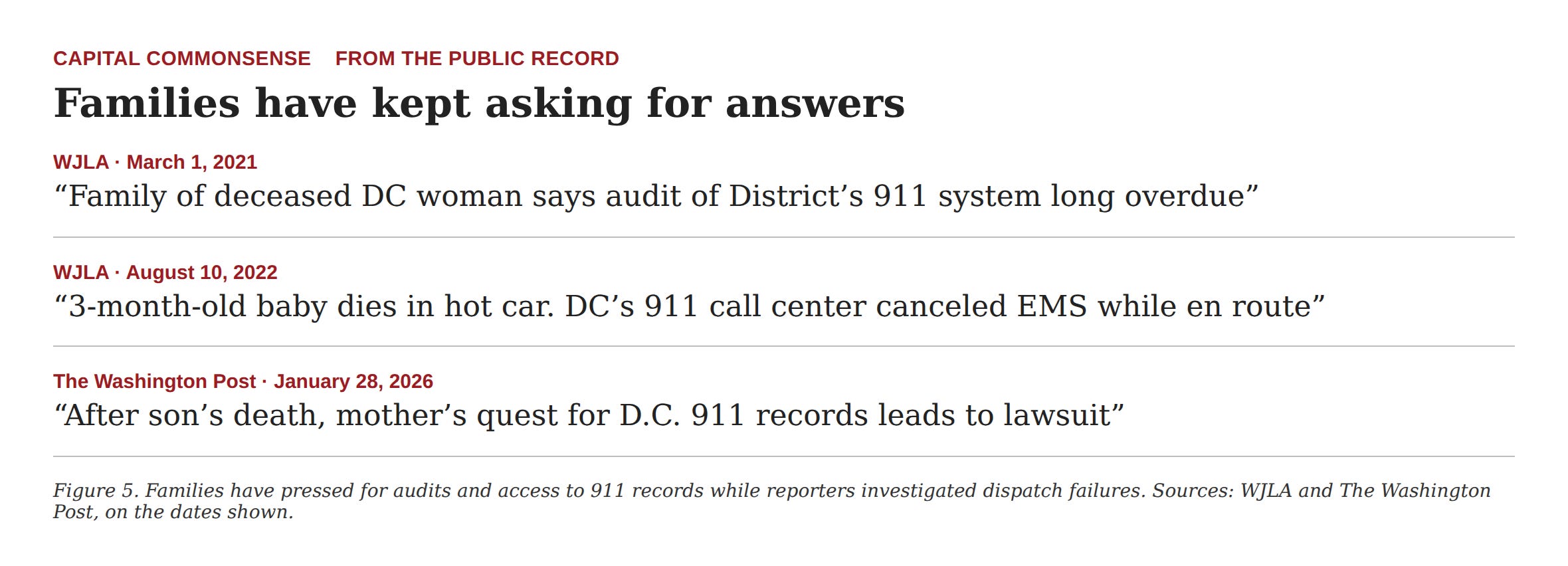
OUC’s April testimony said it fulfilled all agency-held records requests within legislated timeframes. Stephanie Clemans’s lawsuit concerned access to her son’s recordings. The published accounts do not establish that the testimony covers the same requests or period. OUC should report how long requests take and how often families receive the recordings they sought.
No parent should have to hire a lawyer to learn what happened after they called 911 for their child. D.C.’s records law already sets response deadlines, requires reasons for denial and provides recourse. OUC should honor those rights and give each family a staff contact who can explain the response and follow up on missing records. Report how long that takes, while protecting private information. A request may be closed in the agency’s records while a family still has questions no one has answered.
The D.C. Auditor recommended de-identified after-action reports within ten days in 2023. Pinto’s 2024 transparency proposal separately sought reports within 45 days after responses involving serious injury or death. OUC’s dashboard already lists reviewed concerns, causes and corrective actions. I would use the auditor’s ten-day deadline for an initial public account, stating what is known, what remains unanswered and when the review will be complete. The final report should name who will correct each failure and explain how an independent reviewer will check the work.
OUC says it began automated call reviews in December 2025. The Inspector General has also called for better analysis of recurring problems. Independent human reviewers should check a sample of calls against the software’s findings and report the errors it missed. OUC should then examine later calls to see whether employees repeated those mistakes after retraining. That would tell managers where the software helps and where they still need closer supervision.
Council members have pushed for change. Brooke Pinto advanced public reporting requirements and proposed greater disclosure after serious response errors. Christina Henderson tackled the staffing shortage through legislation allowing retired first responders to work at OUC without losing their pensions. Brianne Nadeau proposed restructuring emergency response and demanded more data, while Charles Allen’s committee examined stalled reforms in 2022.
Those efforts deserve credit, but more must be done. Council members should ask which fixes are overdue and examine the records behind OUC’s claims of improvement. It should not take another death to get their attention.
The first six months
In the first month, the mayor should appoint interim leadership and review the work already underway. Keep programs that are working. For unfinished recommendations, name the official responsible and set a deadline. Where OUC says a problem is fixed, have an independent reviewer check the records and test the procedure.
By day 90, publish the remaining work, what it will cost and any funding or legislation it needs. Use existing reports to establish the starting figures for later comparisons. Staffing and clinical supervision should come before optional technology pilots. Council can question missed deadlines in its existing hearings, with auditors checking the agency’s progress through follow-up reviews.
At six months, report what has changed. Explain any repeated errors and what remains unfinished. The deputy mayor should review progress monthly and resolve urgent disputes between agencies as they arise. Make those results available to residents so we can judge whether the administration is doing what it promised.
Any of us could need 911, whatever our income, neighborhood, background or politics. Neighborhood groups can put overdue recommendations on their agendas, and residents can press Council members for answers at oversight hearings. Acknowledge improvements; ask for an explanation when a deadline passes. Families who have spent years seeking answers should have the rest of us beside them.
I believe our grassroots, volunteer-led campaign helped keep basic city services in the public debate. Janeese Lewis George had pledged 911 reform during her campaign. My community joined Council members, auditors, reporters and families who had been pressing for change. Her administration now has to follow through, and those of us who raised this during the campaign should keep asking about it after the election.
Janeese Lewis George should start with 911. Hire an experienced director, provide the staff and authority the job requires, and check the results. D.C. residents already pay for this service. When someone calls because their child is choking or their parent has collapsed, they need the city to send the right help to the right place. Residents deserve evidence that help will arrive when they need it. No family should have to discover the next failure in the middle of an emergency.