

Rini Sampath is a former Democratic candidate for Washington, D.C. Mayor
D.C. stands on the edge of its first mayoral transition in 12 years. The presumptive mayor, Janeese Lewis George, will inherit an opportunity to change how District government operates and an obligation to restore public trust.
My own experience running for office, and the vast amount of information I uncovered along the way, has convinced me the next mayor’s first major ethics test will be the people she appoints to run the government and the actions she takes to rid D.C. of its existing corruption culture.
Agency directors and senior political appointees make decisions that shape nearly every part of life in the District. They oversee contracts, grants, licensing, development, housing, public safety, education, and billions of dollars in public resources. Their judgment determines whether residents receive competent service and whether taxpayers can trust the government acting in their name.
That is why this transition must do more than replace one group of insiders with another. Lewis George must choose capable, ethical leaders and build systems that expose conflicts, track performance, protect public money, and impose consequences regardless of status or connections. Washingtonians should not have to trust that this administration will govern differently. They should be able to see that it does.
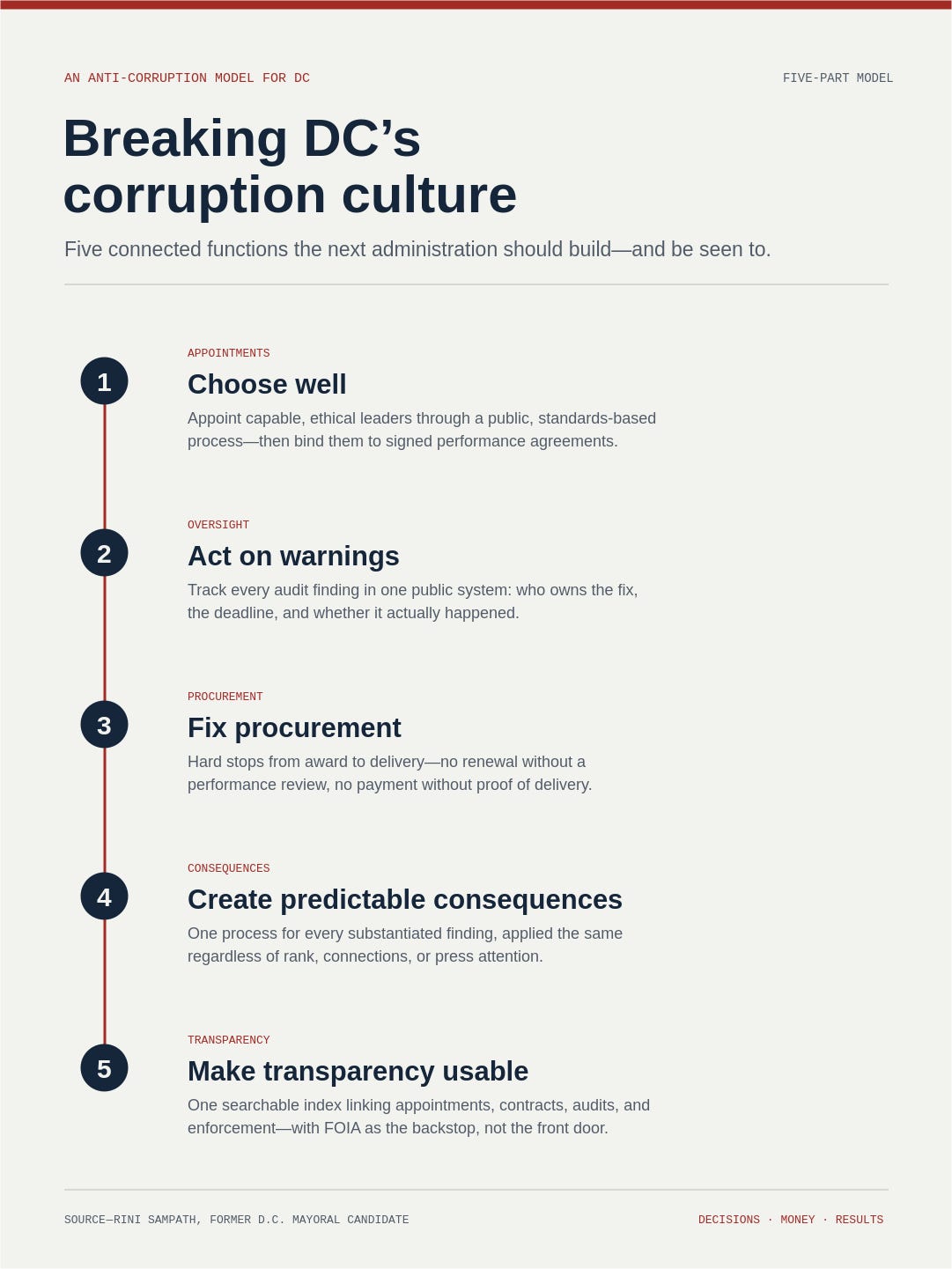
Corruption is a Systems Problem
Corruption has accompanied the government for as long as people have held public power. American politics provides plenty of examples, from Teapot Dome and Watergate to bribery schemes involving state legislators, regulators, and government contractors. D.C. has lived with its own versions for decades. The scandals have changed names and agencies, but the patterns remain familiar: political relationships crossing into government business, contracts influenced by personal interests, officials using public positions for private gain, and oversight arriving only after journalists or prosecutors expose the damage. The history stretches from contracting scandals during the Barry era to the ethics violations that drove former Councilmember Jack Evans from office and recent bribery cases inside District agencies.
Not every ethics violation carries the same moral weight. But they share a common mechanism: someone separates public authority from public accountability. A favor in a contracting office can produce a defective building, an ineffective public-safety program, an unqualified service provider, or a government agency that fails when residents need it most. This matters.
What Denmark and Singapore Can Teach our City
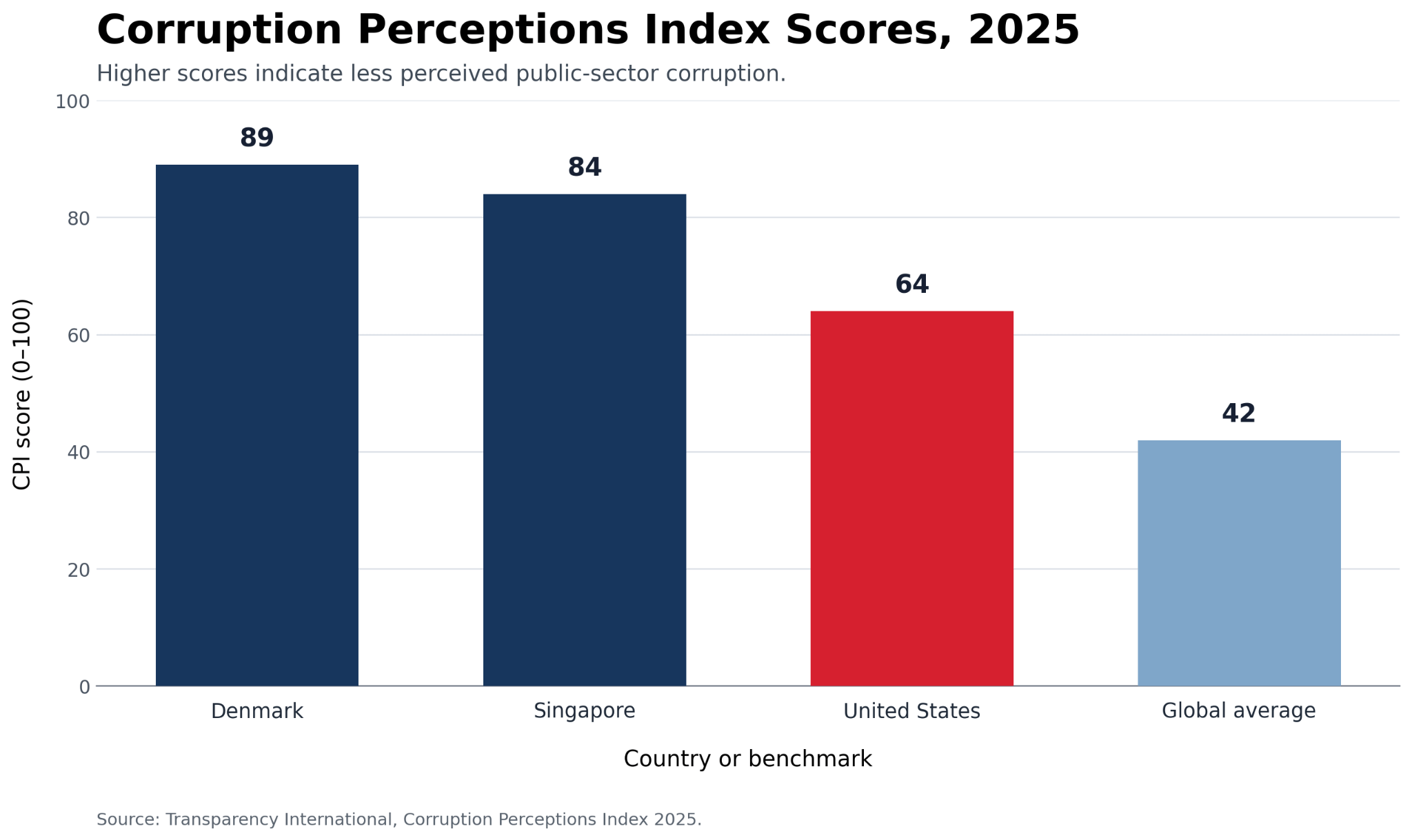
Denmark and Singapore offer two distinct approaches to limiting public corruption. Denmark scored 89 on the 2025 CPI, ranking first among 182 countries and territories. Singapore scored 84, ranking third. Their records demonstrate that no single anti-corruption model guarantees success, but effective systems consistently make misconduct easier to detect and harder to escape.
Transparently, ha!, I should disclose a bias: I spent three years of my life in Singapore. Granted, they were my toddler years, but I retain a particular affinity for the country and the way it conducts public business (minus its draconian tendencies).
Singapore often approaches the government like a corporation. It recruits highly credentialed officials, pays them competitively, measures their performance, and imposes serious consequences when they violate the public trust. The compensation benchmark for an entry-level minister totals approximately S$1.1 million annually, while the prime minister’s package totals approximately S$2.2 million. Portions of that compensation depend on individual performance and national economic outcomes. The theory remains straightforward: pay enough to attract capable leaders, then demand unusually high standards of conduct from them.
High salaries alone cannot explain Singapore’s record. Its Corrupt Practices Investigation Bureau built a reputation for pursuing corruption regardless of an offender’s rank or political affiliation. Singaporean law allows substantial fines, imprisonment, and the forfeiture of illicit gains. In 2024, former Transport Minister S. Iswaran pleaded guilty to obtaining valuable gifts while serving as a public official and obstructing justice. A court sentenced him to 12 months in prison.
D.C. should not copy Singapore wholesale. Its political system concentrates power and limits forms of political expression, assembly, and opposition that Washingtonians rightly consider fundamental. Freedom House classifies Singapore as “Partly Free.” Rigorous enforcement cannot justify sacrificing democratic rights or due process.
Denmark provides a useful democratic counterpoint. Its approach places greater emphasis on openness, access to government records, independent review, and administrative institutions that make official decisions visible to the public. Denmark’s Access to Public Administration Files Act establishes public access to government records, while the independent Parliamentary Ombudsman helps enforce those obligations and investigate administrative failures. Denmark’s own Ombudsman has called access to public files a cornerstone of an open society.
Neither country offers a perfect template, and the CPI measures perceptions rather than every act of misconduct. But, Denmark and Singapore illustrate the balance DC needs. Singapore demonstrates the importance of clear rules, credible investigations, and consequences that reach powerful people. Denmark demonstrates the value of transparency, independent scrutiny, and institutions that allow the public to see how authority gets exercised.
Weak Accountability Costs the Taxpayer
The costs already surround us.
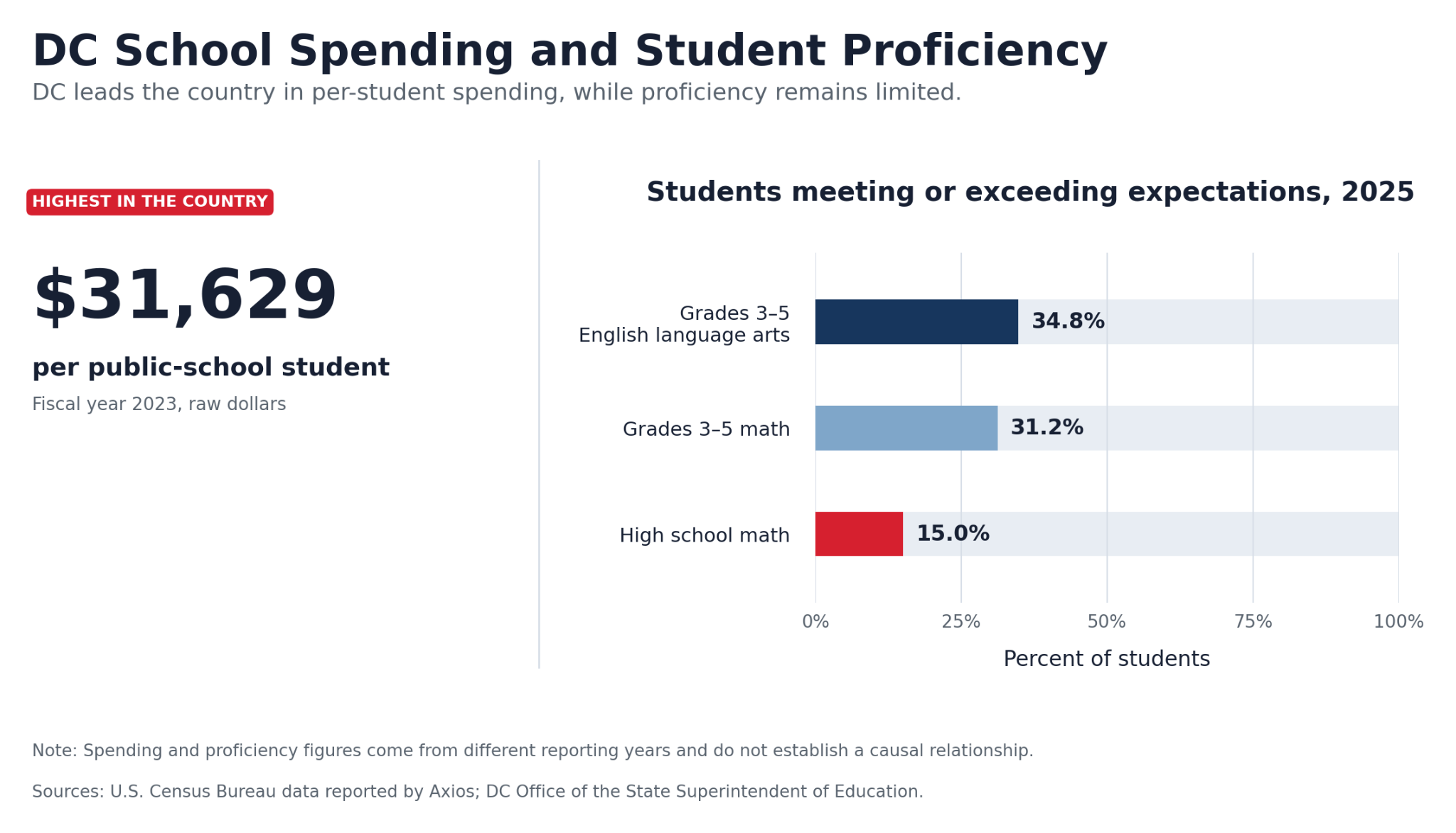
In fiscal year 2023, D.C. led the country in public-school spending at $31,629 per student, measured in raw dollars. Yet despite recent gains, student outcomes remain nowhere near what that level of investment should produce. In 2025, only 34.8 percent of students in grades three through five met or exceeded expectations in English language arts. Only 31.2 percent met that standard in math. Among high school students, just 15 percent met or exceeded math expectations.
During this same period, a federal jury convicted former D.C. Public Schools contract specialist Dana Garnett for participating in a bribery and wire-fraud conspiracy. Prosecutors proved that she steered DCPS business to favored vendors, accepted kickbacks for years, and allowed vendors to deliver significantly fewer supplies than the school system had purchased. A judge later sentenced her to 24 months in prison.
That conviction does not explain the District’s overall education outcomes. It does illustrate how weak controls can drain a system that already spends heavily. Money approved for students loses its value when an employee can redirect contracts, accept incomplete deliveries, and collect payments from vendors without intervention.
The 2026 snowstorm provides another example. D.C. spent more than $67 million on cleanup. Approximately $4.5 million went to District Logistics, a trucking company whose owner had faced a federal indictment since November 2025 for allegedly defrauding the federal government of approximately $1.35 million in pandemic-relief funds. District procurement officials reportedly did not learn about the indictment until April, months after the storm.
The episode raises an obvious question: How did the District direct millions of emergency dollars to a company without detecting that its owner already faced federal fraud charges?
Both cases expose the same structural weakness. The government checks whether someone signed a form, but not always whether the vendor delivered, the official disclosed a relationship, the agency resolved a warning, or the public received value.
An Anti-Corruption Model for D.C.
Any reform agenda begins with the people entrusted to carry it out. Agency leaders translate a mayor’s promises into staffing decisions, contracts, regulations, and public services.
During the campaign, Janeese Lewis George emphasized the importance of hiring capable people who can deliver results. Her administration now has an opportunity to prove that coalition representation and administrative competence do not have to compete.
The next administration should organize its anti-corruption work around four commitments: making auditors matter, fixing procurement, creating predictable consequences, and making transparency the default. These reforms can prevent misconduct, catch it earlier, and produce a meaningful response before the public absorbs the cost.
1. Act on Warnings: Make Auditors Matter
Effective governments need a disciplined way to identify failure before it hardens into routine practice. Auditors examine evidence across agencies and administrations, compare performance against laws and professional standards, identify the causes behind recurring problems, and recommend corrective action. They provide something political transitions often lack: an institutional memory of what went wrong, why it went wrong, and how the government can prevent it from happening again.
D.C. does not need another oversight office or audit-tracking program. It already has talented auditors and much of the necessary infrastructure. The Office of the Inspector General, the Office of the D.C. Auditor, agency inspectors general, and Council staff regularly uncover waste, control failures, legal violations, and programs that cannot demonstrate results. The Office of Risk Management already maintains ERisk, a District-wide portal through which agencies manage, track, and respond to findings from the Inspector General, DC Auditor, and external auditors. The OIG and D.C. Auditor also publish reports tracking the status of their recommendations.
The District’s problem stems from what happens after auditors identify a problem. The current system scatters public information across reports, spreadsheets, agency responses, and Council records. Residents cannot easily follow a finding from publication through correction, identify the senior official responsible for fixing it, or determine why an agency missed a deadline. The government tracks recommendations internally, but the public lacks one clear view of whether leaders acted.
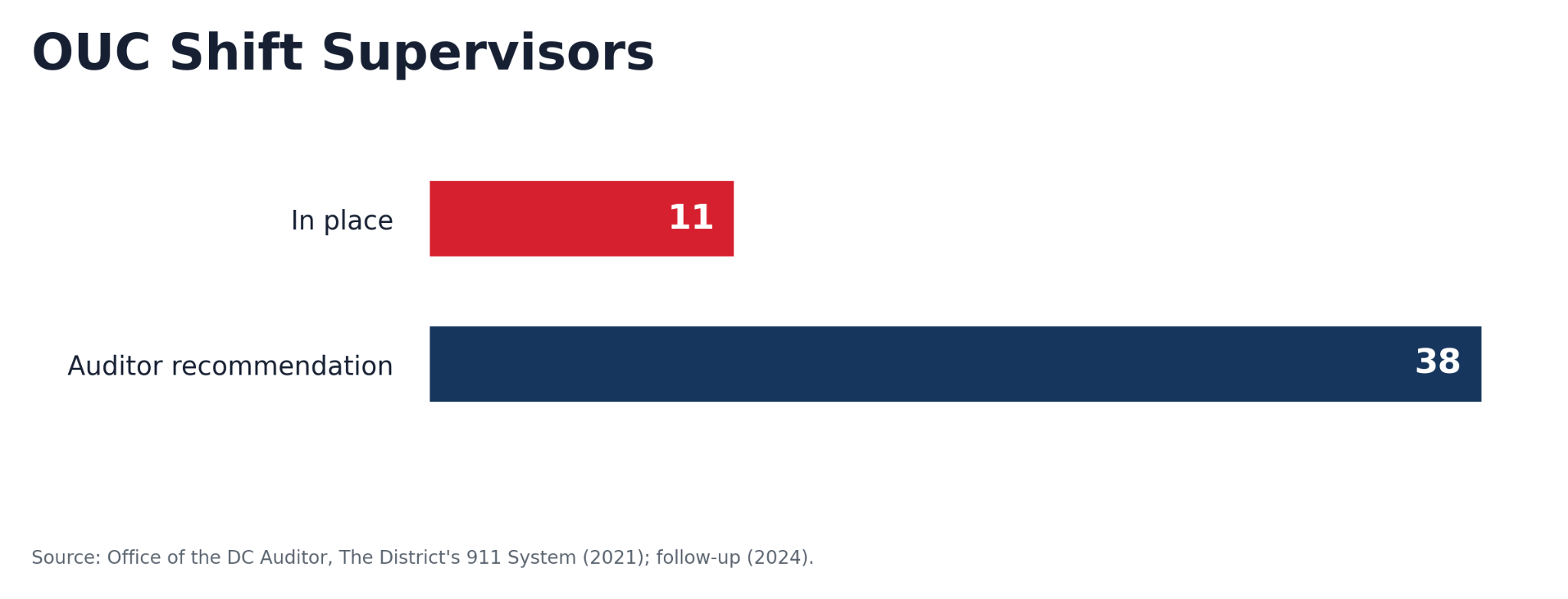
In 2021, the D.C. Auditor found that the Office of Unified Communications failed to meet national standards for timely assistance on top-priority fire and emergency medical calls during most of the 24 months reviewed. Auditors cited inadequate supervision and weak quality assurance and recommended increasing the number of shift supervisors from 11 to 38. Significant staffing increases did not begin until 2023. For a resident waiting for an ambulance, delayed implementation does not represent an administrative abstraction. It can determine whether help arrives in time. As I routinely described during the campaign trail, a member of my community, William Ostertag, died of cardiac arrest because DC 911 coded his call incorrectly. Our corruption culture is deadly.
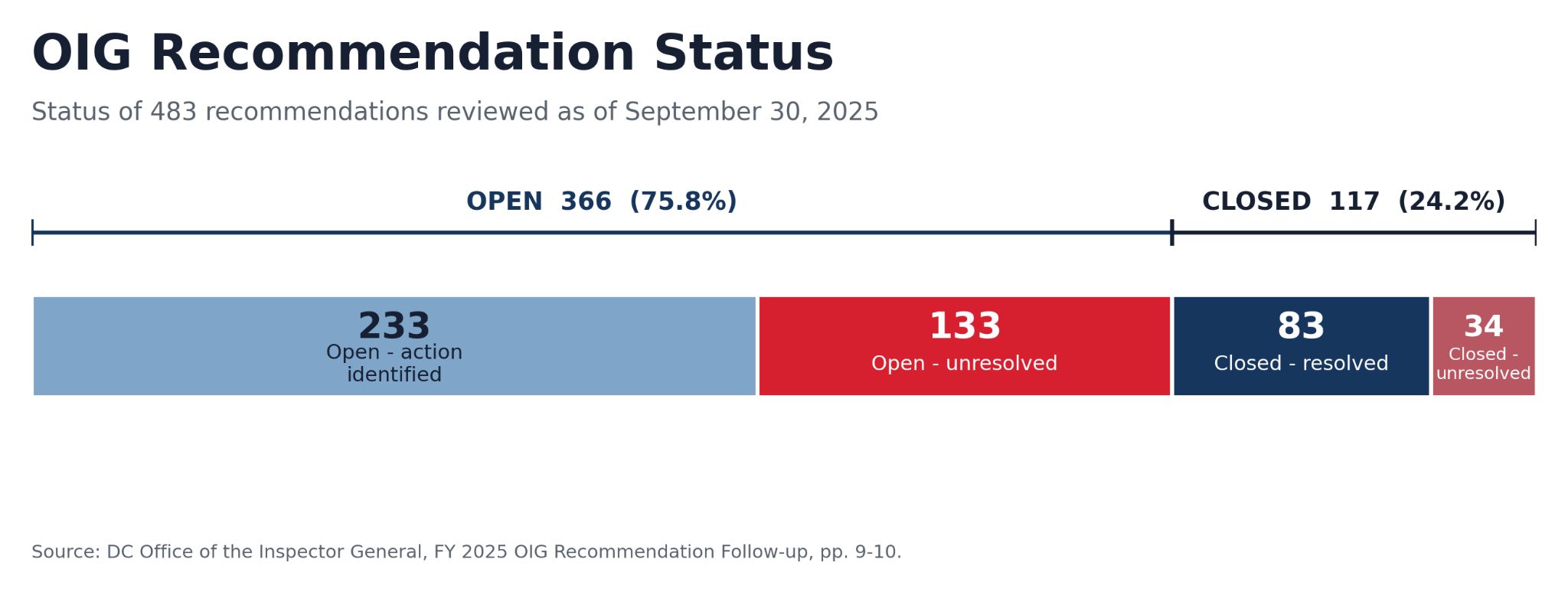
The broader numbers reveal the scale of the follow-through problem. As of September 30, 2025, the Inspector General had reviewed 483 recommendations across 66 reports involving 41 agencies. Of those, 366 remained open, including 133 for which agencies had not agreed upon an adequate corrective action. Of the 117 recommendations closed during the year, 34 closed without resolution. In some cases, circumstances had overtaken the recommendation. In others, an agency declined to implement stronger controls and accepted the accompanying risk.
The Lewis George administration should build on what D.C. already has. Rather than launch another program, it should create a public-facing interface for the District’s existing audit-management system. That interface should consolidate recommendations from the Inspector General, D.C. Auditor, and other oversight bodies. For each recommendation, residents should see the finding, the responsible agency, the senior official who owns the corrective action, the promised deadline, the evidence required to demonstrate completion, the current status, and the reason for any delay.
Agencies already respond to draft D.C. Auditor reports within 15 business days by stating whether they agree or disagree with each recommendation. The next administration should take the next step: within 90 days after a final report, the responsible agency should publish a corrective-action plan or explain why it will pursue another course. Agencies should then update their progress quarterly through the public interface.
D.C. also already has a forum for executive follow-through. The Office of the City Administrator conducts CapSTAT sessions and quarterly cluster meetings to review agency performance, budgets, and operational challenges. Unresolved audit findings should become a standing agenda item in those meetings, not the subject of a new board or bureaucracy. The mayor and city administrator should require agency directors to explain overdue corrective actions and incorporate those results into existing performance plans and evaluations.
Of course, elected officials should not treat every auditor recommendation as an unquestionable command. Agencies may identify legal, financial, or operational reasons to choose another solution. But disagreement cannot excuse silence. When an administration rejects a recommendation, it should explain its reasoning publicly, identify an alternative corrective action, and disclose the risk it has chosen to accept.
D.C. already pays people to find its weaknesses, maintains a system to track them, and convenes leaders to review agency performance. The next mayor does not need to build something new. She needs to make the government use what it already has and let residents see whether it works.
2. Fix Procurement from Award Through Delivery
D.C. can budget money for school supplies, behavioral-health programs, road repairs, affordable housing, or emergency response, but residents receive value only when a qualified vendor performs the work. A contract award authorizes spending. It does not guarantee results.
D.C. does not lack procurement rules, personnel, or technology. District law already requires competition, documentation, Council review of certain large contracts, and public disclosure. The Office of Contracting and Procurement already operates an electronic procurement system, a public contracting portal, an integrity and compliance office, and the Contractor Performance Evaluation System, or CPES. District law also requires agencies to consider past performance when evaluating proposals and protects new vendors from receiving a negative rating simply because they lack a government contracting history.
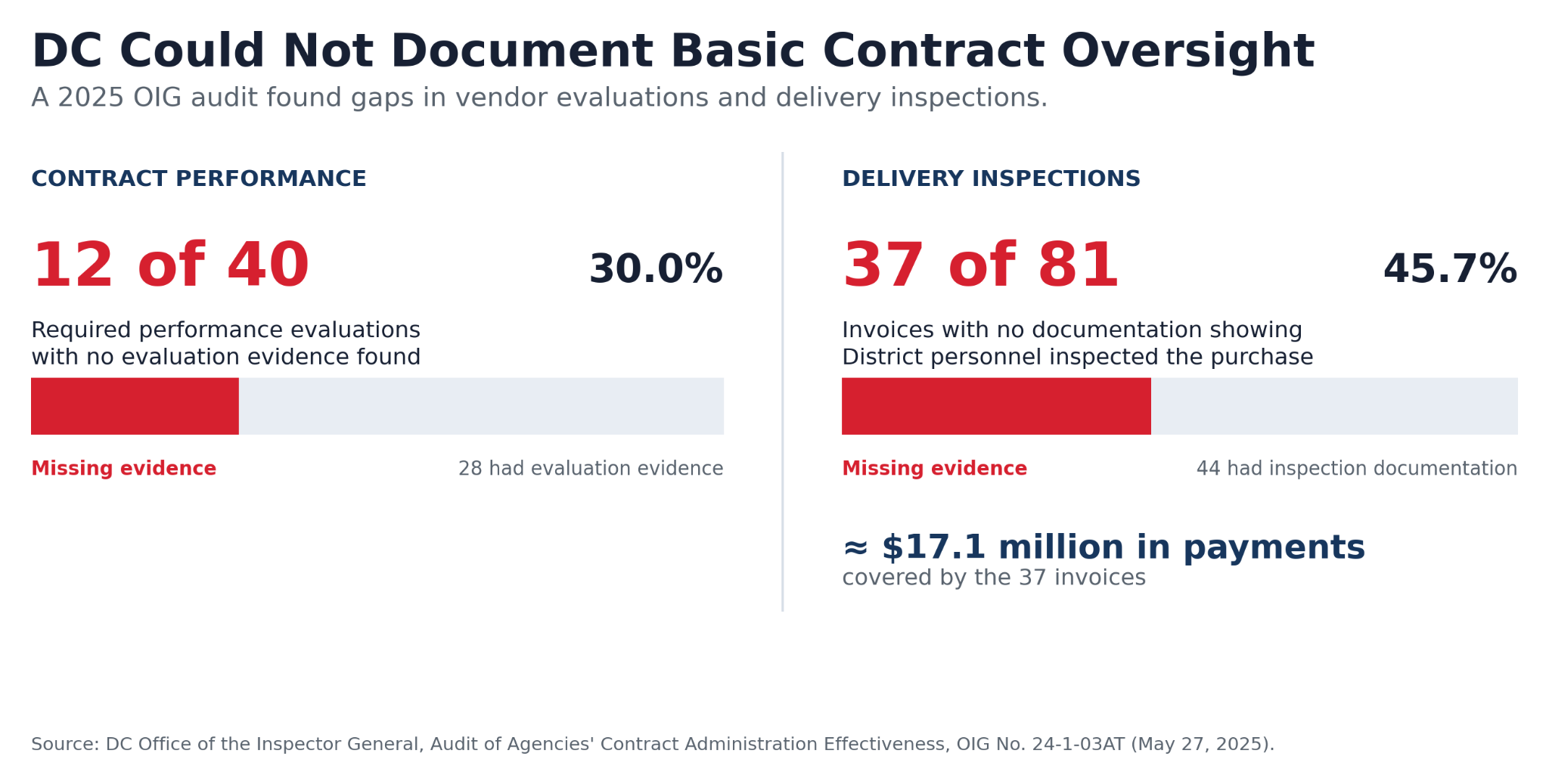
The problem begins when agencies fail to use those controls and the systems allow contracting actions to proceed anyway. In 2025, the Inspector General reviewed 40 contracts that required performance evaluations and found no evidence of an evaluation for 12. Auditors also examined 81 invoices and found that 37, covering approximately $17.1 million in payments, lacked documentation showing that District personnel had inspected what the government purchased. Those failures exposed the District to poor performance, inflated invoices, and payments for incomplete or defective work.
D.C. created CPES to prevent that outcome. The system allows agencies to evaluate contractors on contracts worth at least $100,000, gives vendors an opportunity to respond, and preserves performance information for future awards and option decisions. Yet agencies do not consistently complete the evaluations, different procurement authorities use different systems, and contract administrators reported that CPES did not always send the expected evaluation notices.
The next administration should make those existing controls unavoidable. CPES and the District’s procurement system should block an option, renewal, extension, final closeout, or additional award to an existing contractor until the responsible agency completes the required evaluation. Agencies should evaluate covered contractors before each option or renewal, at final completion, and at least annually during longer multiyear contracts. OCP should also collect evaluations from DGS and other procurement authorities in one searchable government repository. When the District selects a contractor with a documented record of poor performance, officials should publicly explain why that vendor still offers the best value.
D.C. also needs stronger safeguards against an official steering the initial award. District law already requires requests for proposals to publish their evaluation criteria and relative weights. OCP already uses technical evaluation panels for some major procurements, with members scoring proposals individually before producing a consensus report for the contracting officer. District law also restricts communications intended to influence a source selection outside the authorized process.
The next mayor should standardize those protections for substantial, complex, and high-risk contracts. Panelists should record and electronically lock their individual scores before discussing the proposals as a group, creating a record of any later change. Everyone who writes the requirements, evaluates a bid, recommends an award, or approves the selection should complete a procurement-specific disclosure identifying personal, professional, and financial relationships with the bidders and their beneficial owners. The government can cross-check those disclosures against beneficial-ownership information that District businesses already file. Officials with conflicts should recuse themselves, and the contract file should document that decision.
Post-award controls need the same treatment. District rules already require personnel to receive, inspect, and accept goods and services before the government pays an invoice. Contracts worth more than $100,000 already receive a designated contract administrator responsible for monitoring performance, reviewing invoices, and recommending option exercises. The Inspector General’s findings demonstrate that policy alone does not ensure compliance. The procurement system should require inspection documentation and approval from the appropriate District employee before releasing payment. No individual should control the specifications, vendor evaluation, award, inspection, and payment.
The District should also use its existing data to identify contracts that deserve additional scrutiny. OCP’s Office of Procurement Integrity and Compliance already conducts audits, reviews procurement operations, and investigates fraud, waste, abuse, conflicts, and bribery. The administration should equip that office with automated alerts for repeated emergency awards, single-bid competitions, concentrated spending with one vendor, sharply divergent evaluator scores, split purchases, large post-award modifications, repeated extensions, and payments unsupported by inspection records. A warning would not prove misconduct, but it would trigger review before the District commits or releases additional money.
Transparency also requires enforcement and expansion, not another portal. DC law already directs the Contracts and Procurement Transparency Portal to publish executed contracts worth at least $100,000, solicitation documents, determinations and findings, amendments, modifications, and Council summaries. The next administration should enforce those requirements and add the missing performance information: final evaluation scorecards, award explanations, major deliverables, contractor evaluations, inspection records, and contract outcomes. Residents should not have to search across multiple systems or file a public-records request to determine whether a contractor delivered.
Emergency contracts already require written justification, as much competition as circumstances permit, and online disclosure within seven days. The administration should add a formal after-action review for major emergency awards, covering the price paid, vendor selected, work delivered, modifications made, and lessons learned. Urgency may justify a faster award. It should not excuse the government from reviewing the result.
None of these reforms requires a new procurement bureaucracy. D.C. already employs the people, operates the systems, and enforces many of the necessary rules on paper. The next mayor should connect those pieces and replace optional follow-through with hard stops: no renewal without a performance evaluation, no payment without proof of satisfactory delivery, and no high-risk award without documented scoring and conflict review.
3. Create Predictable Consequences
D.C. has penalties, but unfortunately lacks a reliable process for connecting a substantiated finding to every consequence the law authorizes. Existing law already gives the District substantial enforcement power. The Board of Ethics and Government Accountability can fine officials up to $5,000 per violation, censure them, and order corrective action. Officials who retaliate against whistleblowers can face discipline, dismissal, and civil fines. Most subordinate agency heads serve at the mayor’s pleasure. The Chief Procurement Officer can suspend or debar contractors for fraud, bribery, serious performance failures, and other conduct that undermines their responsibility. The False Claims Act allows the District to recover three times the damages caused by fraudulent claims.
The law also creates several referral requirements. An Inspector General or DC Auditor finding of waste, fraud, abuse, or a possible ethics violation can trigger a formal BEGA investigation. Prosecutors must notify the Chief Procurement Officer of certain contractor charges and convictions. The Office of Contracting and Procurement already publishes an Excluded Parties List.
What D.C. does not publish is one government-wide record showing whether every substantiated finding reached each office with authority to impose an additional consequence. During the second quarter of fiscal year 2026, BEGA reported that 55 of the 124 matters it closed fell outside its jurisdiction. That number demonstrates the information gap: the public cannot readily determine whether those matters reached another authority or what happened after they left BEGA.
The next mayor should direct subordinate executive agencies to adopt a written consequences protocol and seek an interagency agreement with BEGA, the Office of the Attorney General, the Inspector General, the D.C. Auditor, and the Chief Procurement Officer. Because several of those officials and offices exercise independent or protected statutory authority, the protocol should govern referrals, acknowledgments, and reporting—not dictate investigative or enforcement outcomes. BEGA operates as an independent agency, and the Chief Procurement Officer serves a five-year term with removal only for cause. The Council should codify any government-wide deadlines that the mayor cannot establish through executive authority or interagency agreement.
The protocol should distinguish among three stages. Credible evidence should trigger a confidential referral to every office with relevant jurisdiction. A substantiated finding should require the responsible executive agency to prepare an action memorandum within 30 days identifying the available consequences, the action taken, and the reason for imposing or declining each one. A final disposition, after applicable appeals, should trigger a public summary consistent with personnel, investigative, and privacy laws. Agencies should retain authority to take lawful interim steps—such as restricting an official’s contracting authority or suspending a vendor—when necessary to protect public money while an investigation proceeds.
For political appointees, accountability must remain personal to the mayor. After a substantiated finding, the mayor should decide whether to restrict the appointee’s delegated authority, require a corrective performance plan, impose discipline where permitted, or remove the appointee. If the mayor retains an appointee after serious misconduct or repeated management failures, the administration should explain that decision publicly once the matter reaches final disposition. The performance agreements described earlier should identify these consequences before a failure occurs, so the administration does not invent a standard after learning who violated it.
A published enforcement matrix should guide those decisions without turning them into automatic punishment. It should distinguish negligent errors from intentional deception, isolated failures from repeated conduct, and technical violations from conduct that threatens public money, employee rights, or resident safety. Aggravating factors should include concealment, retaliation, personal enrichment, obstruction, repeated violations, and harm to the District. Mitigating factors should include prompt disclosure, cooperation, restitution, corrective action, and reliance on formal advice sought in good faith.
Contractor enforcement needs the same consistency. D.C. already requires contractors on contracts exceeding $100,000 to certify their responsibility, update that information within 60 days of a material change, and update it again before the government exercises an option year. The District should make explicit that contractors must disclose credible evidence of fraud, bribery, significant overbilling, concealed ownership, or serious performance failures connected to District work. A disclosure should then trigger a serious review. Failure to disclose, however, should weigh heavily in responsibility, termination, suspension, and debarment decisions. This would adapt the federal government’s credible-evidence disclosure rule to DC’s existing contractor-certification system.
D.C. should also borrow the principle of conditional release used by the World Bank and reflected in the European Union’s “self-cleaning” approach. A formerly debarred vendor seeking new public work should provide evidence that it repaid improperly obtained funds, cooperated with lawful investigations, removed responsible personnel where appropriate, and repaired the controls that allowed the misconduct.
Current D.C. law caps an ordinary debarment at five years. The administration can immediately require a fresh present-responsibility determination before awarding new work to a formerly debarred vendor and treat evidence of reform as central to that decision. If the Council wants to keep a vendor excluded beyond five years until it satisfies specific rehabilitation conditions, however, it must amend the procurement statute to authorize debarment with conditional release. Rehabilitation requirements should reflect the vendor’s size, role, conduct, and contract risk. A small business responsible for an isolated control failure might need targeted training and documented invoice controls. A large contractor involved in systemic fraud might need management changes, an independent compliance review, repayment, and continuing monitoring. The District should coordinate any cooperation or disclosure requirement with prosecutors so it does not interfere with an active case or demand public admissions before due process runs its course.
Finally, the administration should consolidate existing enforcement data into one public integrity scorecard rather than create another enforcement office or glossy report. The scorecard should track referrals, acknowledgments, processing times, final dispositions, disciplinary outcomes, debarments, recoveries, and the reasons for reinstating formerly debarred vendors. It should measure whether the system acted promptly and consistently.
Predictability means applying the same process regardless of an official’s political influence, a vendor’s connections, or the amount of press attention the matter receives. No one should gain protection from consequence simply because the government divided responsibility among several offices.
4. Make Transparency Usable
The District already operates an Open Data Catalog with downloadable datasets and APIs, a procurement portal covering contracts and payments, and a public FOIA system. But those tools do not guarantee complete or timely access. Independent procurement agencies still publish through separate systems. In 2025, the Inspector General found that DCPS had transmitted none of its contracts exceeding $100,000 to the central procurement portal during the period reviewed, including all 70 contracts worth more than $1 million. At the end of fiscal year 2024, more than 1,000 FOIA appeal decisions also remained overdue for publication, though officials cleared that backlog in January 2025.
The problem does not stem from a lack of transparency laws or websites. Agencies publish information unevenly, systems do not connect, and records often appear only after journalists or residents already know what to request and where to look.
Transparency changes that dynamic by affecting behavior both before and after misconduct. An official who knows the public can trace evaluation scores, conflicts, and contract amendments has less room to steer a decision. A vendor whose performance record follows it into future competitions has a stronger incentive to deliver. Connected records also help journalists, competitors, and auditors detect favoritism, overbilling, and ignored warnings before the District renews a contract or releases more money.
The next administration should enforce existing disclosure requirements and connect the systems D.C. already operates. One searchable index should link appointments, contracts, vendors, audit findings, corrective actions, and enforcement outcomes through common identifiers. Agencies should apply the District’s existing open-data standards to those records by providing searchable downloads, permanent links, and revision histories. FOIA should serve as a backstop, not the primary way the public discovers how officials exercised power.
Denmark demonstrates the value of this approach. Its transparency model combines public access, strong recordkeeping practices, and independent review by the Parliamentary Ombudsman. Those protections help journalists reconstruct decisions and test whether officials followed the law. D.C. can expand its oversight capacity in the same way: give journalists and residents usable records, let them identify warning signs earlier, and make it harder for the government to ignore what they uncover.
Closing Thoughts
It is hard to discuss government accountability in the Elon Musk era without alarming Washingtonians. During 2025, DC recorded 30,813 federal separations and only 8,457 new hires, while the city’s chief financial officer forecast that federal downsizing could eliminate 40,000 jobs over four years. The Lewis George administration should not answer cronyism with an indiscriminate purge.
Thousands of career public servants keep D.C. running through political transitions. They often know where the broken processes, ignored warnings, and bad contracts sit. Accountability should begin at the top and follow the evidence: remove appointees who misuse authority or cannot perform, protect whistleblowers, retrain or reassign employees whom broken systems have set up to fail, and use established procedures to address misconduct.
I read Janeese Lewis George’s decisive primary victory as a critique of 12 years of Bowser-era cronyism, insider access, and tolerance for poor performance. She won more than 54 percent of first-choice votes and carried seven of the District’s eight wards—a broad mandate for a different direction.
Her administration can swap out familiar names while preserving the same habits, or it can change the systems that allowed those habits to take hold. The real test will not simply be whom Lewis George appoints. It will be whether her administration makes auditors matter, protects public dollars, imposes consequences for failure, and gives residents the information they need to judge whether their government delivers.

As a former DCPS teacher, I have to ask: does anyone actually vet these vendor contracts?
My first year, I got 8 school-branded T-shirts — maybe 2 were ever necessary. Meanwhile, a $20 Starbucks gift card (something we’d actually use) apparently wasn’t in the budget. I used to joke that someone’s cousin or uncle must run a garment printing business.
Let’s do the math: $20/shirt × 80 teachers × 8 shirts = $12,800 per school. Multiply that across 20 schools and you’re at $256,000.
That’s a quarter million dollars that could’ve gone toward literally anything else — supplies, stipends, gift cards teachers actually wanted. Worth asking where that money really went, and who signed off on it.