

A few weeks ago, Ashley explained how the District collects its own-source revenue—its revenue from taxes, fees, and fines. In this post, I will walk you through the basics of our other major source of revenue: federal funding. Future posts will dive deeper into specific federal grant programs, pandemic-era federal aid, and the District’s handling of federal funding.
In some ways, when it comes to federal funding, D.C. is not fundamentally different from other state and local governments, if we think of those as consolidated entities. As with them, most of our federal funding is earmarked for healthcare spending, with income security, transportation, and education as other major functional categories.
In other respects, D.C.’s unique characteristics come to the forefront. Its Medicaid grant, the bulk of the healthcare category, is based on a matching rate set by statute rather than derived from the usual per-capita income formula. Much of the District’s transit funding flows to a regional joint venture. And its courts and prison are run directly by the federal government. These wrinkles make it particularly important to clarify what we mean by federal funding for the District.
One natural distinction is between funds that flow through D.C.’s books and funds that do not. Funds that flow through D.C.’s books are mostly federal grants in the ordinary sense: grants that exist because a federal statute created them and an agency appropriation funds them. These grants involve money distributed by federal agencies for programs the District administers just like any state or local government might. They amounted to $5.2 billion in FY2025. Medicaid (the largest grant by far, about 60 percent of the total), TANF, and Title I funding for K-12 schools are among the best-known grant programs.
There are two other types of federal funds that flow through D.C.’s books. DC-specific federal payments, appropriated in the D.C. Appropriations Act, include reimbursements for security costs associated with the federal presence and totaled $160 million. And the federal government pays pension benefits to retired District employees that are attributable to service before the 1997 Revitalization Act, just over $680 million.
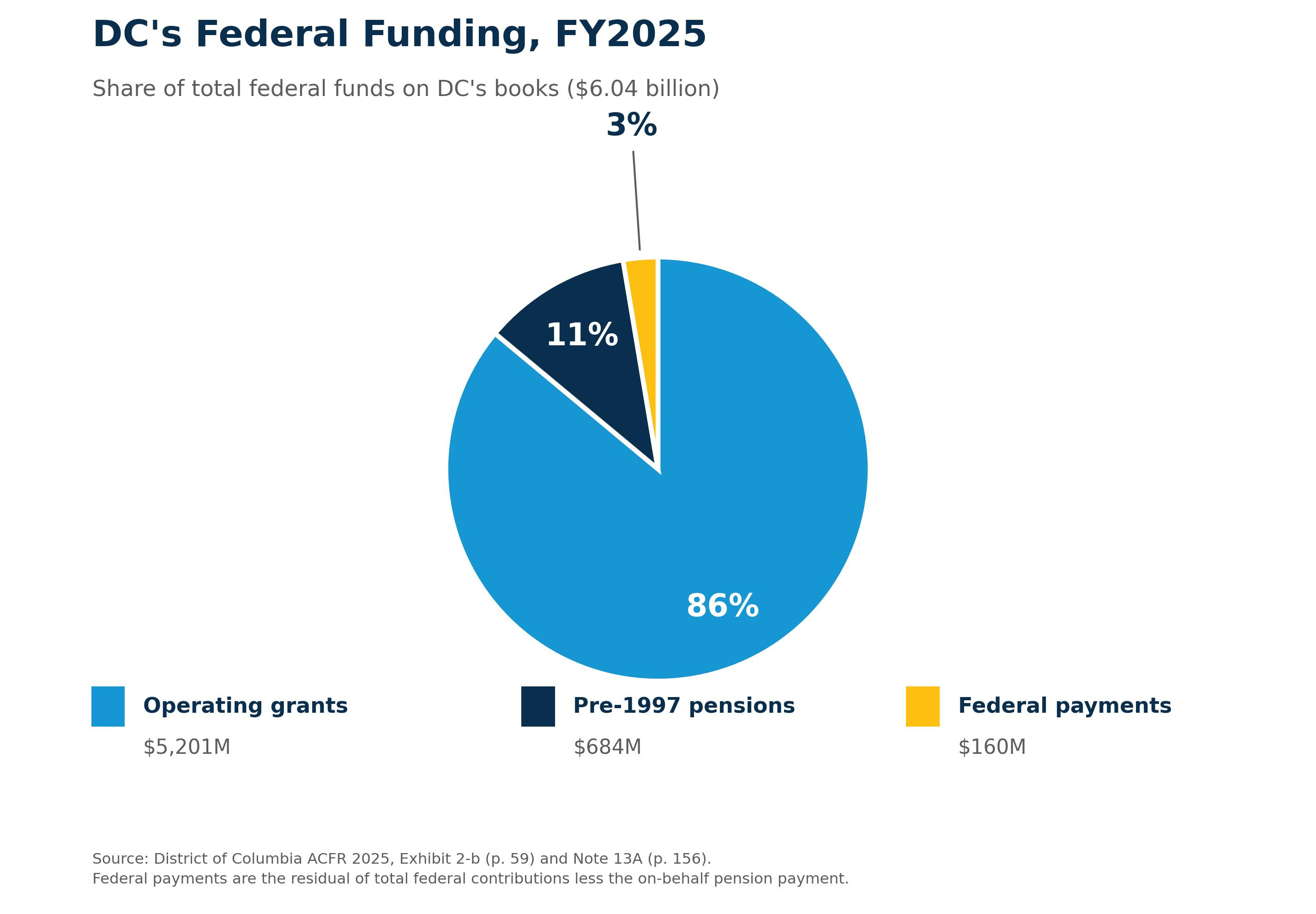
Note: District of Columbia Annual Comprehensive Financial Report 2025, Exhibit 2-b, p. 59, and Note 13A, “Transactions with the Federal Government,” p. 156. Federal payments are the residual of total federal contributions less the on-behalf pension payment.
The total amount of federal funds that flowed through D.C.’s books in FY2025 was about $6 billion. Combined with own-source revenue of some $13.3 billion, this adds up to $19.3 billion, of which federal funds were 31.3 percent. If we exclude the aforementioned pension benefit payments—over which the District exercises no discretion whatsoever and which are booked as both revenue and expenditure by accounting convention—the share is 28.8 percent. The total federal share was 31.0 percent in FY2016, very similar to now, but it spiked during the pandemic, peaking at 37.1 percent in FY2022.
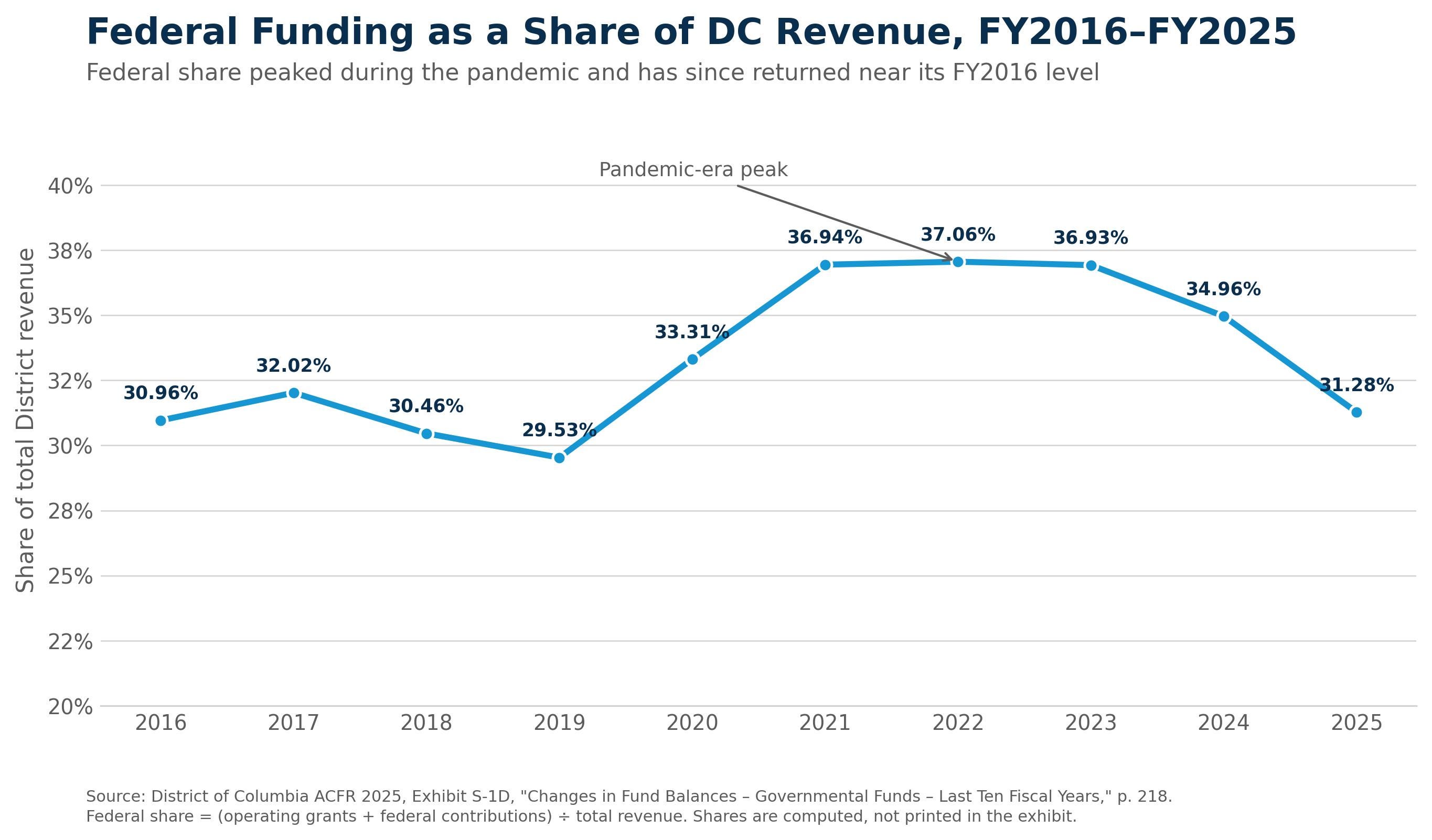
Note: District of Columbia Annual Comprehensive Financial Report 2025, Exhibit S-1D, “Changes in Fund Balances - Governmental Funds - Last Ten Fiscal Years,” p. 218.
Other federal funds do not flow through D.C.’s books, even if they pay for our non-federal (quasi-)public sector. These include funds for the functions Congress removed from home rule in the 1997 Revitalization Act: the courts, probation and parole, indigent defense, felony incarceration, and local prosecution by the U.S. Attorney.
The federal funds numbers above also do not include funds for independent authorities and interstate compacts, such as the D.C. Housing Authority, D.C. Water, and WMATA. Neither do they include certain monies for private entities like charter schools. (Most charter school funding does flow through, because the Office of the State Superintendent of Education is a District agency that subgrants to charters and DCPS alike.) Finally, they do not include the cost of the Department of Defense’s deployment of National Guard troops to DC, estimated to exceed $600 million for FY2027.
Comparing federal funding for the District to the funds received by other states (and their localities) involves several complications. But in my next post, that is precisely what I will do.

A very clear presentation, Dr. V. well done.