


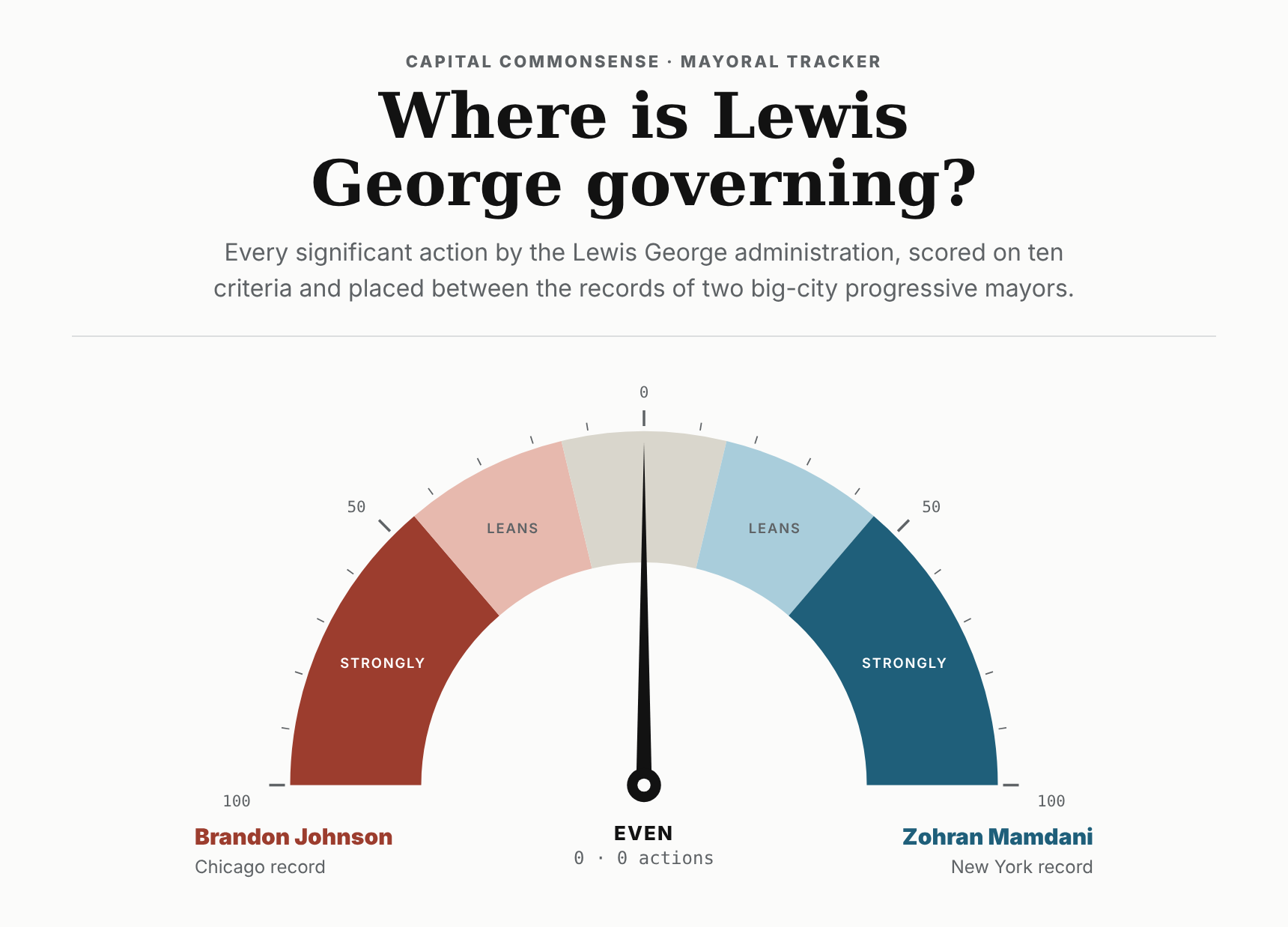
Now that Janeese Lewis George is officially the mayor-elect, Capital Commonsense will track significant actions she takes on our very own “needle.” Veterans of The New York Times election night coverage know the format. (We’re sorry to bring back bad memories, but hopefully Tuesday night’s experience makes you more “needle” friendly.)
Our needle swings between mayors whose records show how progressive city government is working in practice. On one end is Chicago Mayor Brandon Johnson. On the other is New York Mayor Zohran Mamdani.
When Lewis George signs a bill, releases a budget, names a deputy mayor, or launches a program, the model will score it. The needle is our way of differentiating between what we view as a successful model of progressive governance and an unsuccessful one. Today’s post explains how the model will work.
Why Johnson and Mamdani
We picked two mayors who generally have the same ideological views as Lewis George. In a column for City Cast, I explained Lewis George’s two progressive peers: “the popular and pragmatic New Yorker, or the true believer who’s under water in Chicago” and the two paths she could pursue as an executive. Over the coming months, our model will seek to evaluate in a rigorous way which path she takes.
Brandon Johnson is the cautionary tale, as he has run into the wall on budgets, public safety, and his relationship with the city’s employers. A move toward Johnson means a decision that adds costs, drives away investment or jobs, or treats ideological goals as more important than results. His approval rating has reflected this dynamic.
Zohran Mamdani is the other end. He ran on an ambitious left-wing platform, but has been focused on how the city functions and delivery of basic services. He has also abandoned or significantly scaled back campaign promises like free buses or childcare. A move toward Mamdani means a decision that pursues progressive goals in a pragmatic way—growing the economy, being fiscally responsible, and advancing good government. The Capital Commonsense team generally thinks he’s been doing a good job.
To be clear, neither mayor is a perfect symbol and their actions will not always align with the needle. Mamdani is only 10 months into his term, so his record is not as robust. The two mayors are shorthand for different approaches to blue city governance. Seattle Mayor Katie Wilson and Boston Mayor Michelle Wu would present a similar comparison, although Mayor Mamdani is clearly more YIMBY on housing than Mayor Wu.
What we’re actually scoring is the substance of each of Lewis George’s decisions, using the criteria below. The model will be scoring each action, not the Capital Commonsense team.
Two examples from their records
Here is how two real decisions would score. The net score is the sum of an action’s scores, offering a quick read of which way it pushes the needle.
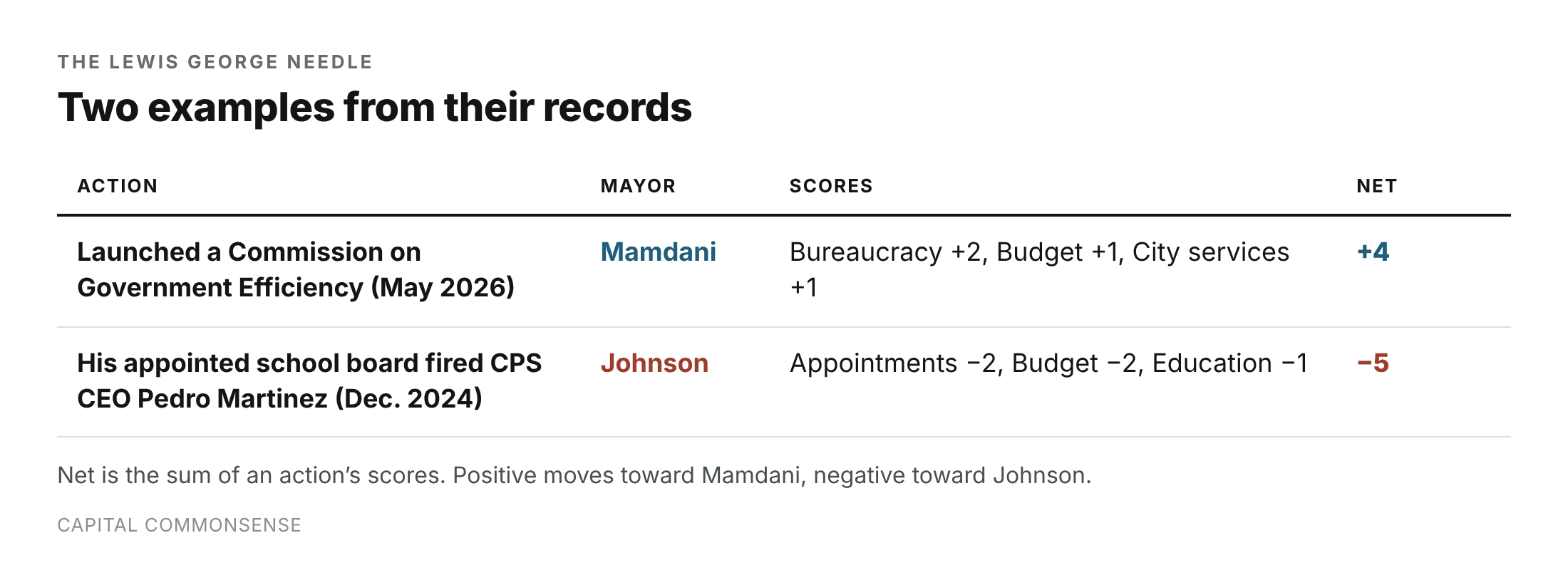
The efficiency commission. In May 2026, Mamdani appointed a charter revision commission to clear bureaucratic barriers that slow city projects and to modernize budget practices. Its proposals go to voters in November 2026. It scores +2 on bureaucracy rather than +3 because a commission is a starting point, not a result. (NYC Mayor’s Office)
The Martinez firing and short-term loan: In December 2024, a school board Johnson had just appointed, after the previous board resigned en masse, voted unanimously to fire CEO Pedro Martinez without cause. At the center of the dispute was Martinez’s opposition to a high-interest short-term loan Johnson’s team wanted to cover new district costs. Pushing out an experienced schools chief for resisting the mayor’s fiscal plan scores −2 on appointments, the borrowing push −2 on budget, and the leadership turmoil −1 on education. (Chalkbeat)
The 10 criteria
Every action is judged against ten questions. Each one has a Johnson end and a Mamdani end.
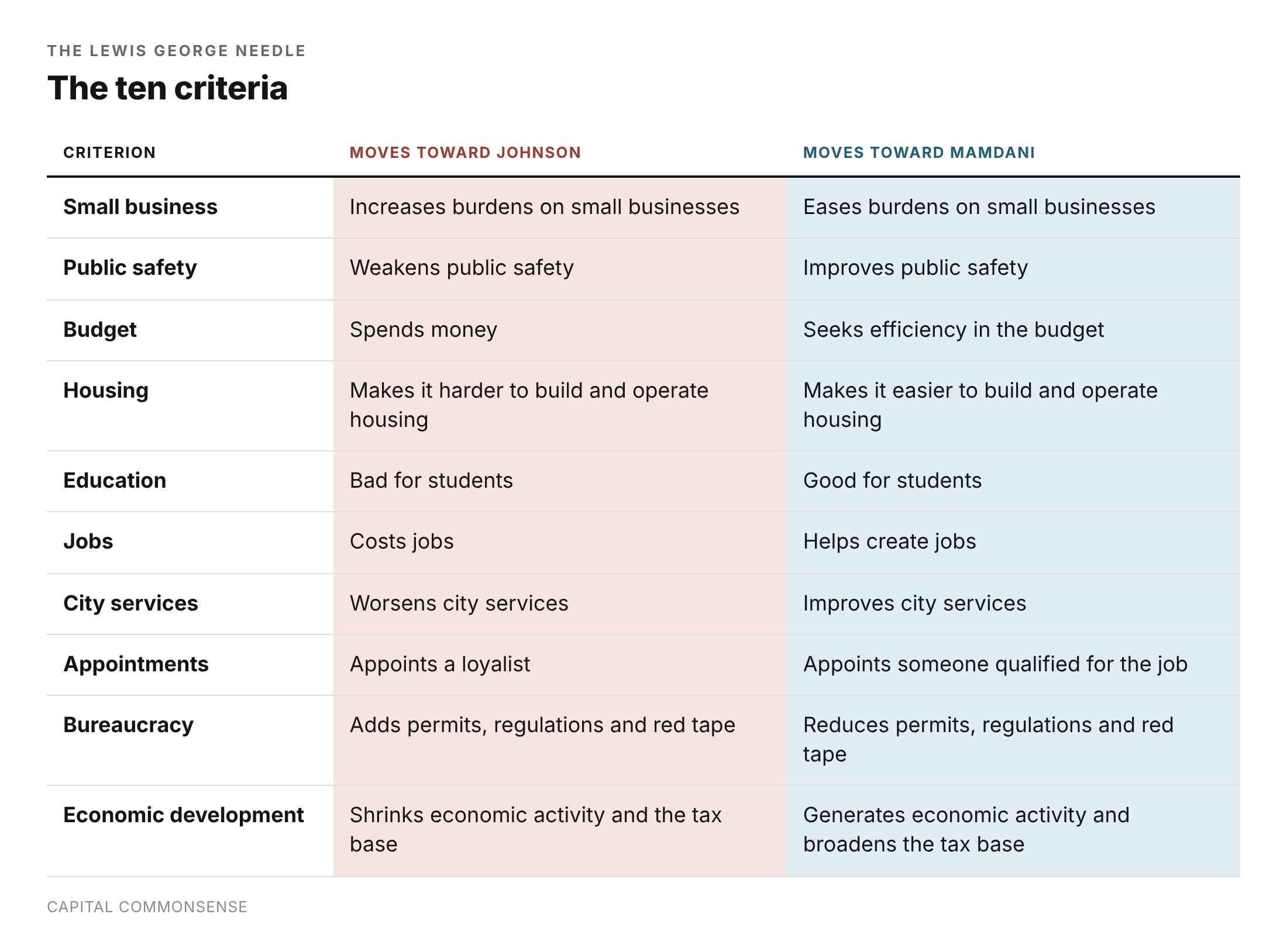
A few of these deserve some explanation:
• Budget isn’t a test of whether spending is good or bad. The District has real fiscal problems, and the question is whether a decision treats taxpayer money as finite. A new program paid for by cutting a weaker one can score well. New spending with no offset or new spending that’s not a good economic investment will not score well.
• Education asks one thing: is this good for students? Not for adults in the system, not for a particular institution. Students.
• Appointments asks whether the person has the experience and track record to run the agency they have been put in charge of. Many appointees are both loyal and qualified, and that’s fine and to be expected. Loyalty only counts against a pick when it seems to be standing in for experience.
How the needle moves
Each action gets a score from −3 to +3 on every criterion it affects. Negative scores move toward Johnson, positive scores toward Mamdani.
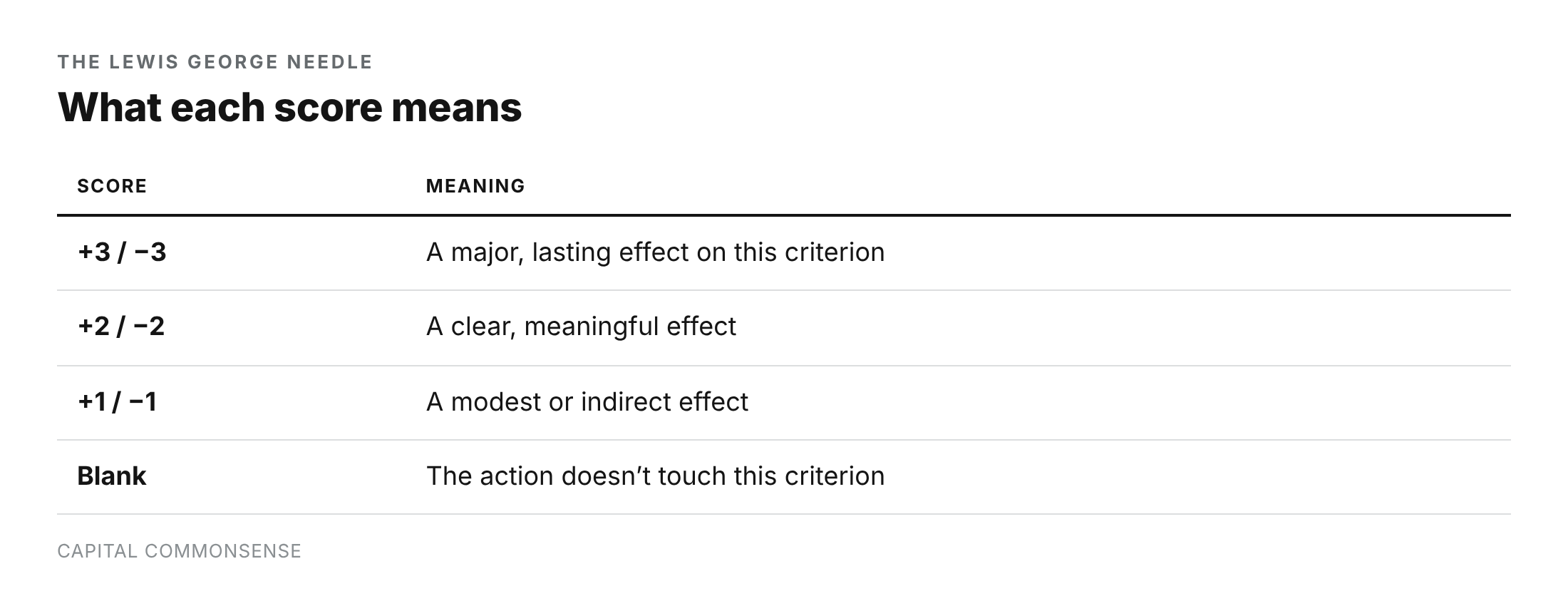
With respect to the last row, a school policy doesn’t get a zero for housing. It gets no score at all, so it can’t drag the housing average up or down.
From there, the math is short:
Each criterion’s score is the average of every score it has received over the administration.
The needle is the average of all ten criterion scores, converted to a scale from −100 (fully Johnson) to +100 (fully Mamdani). A criterion that hasn’t been touched yet counts as zero.
The needle’s reading falls into one of five bands: Even (within 15 points of zero), Leans (15 to 45 points) or Strongly (more than 45 points) toward either mayor.
Because the needle averages all 10 criteria, no single action can pin it to one side. Early on it will move quickly. As the record grows, each new action moves it less, reflective of a long record.
An example
If Lewis George streamlines permitting for home renovations, here’s how the model would score it.
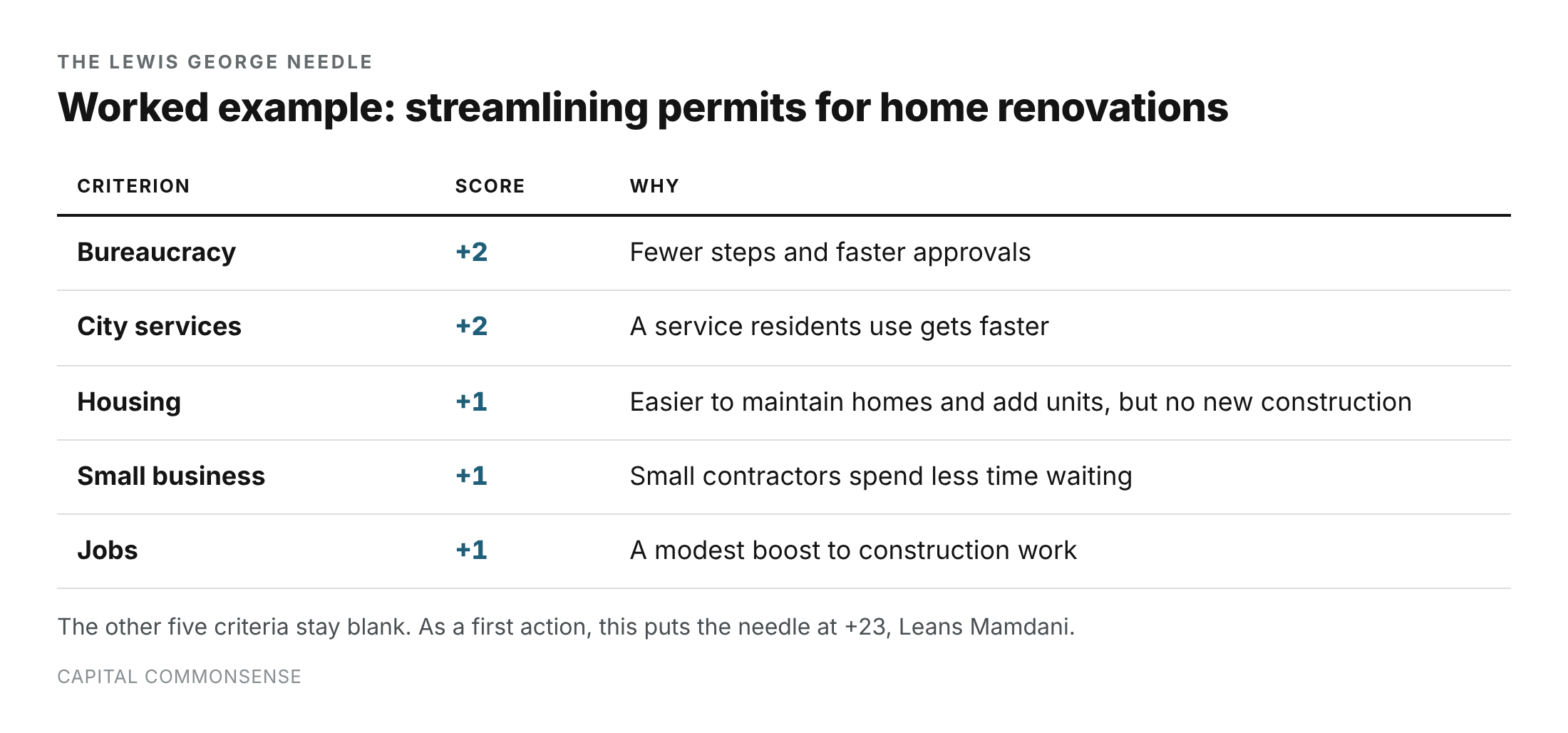
The other five criteria stay blank. If this were her first action, the needle would read +23, Leans Mamdani.
Keeping the scoring fair
Some of the criteria overlap, so the model will follow a few rules to keep one decision from counting twice for the same effect.
• Bureaucracy vs. housing and small business. Bureaucracy scores the process change itself: fewer steps, faster approvals, simpler rules. Housing and small business score what that change does for the people building homes or running businesses.
• Economic development vs. jobs. Economic development is about growth and the tax base: new businesses, new investment, new residents. Jobs is about employment. A major development project might score on both. A hiring program scores only on jobs.
• Appointments are weighted by the job. A cabinet-level pick like the police chief, the schools chancellor or the city administrator can score up to ±3. A seat on a smaller board or commission counts for ±1.
What the needle can’t do
The needle is a transparent judgment call, not a scientific instrument. Every score reflects the model’s read of a decision, and reasonable people will sometimes disagree with it. A few limits are worth stating up front.
• It weighs actions, not outcomes. Crime rates, test scores and job numbers depend on far more than any one mayor. We score the decisions she controls and note the results as they come in.
• It treats all 10 criteria equally. You might care more about public safety than education or the reverse. The needle doesn’t know that, and the scorecard below the dial lets you see each criterion on its own.
• It can only score what’s public. If a decision happens out of view and we don’t know about it, it won’t show up until it does.
We will begin entering decisions as the Mayor-elect begins to make them and update readers periodically.
This is a very cool idea! Can you say more about what the model is and how it decides whether a given action is +/- 1-3? I would have thought that part would still need to be scored manually, but perhaps you’re using an LLM or something to make the judgement call?