



Between all of us, the Capital Commonsense team tuned into much of the D.C. Council revenue hearing yesterday and we wanted to share our takeaways. You can watch the full hearing here.
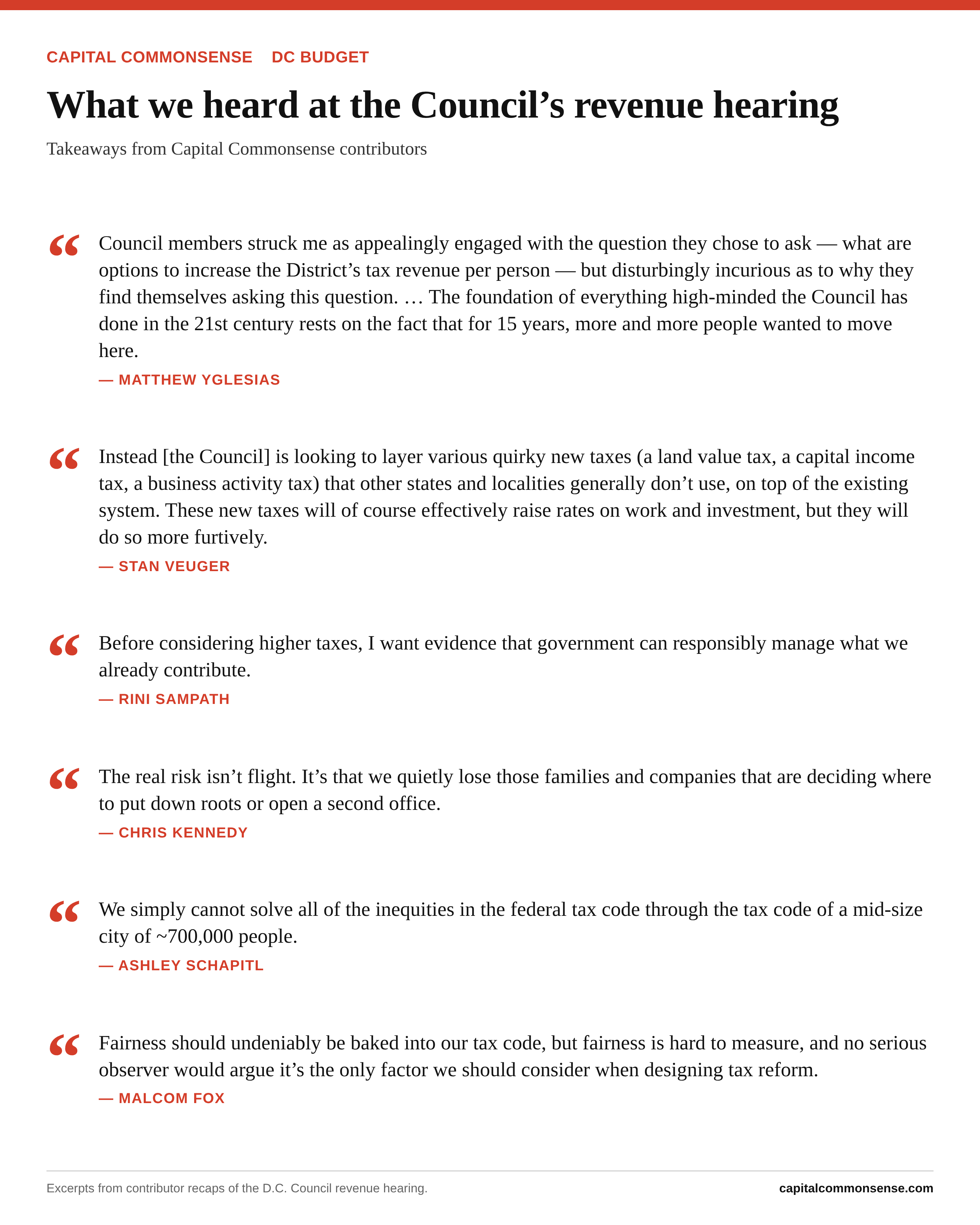
Matthew Yglesias: Council members struck me as appealingly engaged with the question they chose to ask — what are options to increase the District’s tax revenue per person — but disturbingly incurious as to why they find themselves asking this question. The basic cause of the budget gap is not DOGE and certainly not a past failure to try to come up with ways to raise taxes, it’s an astronomical increase in inflation-adjusted per capita spending since Fiscal Year 2018. This is not so much because the Council undertook huge new spending initiatives as that the previously robust population growth trend turned sharply negative in 2020. Despite some bounceback from post-pandemic lows, we still have fewer people than we had in 2019 and are not within a light year of our earlier trend. Since the District is already a relatively high tax jurisdiction, there is simply no way to make this work without either a major curtailment of spending or a new population growth boom.
The population crash is the root cause of the fiscal crisis and the main lens through which the Council should evaluate every question is “does this make D.C. a more or less attractive place to live for middle class taxpayers?” DC is a progressive city with progressive values and a progressive council that rightly cares about the fate of the most marginalized. But they tell parents that in the event of a loss of cabin pressure you need to put your own oxygen mask on first, not because you’re selfish but because that’s the best way to make sure you can take care of your kids. The foundation of everything high-minded the Council has done in the 21st century rests on the fact that for 15 years, more and more people wanted to move here. That boom ended midway through Mayor Bowser’s second term and the city simply hasn’t made a serious effort to address it.
Stan Veuger: One big-picture takeaway from the hearing is that our tax rates are already so high, even our Council doesn’t seem to want to raise the rates on existing taxes. It could just raise the property tax rate, or the income tax rate, or the franchise tax rate, or the sales tax rate, but it appears uninterested in those options.
Instead it is looking to layer various quirky new taxes (a land value tax, a capital income tax, a business activity tax) that other states and localities generally don’t use, on top of the existing system. These new taxes will of course effectively raise rates on work and investment, but they will do so more furtively.
In addition to the usual distortions these new taxes would generate, especially of location choice, investment, and entrepreneurship, they would make an already complex system even harder to navigate. They also come with legal risk, especially the proposed business activity tax, which strikes me as hard to square with both the Home Rule Act and the dormant Commerce Clause. It would be a disaster to introduce that tax with all the distortions it would create and then have to refund the revenue years from now after losing a lawsuit, as happened when local governments in Maryland had to refund $200 million after Comptroller v. Wynne.
If the Council really wants to increase tax revenue instead of bringing spending under control, it should look at base broadeners. Obvious options there include extending the sales tax to services and scaling back the property tax relief wealthy seniors receive. We could also generate significant additional revenue from enforcement of traffic and solid waste disposal rules, which would have the added benefits of increasing traffic safety and reducing the rat population.
Rini Sampath: During today’s Council hearing on taxes, veteran DC journalist Tom Sherwood wrote on Twitter: “Let me know when anyone proposes ways to ‘control spending.’” That’s where I stand. I want DC to become a world-class city that fulfills our democratic commitment to a just and equitable society. But the direction of our city gives me little confidence that this government will responsibly manage additional public dollars.
Now is not the time to ask residents to pay more to compensate for the Bowser administration’s failures and Council’s budget mismanagement. As liberals, we care deeply about affordable housing, child care, health care, and a strong social safety net. We should demand that those services reach the people who need them. The same DC Fiscal Policy Institute now advocating higher taxes reported in March 2025 that people waited an average of 380 days between matching with a housing voucher and signing a lease. It urged officials to process 750 pending supportive housing applications. DCFPI rightly called for fixing those delays. I disagree with pursuing higher taxes before officials demonstrate progress on the failures already documented. A separate 2023 analysis estimated that the DC Housing Authority overpaid landlords by $12 million annually. Residents deserve to know what government has corrected, what savings it has identified, and why additional revenue would produce better results.
We also need to take business owners seriously. Several have told me they would prefer to open in Maryland or Virginia because they expect fewer regulatory hurdles and lower tax burdens. Their accounts don’t establish the effects of every tax proposal, but Council should investigate what drives those decisions. DC already has the country’s highest first-year business failure rate: 32.9%, compared with 22.1% nationally, according to LendingTree’s 2026 analysis. The DC Policy Center also reported that the District lost 44,600 jobs between January 2025 and April 2026. Those losses reflect several pressures, including federal cuts, but they make retaining and attracting employers more urgent. Policies we support nationally still need scrutiny when applied to a city where businesses can choose locations just across the border.
Our next mayor should recover improper payments, renegotiate overpriced contracts, fix permitting delays, and publish a savings plan alongside a plan to expand the tax base. Savings may not close the entire deficit. But before considering higher taxes, I want evidence that government can responsibly manage what we already contribute. Protecting the safety net requires an economy that can sustain it and a government that can deliver it. That’s common sense reform.
Chris Kennedy: Anyone interested in the future of DC should put today’s hearing on in the background while cooking dinner or going for a walk. It’s in the weeds, but you’ll get a real sense of the challenges facing the city. The witnesses held a range of views, but they broadly agreed on three things. DC faces a genuine fiscal dilemma. Much of it stems from forces outside local control. And the District has an obligation to model progressive governance, including a robust social safety net.
Where they diverged was on solutions, and on how the people and businesses that call DC home, or might, would respond to them. Will higher taxes on business and personal income trigger a mass exodus? Probably not. But studies finding little tax-driven migration mostly look at moves between states, and they don’t account for long-term business creation or population growth. Our income tax is exceptionally progressive and increasingly dependent on a small segment of our community. Residents earning $1 million or more file fewer than 1% of tax returns but pay roughly a quarter of all income tax, and the top 12% of filers account for about 2/3 of DC’s income tax. The real risk isn’t flight. It’s that we quietly lose those families and companies that are deciding where to put down roots or open a second office. Those decisions are crucial to our efforts to build an economy less dependent on the federal government.
And then there is spending, which I hope the council takes up in a future, similar hearing. Writers in this blog have and will continue to highlight areas where we believe there are opportunities to save money; address waste, fraud and abuse; and improve service delivery for District residents. This is not just about cutting costs; it’s about trust that our council is a sober steward of taxpayer money.
Ashley Schapitl: Having prepared for many congressional hearings in my day, I know they can be heavy on rhetoric and light on substance. For the most part, I thought this was a productive conversation between witnesses and council members at least if the goal was to discuss the merits of specific tax policies as opposed to our broader structural economic and fiscal challenges. That being said, I was struck by the rhetoric around income from wealth having an advantage over income from wages.
While this is true federally, it is NOT true in the District. At the District level, investment and wage income are generally taxed at the same rate. Add a 3% surtax, as is currently envisioned, and a top-bracket District filer would pay a 13.75% marginal rate to the District on a dollar of capital gains—more than they would pay on a dollar of wage income. The resulting top tax rate of 13.75% would be among the highest state or local rates on this kind of income anywhere in the country, edging past California’s 13.3% top rate and New York City’s 13.5% combined state and local rate for single filers earning $1.5 million.
If the Council wants to argue that’s the right policy on the merits, members are free to do so, but much of the hearing sounded more like a debate over whether capital gains and wage income should be taxed at the same rate federally, rather than a discussion of how they are already taxed in the District. We simply cannot solve all of the inequities in the federal tax code through the tax code of a mid-size city of ~700,000 people.
Malcom Fox: Today’s hearing was a preview of the same revenue and spending debates that will happen during the FY28 budget process. I had hoped the hearing would focus on using smart tax policy to address DC’s ongoing economic and fiscal crises as the District faces its worst economic outlook in 30 years: highest unemployment in the nation, commercial property at half its pre-COVID levels, and record restaurant closures. Instead, the word that came up most frequently and defined the hearing was “fairness.” Fairness should undeniably be baked into our tax code, but fairness is hard to measure, and no serious observer would argue it’s the only factor we should consider when designing tax reform.
Virtually every District resident agrees DC should have a fair and progressive tax system. Fortunately, DC has the most progressive tax code in the country and has some of the highest top bracket income tax rates. Despite our existing system, many Councilmembers and activists framed every tax proposal through the lens of fairness and ignored the potential consequences of tax flight, legal challenges, and higher costs passed onto residents. During one memorable interaction, Council Chair Phil Mendelson asked the Director of the Fair Budget Coalition, “ You say the rich should pay their fair share, and I agree, but what is their fair share?” Her answer: “They should just pay more.” I worry for DC’s future if tax policy is debated, and possibly implemented, based on vibes.
The issue you mention about the “income from wages/income from wealth” distinction feels symptomatic of the broader inability to differentiate between what’s going on in the District versus what’s going on at the national level.
As a district resident with meaningful cap gains income, the reality is that it might make sense to raise the cap gains tax than the top income bracket rate. You have the same issue of relative disadvantage vs Md/Va, but the all-in marginal rate would be lower, whereas the top income rate is already breaking 50% including federal. The problem might be that capital income is more mobile. Ultimately the answer here, beyond containing spending, is probably to broaden and possibly increase the sales tax. One can complain that sales taxes are regressive, but essentially every other industrialized country has a VAT that creates a stable tax base for generous benefit programs. It would be better to do all of this at the national level, but absent that, if one wants to provide generous low-income benefits, taxing 1% of the population is not going to get you there, because they will no longer be there to tax.
I write this having just discussed with my spouse (before reading this) whether we should move 5 minutes away from NW DC to McLean or Bethesda to beat the coming DC fiscal death spiral. I raised it in the context of AI job displacement of the paper-pushing DC economy (which I am a part of). There is a good chance it makes little difference to DC population growth, but I highly doubt it will be helpful.