


Councilmember Felder’s B26-0656, the Internet Gaming and Consumer Protection Act of 2026, cleared committee on November 18 on a 3-1 vote, with Councilmember Henderson voting against. That leaves just enough time for the Council to pass the bill before the end of the legislative year.
They shouldn’t. Gambling may seem like an appealing option for revenue during a budget crunch. But it’s an inefficient way to extract funds from DC residents. And it comes at too high a social cost.
iGaming is being considered because we’re strapped for cash
This isn’t D.C.’s first flirtation with online gambling. The Council passed a measure at the start of the 2010s, but repealed it prior to implementation. The idea is back in the conversation for one big reason: the budget. As one-time COVID-era subsidies expire and our economy cools, the city is projecting an annual budget deficit of nearly a billion dollars.
There are three paths by which a city like ours can address this problem.
First, we could borrow money or spend down our savings. D.C. has been doing this, but we probably can’t do much more.
Second, we could spend less. But finding fraud and other unwise spending is hard, and cutting other spending is unpopular.
Third, we could find more revenue. This can be done by hiking tax rates or by growing the economy, which creates more taxable activity. Of all of these options, growth is the most politically palatable, which is why cities spend so much energy trying to attract new industries and residents.
iGaming is a revenue-raiser, and it sort of looks like growth. Although Felder’s bill would allow fully automated games like slots and video poker, it would also require live video-streamed dealers based in D.C. (the bill’s backers estimate that it would create about 100 new positions). Legalization would mean new jobs, new leases, and new flows of economic activity that would create tax revenue. Best of all, it would be a sure thing. There would be no need for embarrassing press conferences about becoming an “innovation hub” or community meetings about data centers or 5G antennas. The Council just has to give its okay and a new local industry will spring to life.
Gambling is socially destructive
But gambling is a strange kind of industry. The house always wins, so customers, on net, come away with nothing (if this weren’t true, D.C. wouldn’t raise any tax revenue from iGaming). Gamblers choose to spend their money, but when they do it’s pure consumption–they don’t receive anything of enduring value. The most charitable way to think of this is as an entertainment business, not so different–except for better economics–than if D.C. invested in live concerts, sports, or a socialized juggling troupe.
For you and me and many other people who enjoy an occasional hand of blackjack, this is approximately true. But for a lot of people, it is different.
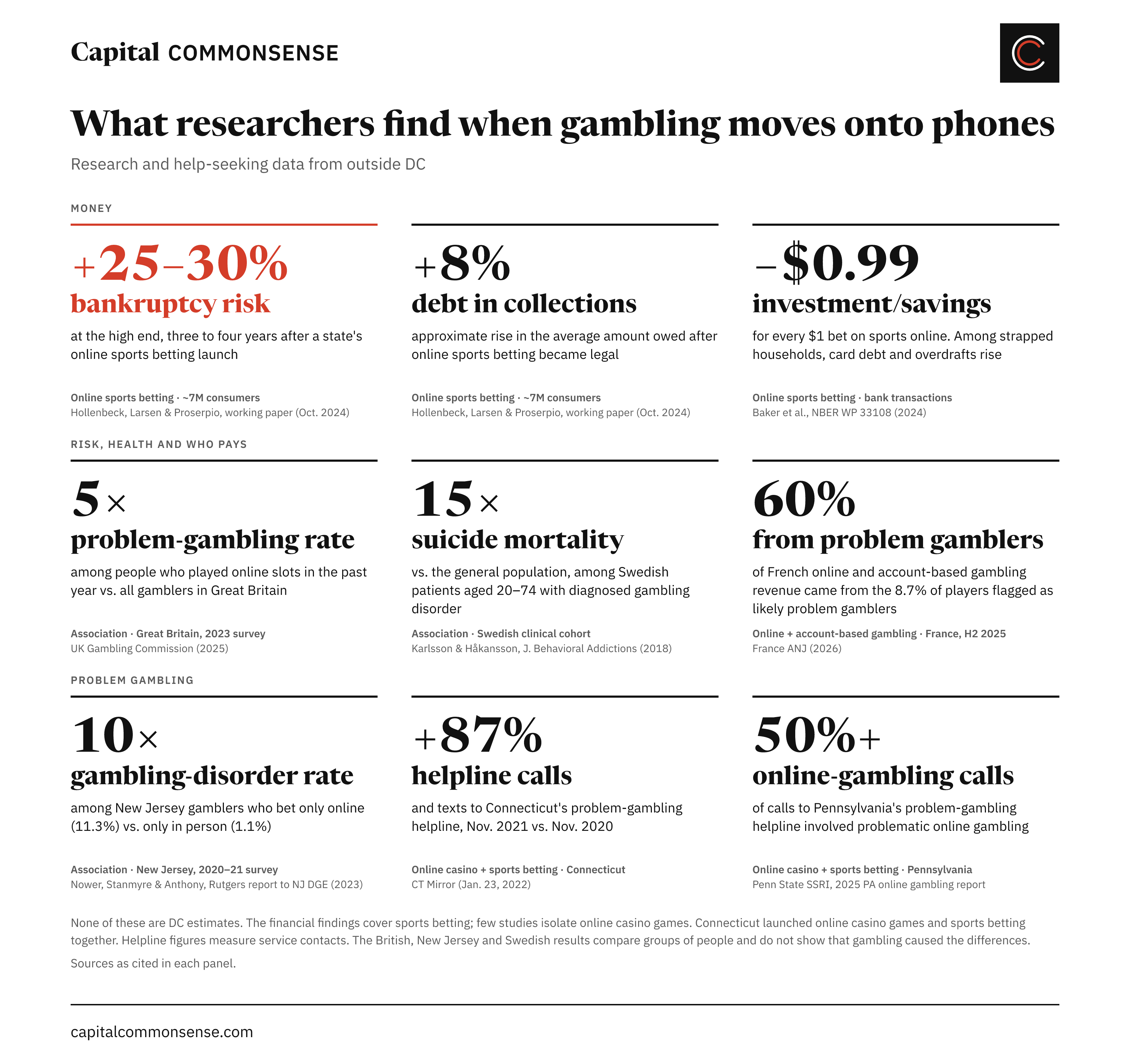
A significant number of people are at risk of gambling addiction, and app-based gaming is linked to more of them getting hooked. The consequences for them and the people around them are devastating. This has come into sharper focus in recent years as researchers have examined the effects of the boom in app-based sports gambling. The fact that problem gamblers fare poorly when they have a casino in their pocket is perhaps unsurprising, but it’s worth noting that the app model allows these businesses to adopt an even more predatory approach to their customers than the traditional casino industry, boosting engagement with losers and shooing winners away (notably, Felder’s bill does not mandate specific payout percentages). Research makes clear that our country’s anti-gambling legal regimes—which in recent years have been steadily dismantled—were not motivated solely by old-fashioned prudishness.
With this in mind, let’s dispense with the overly charitable economic development framing. iGaming would be an effective way to extract large amounts of money from Washingtonians, who would receive nothing in return. Gamblers would be left worse off–sometimes disastrously so–but the city would receive a cut of the action.
From this perspective, iGaming looks less like economic development and more like a particularly harmful form of taxation. If the Council is going to take a dollar out of Washingtonians’ pockets, it should at least do so in a way that keeps the money here instead of sending more than half of every lost dollar out of D.C. And it should do so in a way that spreads the burden (gambling losses are highly concentrated among problem gamblers) and which limits the harms imposed.
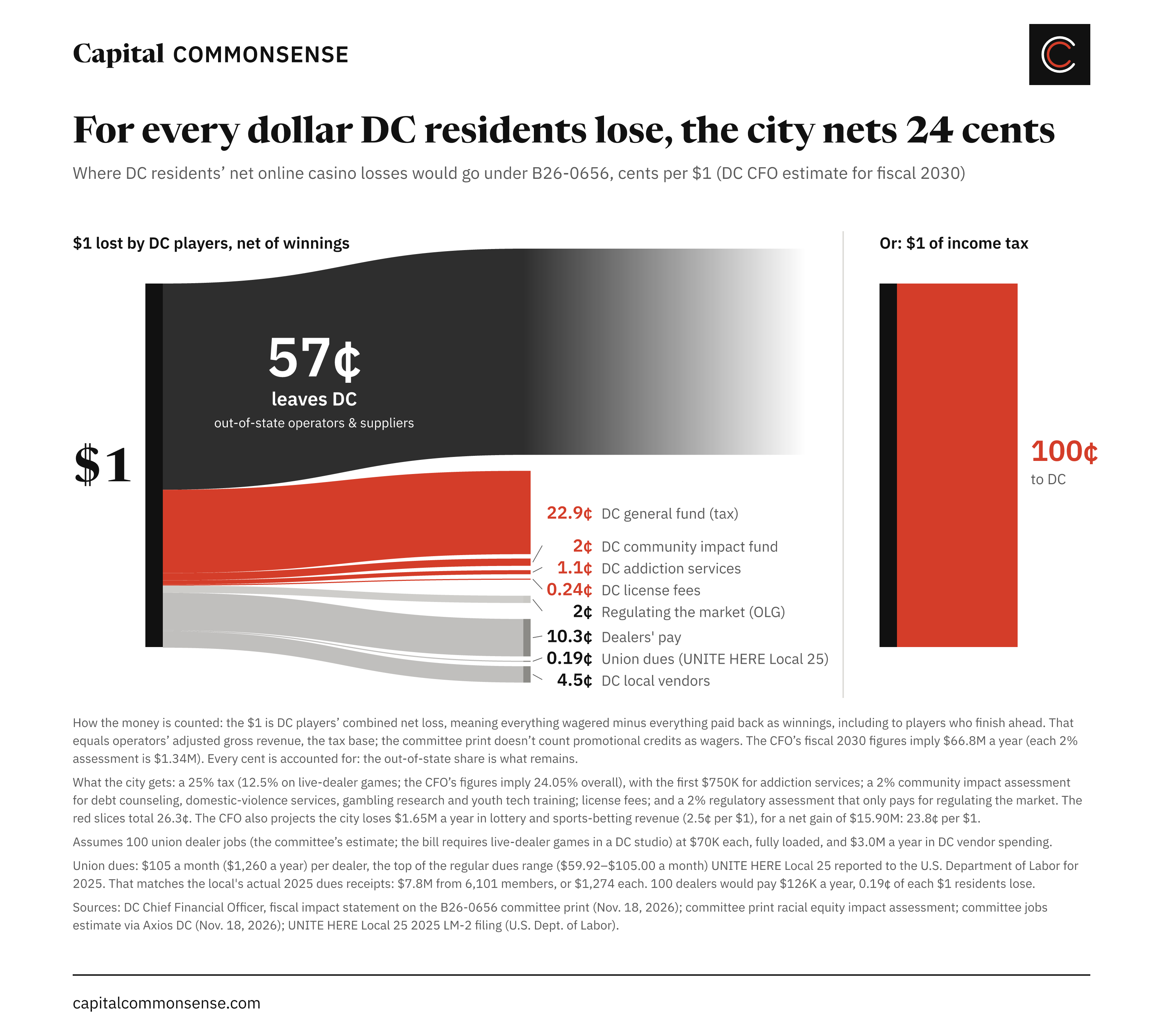
The iGaming system would allocate a small portion of its estimated $19 million of annual revenue to fund programs for gambling addicts, victims of domestic violence, and purposes like financial counseling. But this may not be enough to cover the public costs that come with gambling. One study examining the industry in New Jersey estimated that problem gambling’s costs for healthcare, welfare, homelessness, and criminal justice roughly cancel out the extra tax revenue that online gambling brings in.
The view from outside D.C.
The comparison to a simple tax is complicated by the fact that some of iGaming’s revenue would come from people who aren’t D.C. residents. Shifting tax incidence onto visitors is an appealing idea for officials who want to shield their constituents from tax increases. In practice this ideal can be hard to achieve, but it’s already embodied in D.C.’s existing taxes on things like hotel rooms and rental cars. How much iGaming revenue would come from out of state?
Under the bill, games would only be playable by people physically located in D.C. or other states where online gaming is legal. That’s currently only seven states, with Maine set to join, and those states have every reason to complicate D.C.’s ambitions in order to keep gambling revenue local. So while it’s true that some of the iGaming money would come from people who don’t live in D.C., it seems likely that most of it would come from residents. The CFO’s estimates don’t currently model this.
iGaming boosters sometimes suggest that D.C. needs to legalize gambling before nearby jurisdictions beat us to the punch and lure D.C. bettors into neighboring states. But iGaming measures in both Maryland and Virginia stalled earlier this year. This probably boosts the odds of suburbanites coming into D.C. to bet to at least some extent, but it also undercuts the argument for urgency.
D.C.’s track record at administering gambling is awful
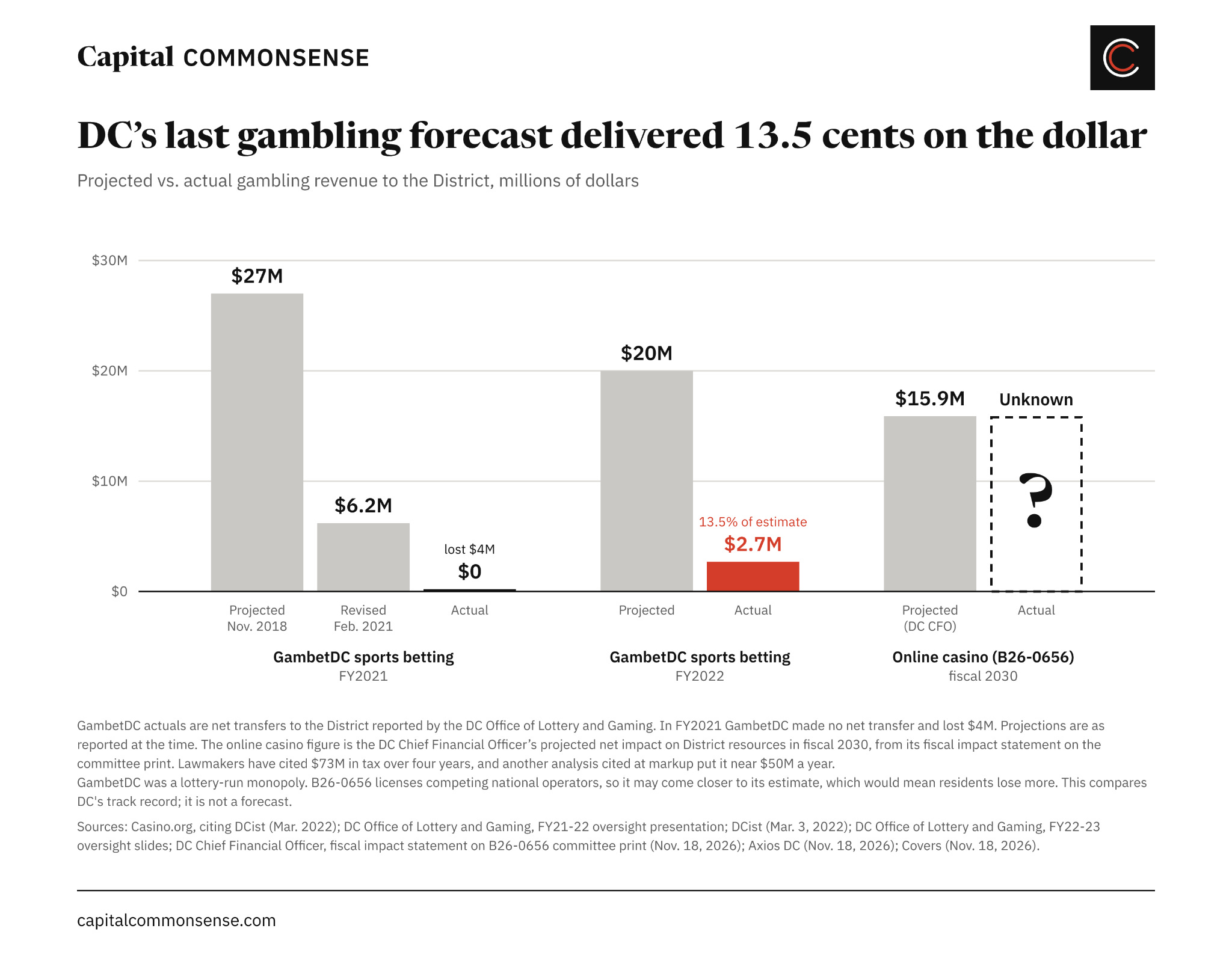
It’s worth remembering how poorly D.C.’s most recent foray into legalized gambling went. The Council’s attempt to bring sports betting to the District resulted in a fiasco of alleged fraud and comical ineptitude after the operator–who was awarded a sole-source no-bid contract–failed to hit operational and revenue targets. D.C. made dramatically less money than expected, and the saga culminated in a multi-million dollar settlement over allegations that the deal’s local-sourcing requirements were skirted. The best thing you can say about the episode is that a busted gambling regime probably does less harm than one that’s competently run.
In fairness, Felder’s iGaming bill is structured significantly differently than the proposal that birthed the Intralot scandal, allowing for multiple operators and giving a leg up to the online sportsbook operator incumbents who, for better or worse, have managed to deliver on the Council’s intention to bring sports betting to D.C.
Still, skepticism of the plan’s projections may be warranted. While I didn’t examine the CFO estimate exhaustively, in the course of researching this post it became clear that its tax figures imply a live-dealer revenue share 2-3x smaller than Pennsylvania’s actual numbers. Live dealer games would be taxed at a lower rate than slots or video poker, so this suggests that the revenue estimates might be overly optimistic. That’s just one example of how iGaming could prove to be a worse deal for D.C. than the proposal suggests, even apart from its social costs.
This is not an ethical way to fund our city
It may be tempting to imagine that legalized gambling is similar to a sin tax on cigarettes or alcohol. But that isn’t true: those revenue-raisers discourage compulsive behavior that harms addicts. Here, the Council would be the ones choosing to expose citizens to a new and harmful vice.
No one is eager for a tax hike, but the idea of paying for government services with our neighbors’ self-destruction should leave all of us queasy. Before making D.C. complicit in this industry, perhaps the Council should take a field trip to a Gamblers Anonymous meeting–there’s one over in Chinatown, a nice walk from the Wilson Building. They’d need to ask permission, of course. But I suspect there would be more than a few attendees who’d appreciate the chance to look our representatives in the eye and explain to them exactly what they’re preparing to invite into D.C.
Sources
Code, sources, and checks of all claims:
https://github.com/capital-commonsense/igaming
Grow successful local businesses? That pales in comparison to my strategy, USE DISCOUNT CODE GAMBLERMAXXING FOR 25% OFF YOUR FIRST PARLAY...