

We’re continuing the housing series that kicked off last week with Lessons from the Delta Pearl by beginning to look at issues involving the District’s beleaguered Housing Authority (DCHA). The Washington Post did extensive reporting on this topic in 2023, as did Greater Greater Washington.
Today, we’ll examine how DCHA’s citywide payment standards compare with rents across neighborhoods, why “rent-reasonableness” reviews are so important, and how they have fallen short.
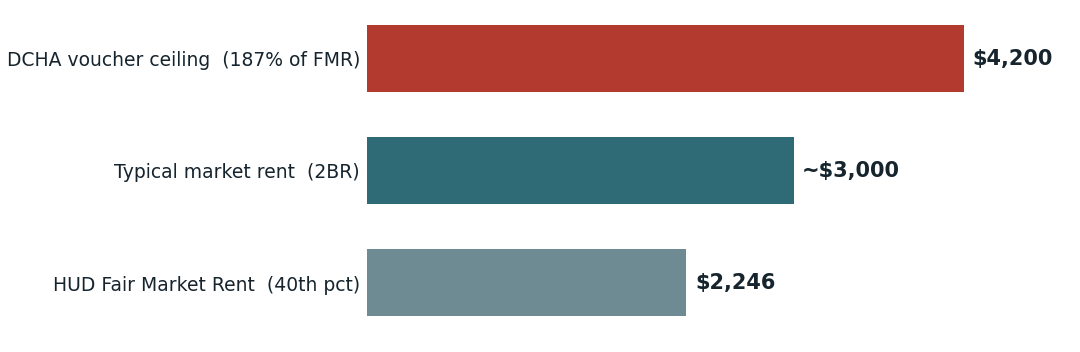
Every year, the District sets payment standards to calculate housing assistance for voucher holders. For fiscal 2026, the DCHA board approved standards at 187% of HUD’s Fair Market Rent—up to $4,200 a month for a two-bedroom, $5,301 for a three-bedroom, and more for larger units. The figure is identical across the city. A two-bedroom in Dupont Circle and a two-bedroom in Congress Heights are subject to the same $4,200 payment standard. As all Washingtonians know, rents do not work that way.
This does not mean DCHA automatically pays a landlord the maximum. The approved rent must also pass a rent-reasonableness review, and the household typically pays part of the rent—generally 30% of their income. Nonetheless, the payment standard establishes how much subsidy may be available and gives landlords a target. The gap between the citywide payment standard and actual rents creates room for taxpayer money to be misspent when the review is not done properly.
[Figure 1 · How the payment standard and rent-reasonableness test interact]
HUD’s Fair Market Rent is generally set at the 40th percentile of recent rents for standard-quality units occupied by recent movers and includes utilities. This is a modest benchmark. For a D.C. two-bedroom in 2026, the benchmark underlying DCHA’s schedule is about $2,246. DCHA then multiplies this figure by 1.87. The result, $4,200, sits 87% above HUD’s benchmark and well above many neighborhood rent estimates.
In more affordable neighborhoods, the rent-reasonableness review should set a rent at an appropriate level for the neighborhood, but whether it does in practice depends on DCHA.
Before approving a lease or an increase in rent, the housing authority must compare the unit with similar unassisted apartments—considering a range of factors, including location, size, type, age, quality, amenities and condition. Federal rules bar approval of a rent that exceeds the reasonable rent for comparable units.
The Gap Between Market Rent and DCHA’s Payment Standard
Because the payment standard is flat, the gap between market rent and payment standard varies significantly.
DCHA Payment Standard vs. Typical Market Rent
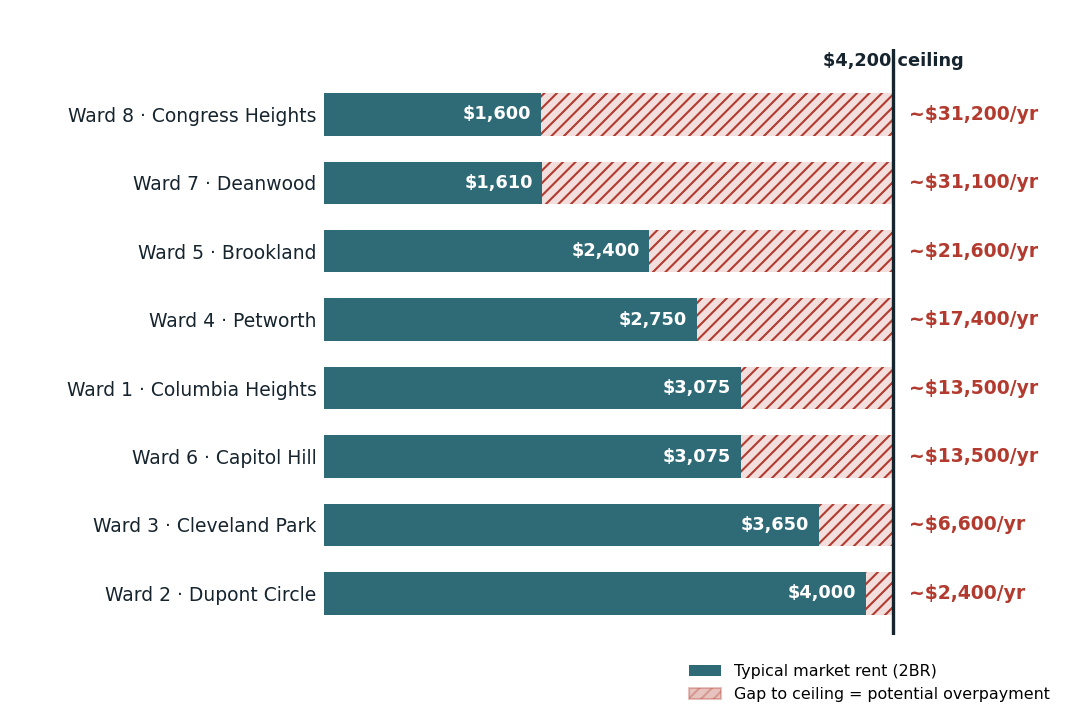
[Figure 2 · The gap by ward between typical market rent for a two bedroom and the payment standard. Market rents are mid-2026 listing aggregates and are approximate. Figures compare advertised rent with the two-bedroom payment standard.]
East of the Anacostia, where listing sources place a typical advertised two-bedroom at roughly $1,600, the flat $4,200 payment standard sits about $2,600 a month—nearly $31,000 a year—above the going listing rent. In upper Northwest, where advertised rents are considerably higher, the gap is smaller. The estimated gap is largest in Wards 7 and 8.
DCHA Payment Standards Compared with HUD Rent Benchmarks
Measured against HUD’s own Small Area Fair Market Rents—the federal government’s ZIP-code-level estimate—the flat standard also leaves large potential gaps in many ZIP codes.
DCHA Payment Standard vs. HUD Zip Code Benchmarks
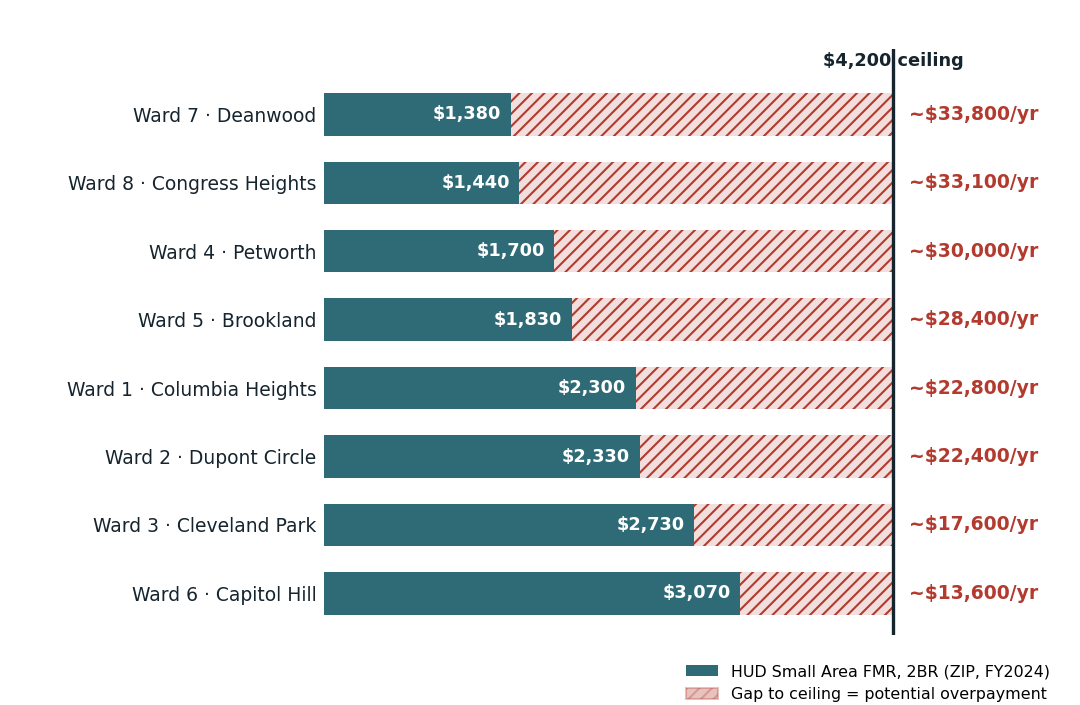
[Figure 3 · The gap against HUD’s ZIP-code benchmark. SAFMR is HUD’s ZIP-level 40th-percentile gross-rent estimate, including utilities. The chart uses FY2024 SAFMRs so provides historical context rather than the current gap today.]
When HUD assessed DCHA in 2022, it found that the agency could not clearly document how it determined reasonable rents for individual units. Across a sweeping review, HUD reported concerns that DCHA was not following its local procedures and that landlords were exploiting the resulting weakness.
Rather than documenting unit-level comparisons, DCHA relied on neighborhood averages—obscuring differences on the same block or within the same neighborhood. DCHA was directed to go back and analyze new admissions and rent increases and reimburse the federal government if the review showed overpayments.
The results of the federal review were no surprise. As the Washington Post reported, as early as 2021, a member of DCHA’s own board flagged this issue. One director departed before fixing it. His successor first promised to finish the job, but then reversed course and floated raising the payment standard. Board members objected observing that landlords treat the published standard as the asking price.
The sum of money at stake is significant. In 2022, DCHA administered roughly 16,000 federal and locally funded tenant-based vouchers combined. Just $100 in average monthly overpayment across 10,000 units would cost $12 million a year.
DCHA has since begun using third-party software to conduct unit-by-unit rent-reasonableness assessments, but serious concerns remain about how the process works in practice. From what commissioners have observed through ANC work, some landlords request and receive the maximum even when nearby unassisted rents suggest that a lower amount may be warranted.
My colleagues in ANC 4B recently passed a resolution raising concerns about rent-reasonableness determinations at several properties in the commission area and urging stronger DCHA and Council oversight. The resolution also raises concerns that some landlords have partitioned rooms to add very small bedrooms and increase the applicable payment standard. DCHA should investigate those claims and verify that units comply with all requirements.
To her credit, Janeese Lewis George has pledged to reform DCHA and overhaul the voucher system to address ongoing overpayments. Following through would be a significant progress.
The current voucher waiting list is closed, and tens of thousands of people have waited for assistance. The District government must do more to ensure limited federal and local voucher dollars are well spent.
Sources & Notes
Payment standards: DCHA Housing Choice Voucher Payment Standard Schedule, FY2026 (approved Oct. 8, 2025), set at 187% of FMR. DCHA lists $4,200 for a two-bedroom and describes the figures as maximum payment standards, while noting that they do not establish the value of a voucher.
Federal rules: 24 C.F.R. §§ 982.503 and 982.507 distinguish the payment standard from the rent-reasonableness determination. Rent reasonableness must be based on comparable unassisted units and relevant unit characteristics.
Benchmarks: HUD FY2026 Fair Market Rents. The $4,200 two-bedroom standard equals approximately $2,246 × 1.87. FMR and SAFMR figures are gross-rent estimates that include tenant-paid utilities; advertised listing rents may not.
Market rents: Listing-aggregate medians (RentHop, Zumper, Apartments.com and RentCafe), mid-2026, using one representative neighborhood per ward: W1 Columbia Heights, W2 Dupont Circle, W3 Cleveland Park, W4 Petworth, W5 Brookland, W6 Capitol Hill, W7 Deanwood and W8 Congress Heights. Because source methodologies differ and neighborhoods do not represent entire wards, the figure should be described as illustrative—not a ward-level market-rent estimate. Archive each underlying result and access date before publication.
HUD SAFMR (Figure 3): Use HUD FY2026 Small Area Fair Market Rents for the selected ZIP codes if comparing them with the FY2026 DCHA standard: W1 20010, W2 20036, W3 20008, W4 20011, W5 20017, W6 20003, W7 20019 and W8 20032. Do not mix FY2024 SAFMRs with the FY2026 payment standard in the same “current gap” calculation.
Oversight and rent reasonableness: HUD, “District of Columbia Housing Authority (DC001) Assessment,” 2022; DCHA’s description of its post-2023 rent-review process; reporting and analysis by the Washington Post, Greater Greater Washington, the Equal Rights Center, Legal Aid DC and Street Sense Media.
When accepting tenant-based vouchers, what obligation do landlords have to comply with DC rent control requirements at rent-controlled properties?