


On October 16 we learned, courtesy of Washington Business Journal, that the D.C. Preservation League has nominated the D.C. Armory for historic designation. This was more than a little surprising!
The Armory is the structure closest to the Stadium-Armory Metro station, which is the primary transit connection for the District’s multibillion-dollar stadium development project. That project is the culmination of an excruciatingly long-gestating effort to balance the competing interests of developers, taxpayers, nearby residents, the National Football League, and countless other stakeholders. Few observers understood those priorities to include the preservation of a little-loved limestone quonset hut best known for hosting roller derby, MMA, and FBI fingerprint archives.
Then again, there are a lot of things about D.C.’s historic preservation system that are surprising. Our preservation laws and processes have been shaped by a small number of activists, and over the past six decades preservationists have been allowed to pursue their mission with relatively few checks. As a result, D.C. has made historic designations at a rate that’s wildly out of step with its peers. This has real costs for the city and its residents.
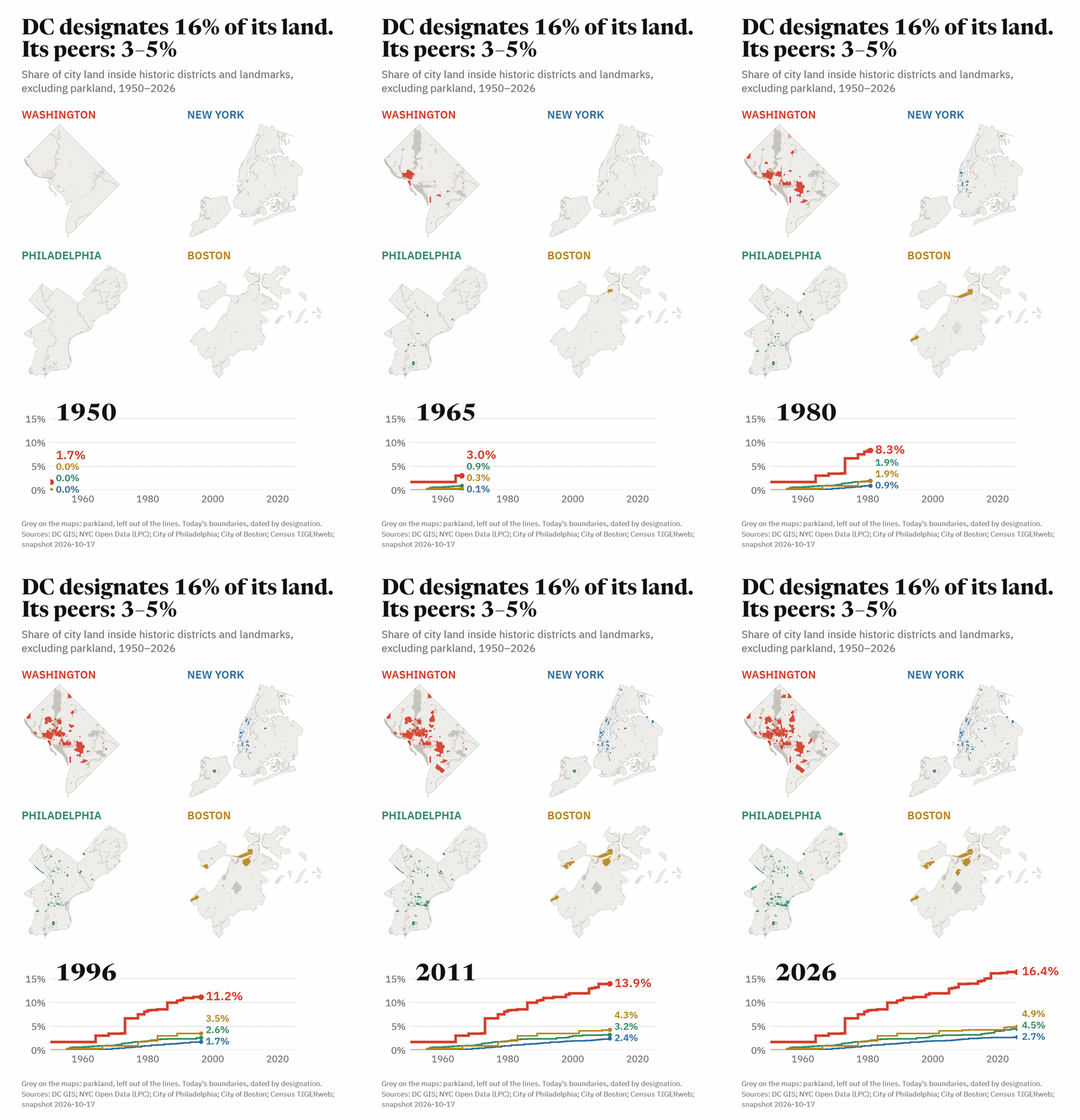
But we should take a step back. What does historic designation mean? How does the process work? What is the D.C. Preservation League? And how does D.C.’s approach to preservation stack up relative to other jurisdictions?
Others have done great work on these questions, but until recently it’s been difficult to understand D.C.’s preservation bureaucracy in a holistic way. The relevant records are scattered across meeting agendas, court records, annual reports, nomination materials, and many other sources. Coding agents have made it newly possible to gather and marshal these materials.
What Does It Mean To Be Designated As Historic?
In D.C., historic preservation is administered by the Historic Preservation Office (HPO) in the Office of Planning and governed by the Historic Landmark and Historic District Protection Act (§6-1101 et seq of the D.C. Code) which establishes the HPO and the Historic Preservation Review Board (HPRB), a nine-member body of mayoral appointees who are confirmed by the Council and who serve three-year terms. The HPRB decides what gets designated as historic and advises the Mayor on permitting decisions related to historic properties.
There are two types of designations: landmarks and historic districts. A landmark can be any number of things, like a structure, monument, sculpture, park, or cemetery. Districts are wider ranging, covering everything in a prescribed geographic area like Dupont Circle or LeDroit Park.
Landmarks and buildings in historic districts are subject to requirements designed to encourage their preservation and to maintain the “character of the historic district.” This includes review processes for demolishing, altering, or subdividing properties; and for new construction in a historic district. The Mayor’s office is ultimately responsible for deciding on permits for these activities (with the HPO and HPRB offering recommendations and handling routine actions) and, by statute, can grant exceptions only on the basis of public interest or economic hardship. Additionally, any city project that could affect a current or potential historic designee has to take preservation into account.
For homeowners living in historic districts the preservation rules typically mean more expensive home repairs and rules limiting renovations (or solar panels) that are visible from the street. For larger properties the consequences can be much further-reaching. But it’s not uncommon for owners to seek designation for their properties or districts, often because they believe it will improve property values or because it will prevent neighborhood changes that they disfavor.
The Process
It begins with an application. The HPO accepts nominations from private property owners, government entities (including ANCs), preservation organizations, and relevant community groups. The application costs between $100 and $1,000 to file, and requires a one-page cover sheet, a written description of what makes the nominee historic, a map, photographs, and a bibliography. After that, the HPRB will schedule a 30-minute hearing where both the applicant and HPO staff present their case. Then the HPRB decides whether to proceed with a historic designation.
It usually does. Based on what I could find, the HPRB approves 92% of nominations it votes on. Whichever way it goes, the outcome can be further challenged in court. But designations are almost never reversed (I could only find two such cases).
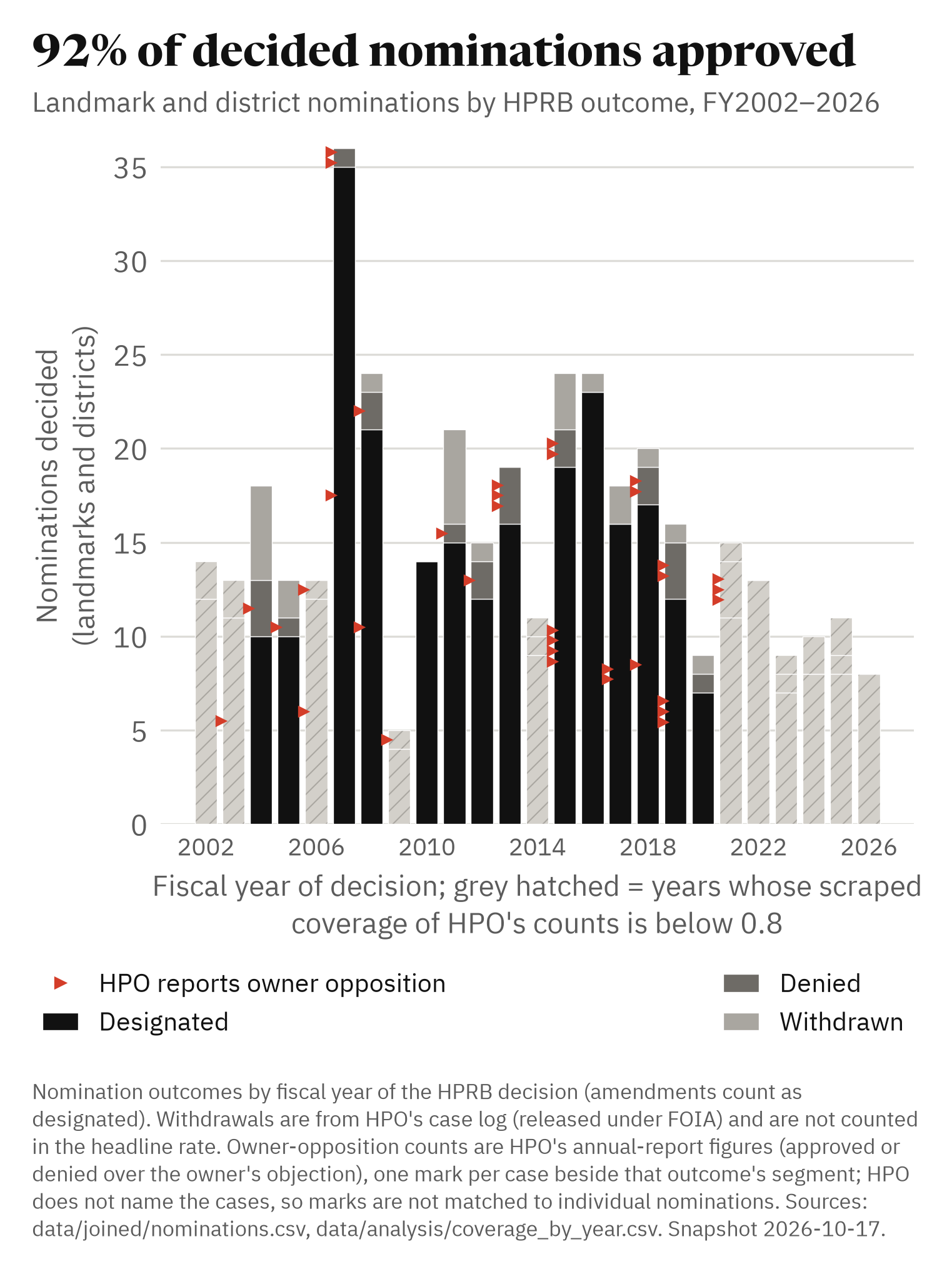
These figures are based on years with adequate data. The HPO publishes yearly counts of applications. I tried to gather the corresponding nominations, but in many years there is a significant mismatch. Here “adequate data” means the scraped nominations covered at least 80% of what the HPO says it received.
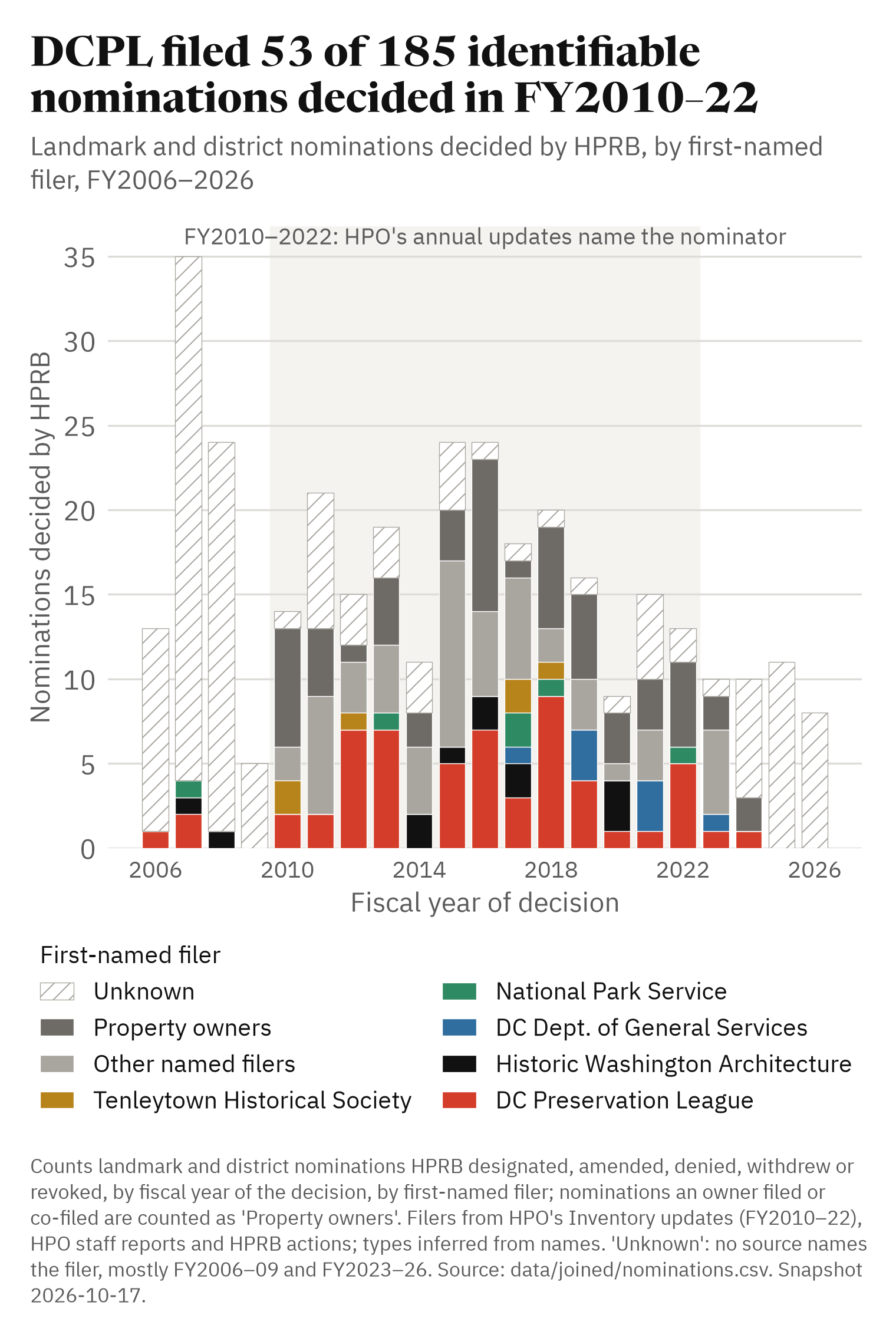
Who makes these nominations? It’s a mix, but the D.C. Preservation League is arguably the single most significant nominator, filing roughly 30% of all identifiable nominations in the years for which HPO’s records list nominators.
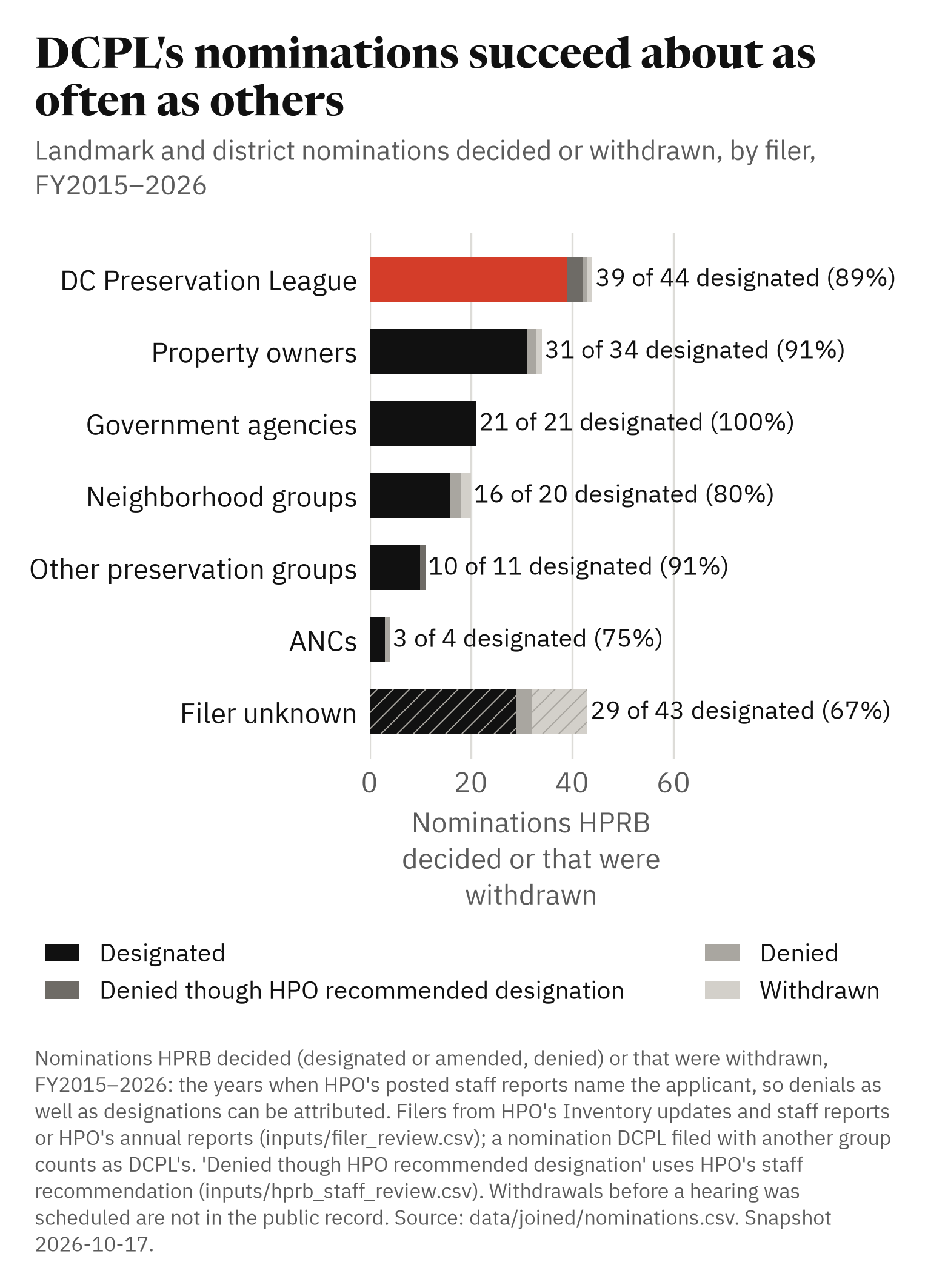
Their win rate is high, too–though perhaps unremarkably so, given how often HPRB votes to designate.
Who Elects DCPL?
They do. It’s run by a board of up to twenty trustees who elect themselves. Founded in 1971 by a WRC-TV journalist as “Don’t Tear It Down”–a campaign to halt the destruction of the Old Post Office–the DCPL evolved into a proper nonprofit after its initial success and played a key role in shaping D.C.’s historic preservation laws.
This might be a good time to mention those red triangles in the first figure: they represent nominations where an owner opposed the historic designation of their property. You don’t need the cooperation of a property’s owner or the residents of a proposed district to nominate it for historic designation. The HPO encourages applicants to get owners’ cooperation, but by law the HPRB’s decision is supposed to be based only on the historical case for designation. Designations can and do occur despite owners’ objections, like in the case of So Others Might Eat’s building on O Street, the West Heating Plant, and the Intelsat building.
And preservationists don’t always need to get a designation in order to notch a win. Back in 2010 the DCPL concluded its fight to stop the Third Church of Christ, Scientist from razing its 16th Street building by reaching a settlement. DCPL dropped the issue in exchange for various concessions, notably including the church agreeing to withdraw its support for legislation that would have chipped away at HPO’s jurisdiction over churches, and a payment of up to $770,000 to a preservation fund under DCPL’s management (DCPL got to keep 20% of it as an “administrative fee”).
Based on public records, this kind of arrangement doesn’t appear to be standard practice for DCPL. But the organization surely understands that inserting itself in the middle of a hard-fought and eye-wateringly expensive stadium development project might invite counter-proposals.
Is D.C.’s Approach Typical?
No. There’s no doubt that D.C. is a historically important city and that its legacy deserves preservation. But we have applied historic designation at a rate that dramatically outpaces peer cities like Philadelphia, Boston, and New York, none of which are exactly slouches in the history department.
Each of these cities has a historic preservation program that defines both districts and places, but they count things in slightly different ways. As a sanity check, I tried running a few different comparisons, looking not only at land area but also OpenStreetMap building records and each city’s address file.
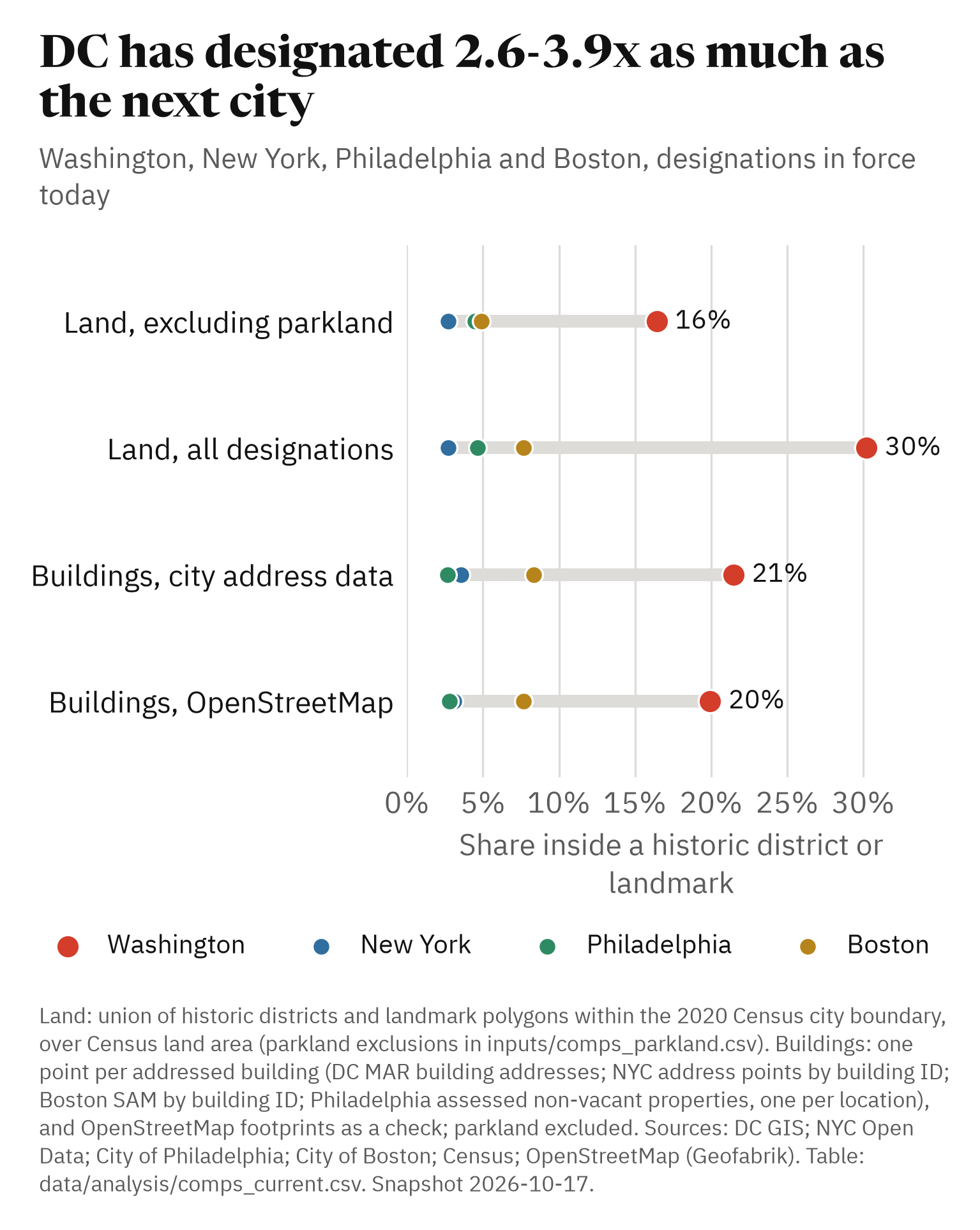
No matter how you slice it, D.C. is an outlier. And this disparity is not attributable to D.C.’s unique federal status. The parkland filter used for the top row of the above figure (and the animated graphic that opened this post) excludes the National Mall, Rock Creek Park, the Fort Circle Parks, East and West Potomac Parks, the Potomac Gorge, the National Arboretum, the C&O Canal, and the National Zoo, while continuing to count them in the “total land” denominator” used to determine the percentages.
At the pace we’ve kept since 1964–roughly a fifth of a percentage point of the city’s non-park land each year–D.C. will finish designating all of itself as historic sometime around the year 2400.
How Much Does This Cost Us?
Designating a property as historic imposes several kinds of costs, none of which are directly borne by those making the designation.
First and most obviously there are costs for owners who must maintain their properties in ways that meet HPO standards. It’s hard to find systematic estimates of these costs, but they can be significant, particularly for multi-family buildings. D.C. maintains a grant program to help low-income residents manage these costs, but the annual total is low–often a dozen or less–and demand reliably outstrips supply, to the point where many eligible homeowners don’t bother applying.
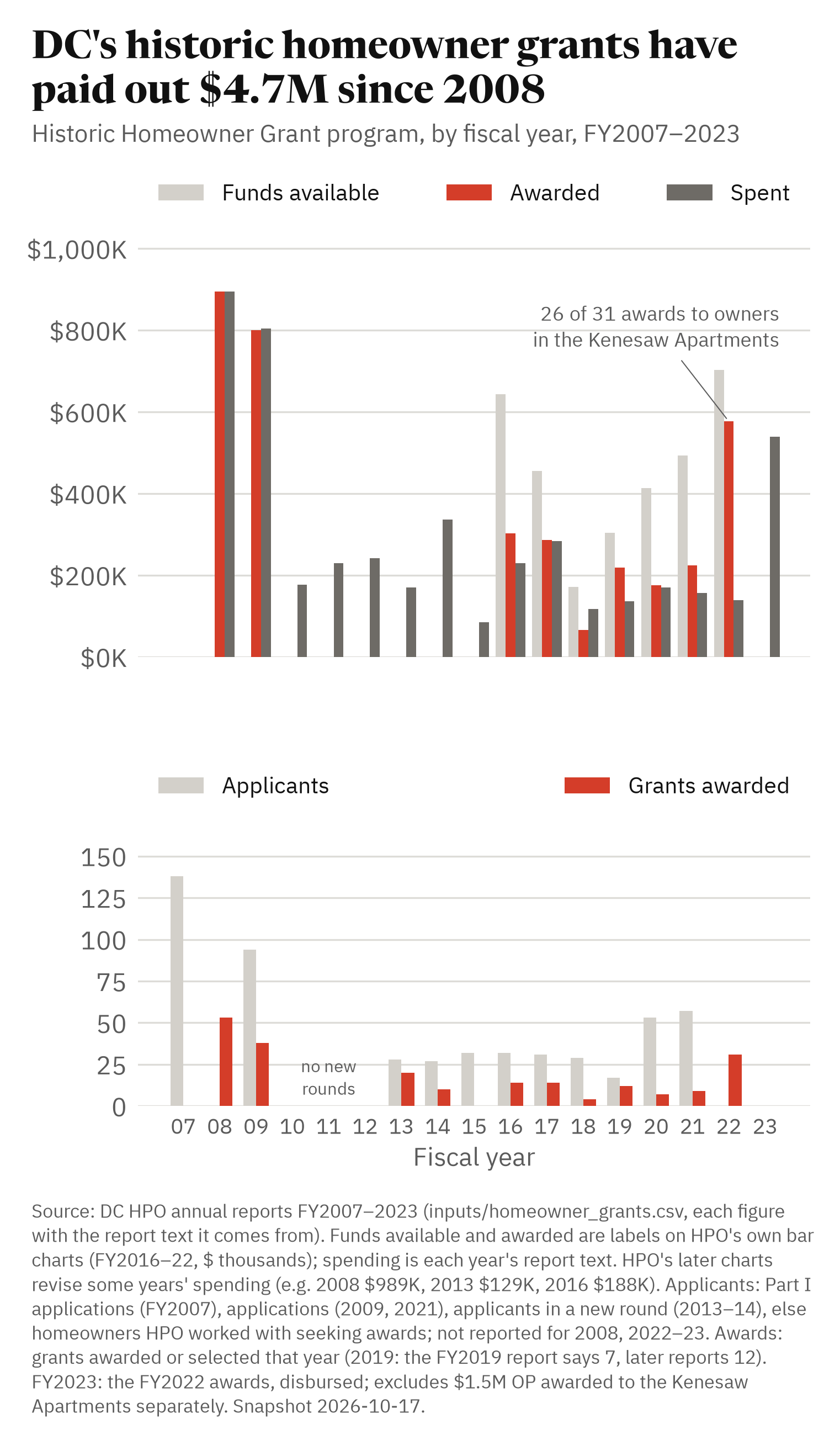
The other kinds of costs come in the form of forgone value: growth we could have had, but didn’t.
First, very little new construction occurs in historic districts. A Furman Center analysis of New York data concluded that “[w]ithin historic districts, six out of every 1,000 lots saw a new building constructed between 2004 and 2014, compared to 39 out of every 1,000 lots outside of historic districts.” A 2022 D.C. Policy Center analysis found a similar effect for our city.
Second, historic designation affects how quickly properties appreciate in value. That same DCPC study found that the total value of properties in historic districts grew at an annual rate of 4.9% while the value of properties that weren’t in historic districts grew at 6.2%.
These two effects are related. A lot of the additional growth in D.C.’s non-historic districts was from new construction. It’s hard to prove how much growth has been suppressed versus moved around: if it had been possible to build in those historic districts, some of the projects that went up elsewhere might have simply happened in different spots. It’s also true that the starting value of historic properties tends to be higher than non-historic ones, which is associated with a slower rate of appreciation.
Still, the potential gap is meaningful for the city’s finances. Projecting DCPC’s growth gap numbers out over time shows a property tax revenue gap that is significant, whether or not you count hypothetical additional construction. The Council members struggling to make D.C.’s current budget numbers work would surely appreciate a few extra tens of millions of dollars of annual revenue right about now.
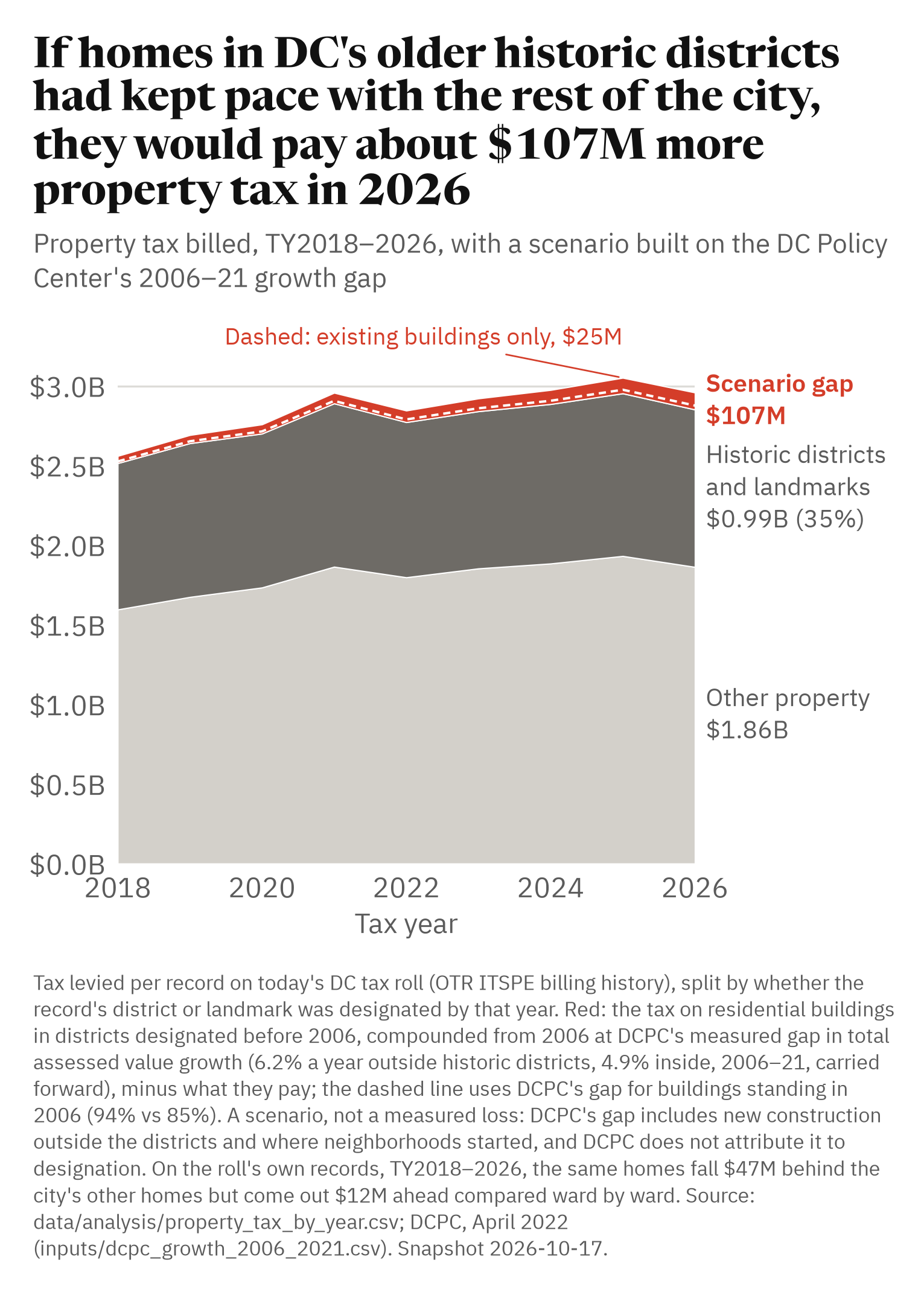
Not every study agrees with this analysis. There is evidence from other cities suggesting that historic designation hurts property values, but also some studies suggesting mixed scenarios, including some where homeowners’ property appreciates while overall housing supply suffers. The evidence that designation inhibits new construction and harms multi-unit valuations seems clearest.
Building hypotheticals from a still-contested body of research is good fun, but it’s probably more important to note that whichever way these effects tilt, they’re potentially large. Those costs are often absent from how D.C. talks about historic designation and its effects. That may be in part because the city itself is protected from them.
The Mayor’s Office Plays By Its Own Rules
The HPO receives between five and seven thousand permit requests in a typical year, and most are dealt with by the office’s staff, who work with property owners to reshape requests to meet HPO criteria. But 2-3% are forwarded on to the HPRB itself, particularly for projects that are large, unusual, or which include new construction.
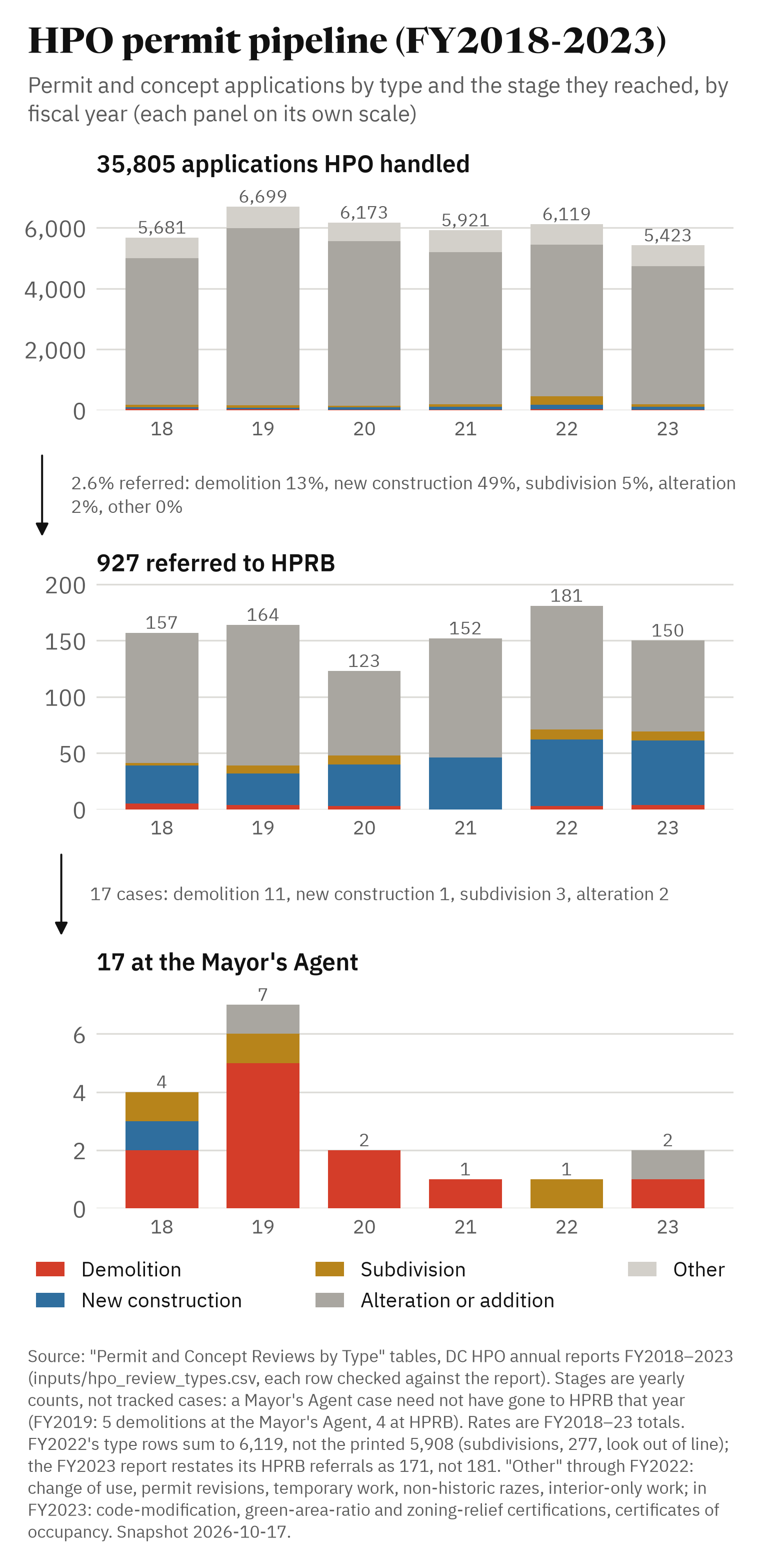
If a historic project involves demolition or the owner wants to fight an HPRB rejection, it can move on to the Mayor’s Agent. There are only a few such cases every year, and the Mayor can approve them on the basis of economic hardship or special merit.
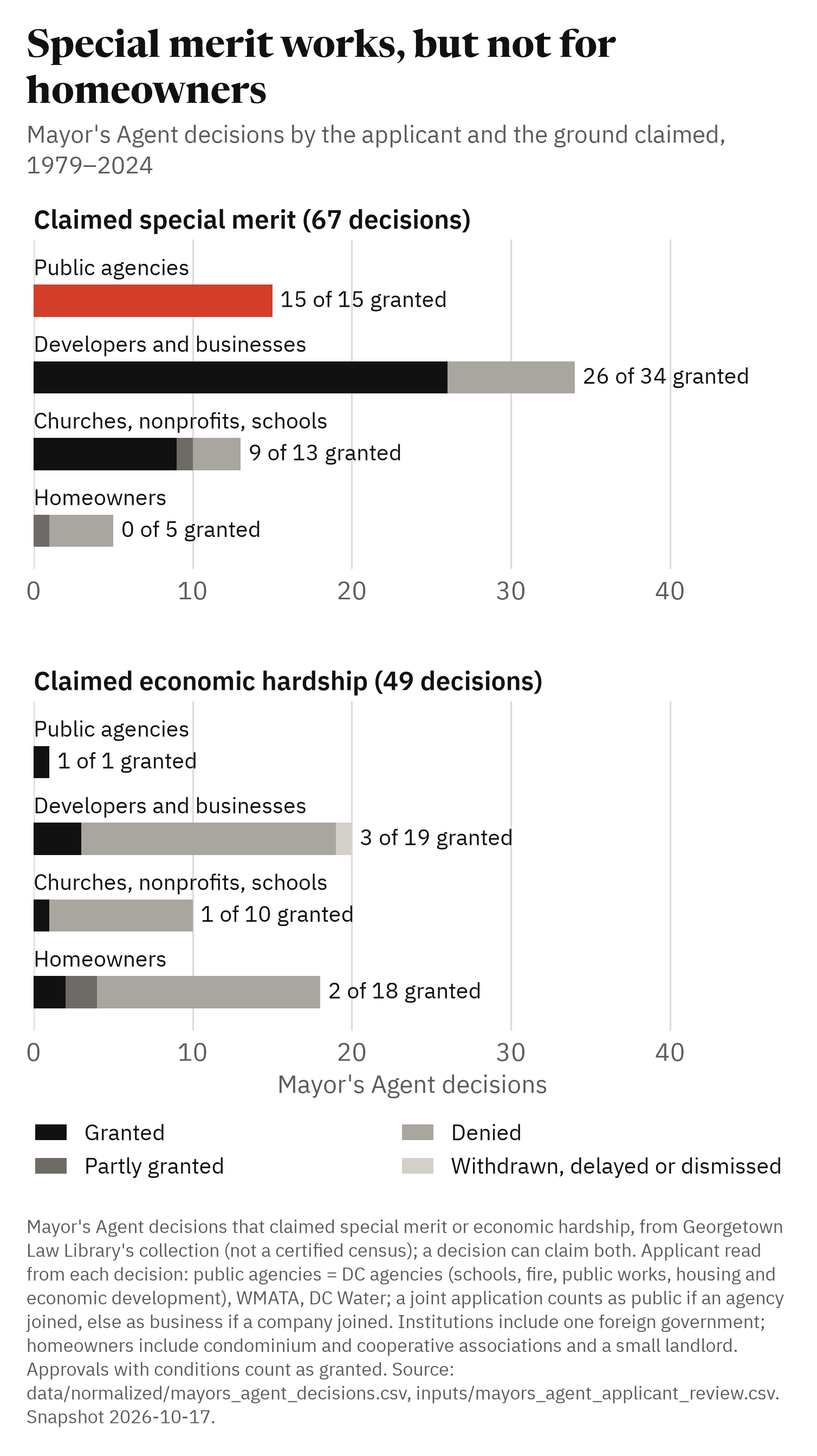
Economic hardship cases and claims from homeowners are rarely granted. But businesses and nonprofits do okay on special merit cases, and D.C. government agencies are granted permits 100% of the time in the dataset–the same success rate that those agencies enjoy when making nominations for historic designation (see above). The administration seems to find its own arguments to be very persuasive!
What Will Happen To The Armory?
Perhaps that’s good news for the prospects of redeveloping the Armory site: in practice, the city can probably push its priorities through past HPO rules.
But there may be other factors complicating the structure’s future. Although Events DC says it owns the Armory, the land it’s on is outside the Transfer of Jurisdiction boundary defined by Congress. The feds only got around to transferring the property last month, and it’s not clear when or if that process will complete. DCPL says it’s nominating the Armory both to the HPRB and to the National Register of Historic Places, and a listing on the latter could interact with federal ownership in ways beyond the scope of this article. This ambiguous status might be why it’s unclear exactly what the planners of the stadium redevelopment have in mind for the Armory: the project master plan spends just two paragraphs on it (see page 86). In a project where every square foot has been debated, it’s hard to imagine there won’t be some productive use for that land.
A One-Way Ratchet
Whatever the fate of the Armory, its nomination is a good reminder that D.C.’s approach to historic designation is unusual. A relatively small number of enthusiasts are able to nominate things for preservation, and the city overwhelmingly approves them–a process that is almost never reversed.
The resulting costs are diffuse and borne by all of us. Or almost all, anyway: the city government seems to be protected from them in ways the rest of us aren’t, which might be part of why the HPRB has been allowed to expand historic preservation rules at such a high rate for half a century.
Is this bad policy? Maybe. Or maybe you just don’t hate the idea of a rowhouse with vinyl windows enough.
Sources
DC designations, property and permits
DC Historic Preservation Office annual reports (FY1979–2023)
“Record of HPRB Actions on Designation Applications“ (HPO case log), released under the DC Freedom of Information Act, October 2026
Review board and Mayor’s Agent decisions
Historic Preservation Review Board meeting records (actions, agendas, notices and staff reports; search “HPRB”)
HPRB meeting archive, 2006–2026, DC Historic Preservation Office
Mayor’s Agent Decisions (D.C. Historic Preservation Law Collection, Georgetown Law Library)
Courts and zoning
CourtListener (Free Law Project records of DC Court of Appeals opinions and federal court dockets, via RECAP)
DC Preservation League
DC Preservation League (nominations, endangered places, grant award lists, board and history pages)
Comparison cities
Census 2020 place boundaries and water areas (U.S. Census Bureau, TIGERweb)
New York Landmarks Preservation Commission on NYC Open Data: individual landmarks, historic districts; address points
Philadelphia Historical Commission register sites and historic districts (City of Philadelphia ArcGIS Online); property points from the city’s Carto server (Office of Property Assessment)
Boston landmarks, historic districts and SAM addresses (City of Boston GIS)
OpenStreetMap building extracts (Geofabrik)
Code & source data