Welcome to the first Capital Commonsense Oversight and Policy Digest, a regular roundup of reports from the people and organizations whose job is to scrutinize DC government and the general state of affairs in the District. This will include the Auditor, the Inspector General, the CFO, the ethics board, and the various think tanks and advocates that dig into city policy.
These reports generally get little attention—but they should! Each digest, which we will aim to publish two to three times a month (depending on volume), gives you a quick summary for new reports and hearings, along with charts if there is particularly interesting data. For especially newsworthy reports, we will do standalone posts. (We have one planned for the CCJC report on implementation of the Youth Rehabilitation Act in December.)
This edition covers October 29 through today. Our finances are the common theme here—the District’s budget is under real strain, with three different offices recently making this point.
The budget
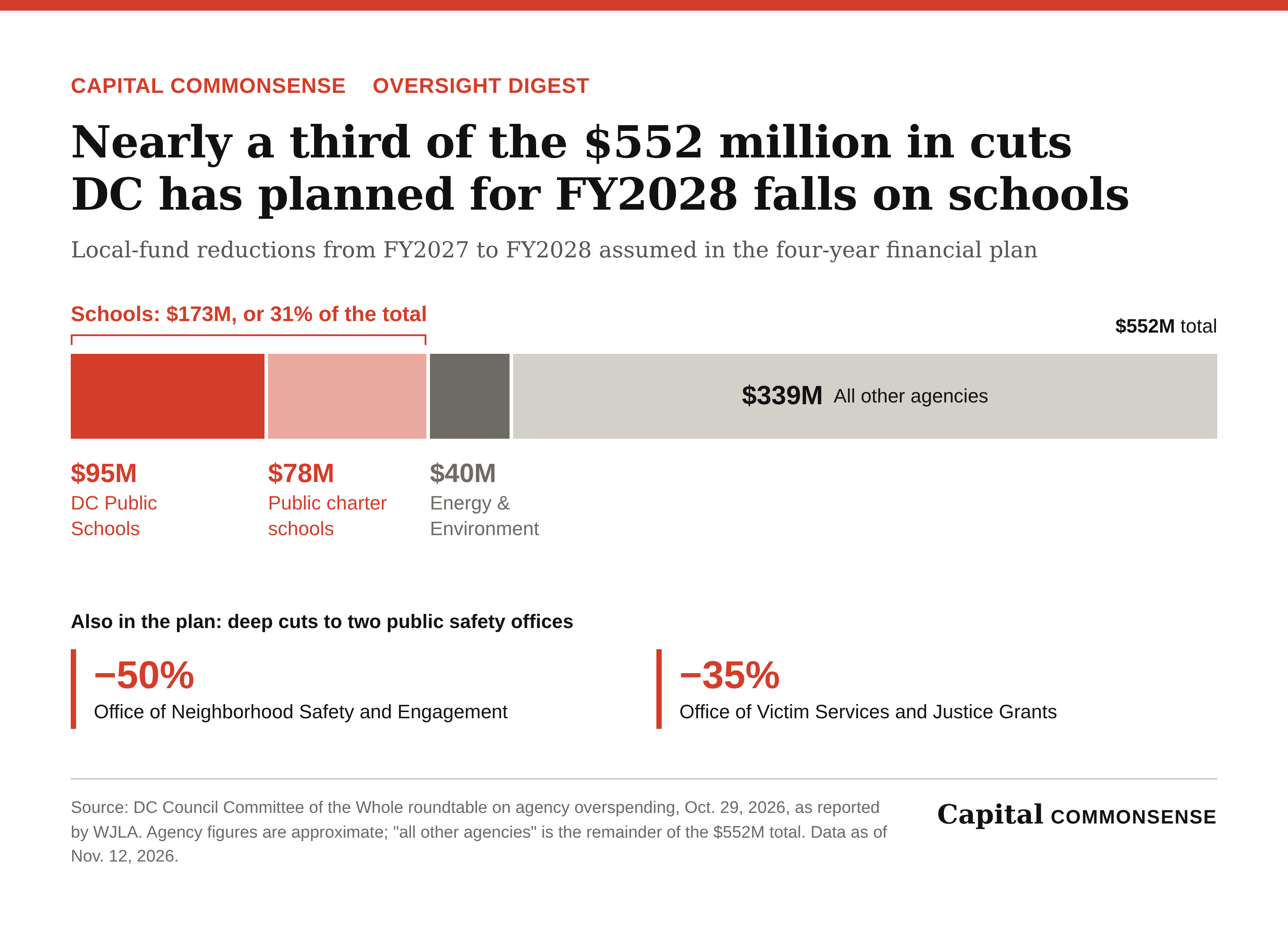
CFO and Auditor testify on agency overspending (Oct. 29) The Council’s Committee of the Whole held a roundtable on why agencies keep spending more than they’re budgeted. CFO Glen Lee warned the District faces “fiscal stress not experienced since the 90s.” He also cautioned that going over an original budget isn’t always illegal, since approved transfers can change budgets during the year. DC Auditor Kathy Patterson testified too. No agency directors appeared, as detailed in the WJLA reporting. Chairman Mendelson put next year’s gap at about $650 million. The current four-year plan already assumes $552 million in local cuts between FY2027 and FY2028, including about $95 million from DCPS, $78 million from charter schools, and half the budget of the Office of Neighborhood Safety and Engagement.
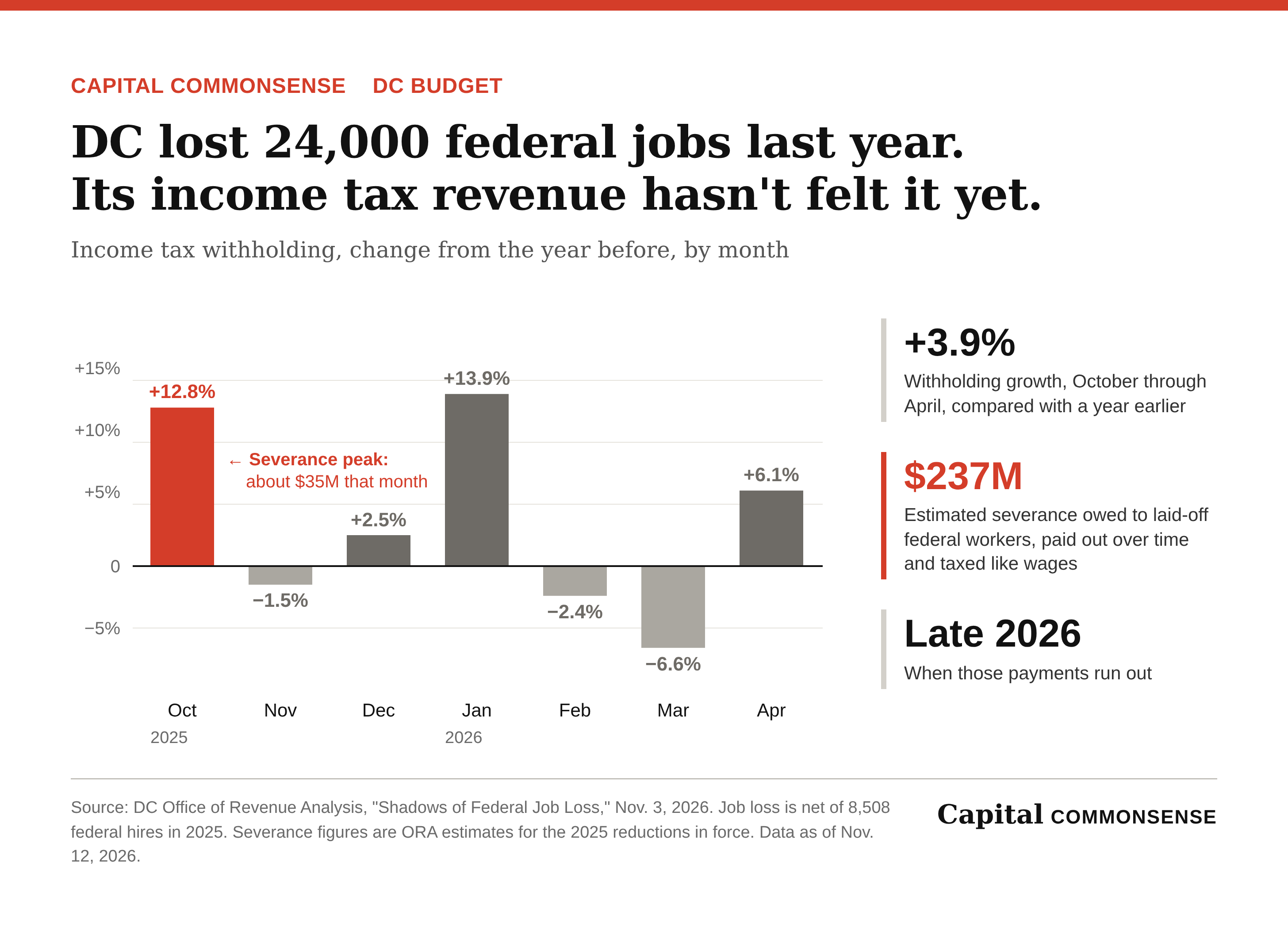
Shadows of Federal Job Loss, Office of Revenue Analysis (Nov. 3) The District lost about 24,000 federal jobs on net in 2025. So why hasn’t income tax withholding dropped? Part of the answer is severance: roughly $237 million in severance pay to laid-off federal workers is still being paid out through payroll, and it’s taxed like wages. Those payments run out this fall, so some of the recent revenue strength is likely temporary.
FY2026 District of Columbia Budget and Appropriations, Congressional Research Service (updated Oct. 30) This is a useful reference on what Congress gave DC this year. The District asked for $895.5 million in federal payments, and the President requested $728.5 million. Congress enacted about $878 million in February.
Accountability
Department of Buildings Can Reduce Risks of Dangerous Construction, Office of the DC Auditor (Oct. 30) The Auditor looked at how DOB enforces permitting rules and found gaps. Projects that are supposed to get extra scrutiny aren’t being watched closely enough. DOB also needs better oversight of the private third-party plan reviewers and inspectors it relies on. The report lays out reforms to reduce the risk of dangerous construction.
Ethics Complaint Summary, FY2026 Q4, Board of Ethics and Government Accountability (Nov. 2) The ethics office closed 82 matters from July through September. More than half (43) were outside its jurisdiction. Of the 39 it could act on, the most common were conflicts of interest (6), outside employment (6), misuse of government resources (5), and using public office for private gain (5). There were also four complaints each about political activity on the job and nepotism.
Policy research
Black Residents Bear the Brunt of Hits to DC’s Economy, DC Fiscal Policy Institute (Oct. 30) New Census data show median household income for Black DC residents fell about $10,000 in a year, to $52,700, the lowest in a decade. The citywide median held steady at $112,700. The poverty rate for Black residents was 30.7%, compared with 4.1% for white residents.
Federal Changes to SNAP Work Requirements Harm DC Residents, DCFPI testimony (Oct. 29) New federal SNAP work rules took effect in DC on June 1. The Department of Human Services estimates about 66,000 residents are subject to them, and hundreds have already lost benefits. DCFPI says DHS has shared little data and asks for a monthly public dashboard broken out by ward.
Affordable Housing in DC Needs To Be a Priority, DCFPI testimony (posted Oct. 29) This is DCFPI’s testimony on the Council’s Housing Production Omnibus. DC has just 37 affordable units for every 100 households earning under 30% of area median income. DCFPI supports the bill and wants a dedicated set-aside for preserving existing affordable housing.
In case you missed it
These came out in the weeks just before this edition and are worth knowing about.
Events DC owes the District $45 million, DC Auditor (Oct. 19). The Auditor found Events DC miscalculated the “excess cash” it’s required to send back to the city. The Council held a hearing on a related fix on Oct. 28.
Four new CJCC reports, Criminal Justice Coordinating Council (fall 2026). They cover juvenile pretrial detention before and after Secure DC, Youth Rehabilitation Act sentences, human trafficking, and felony crime statistics. The juvenile detention report finds more youth were initially placed in secure detention after the law changes, and very few were rearrested. CJCC cautions that the numbers are small.
Recommendations for the next Comprehensive Plan, Office of the Attorney General (Oct. 20). This white paper offers early ideas for streamlining DC 2050, the city’s next land-use plan.
Testimony on the Housing Production Omnibus, DC Policy Center (Oct. 19). The Center argues that the bill’s income targets may not cover the cost of operating the buildings.