

As friends, neighbors, and colleagues have tuned into the mayoral race over the last few weeks, a common theme has emerged: most voters are somewhere in between Kenyan McDuffie and Janeese Lewis George on political and policy preferences. I am no exception. If I could have picked any District leader to be our next mayor, my choice would have been Councilmember Christina Henderson.
So, I wanted to lay out my thinking, how I weighed various factors, and be fully transparent about where I agree and disagree with both candidates. To start, while I’m ranking McDuffie first, I disagree with him on a number of policies, including eliminating speed cameras and preserving historic districts that make it harder to build housing. I also don’t think we should consider freezing property taxes.
Before looking at specific issues, I want to make a broad, overarching point. If I lived in New York City, I would have voted for Zohran Mamdani. While I don’t agree with him on every issue, he made concrete moves to reassure skeptical voters—particularly on crime and education.
He went on Fox News to apologize to the NYPD. He pledged to keep Jessica Tisch on as Police Commissioner. He changed his position on eliminating the Specialized High School Admissions Test.
Changing your mind in public service is good, and I felt confident in how Mamdani would govern.
I can imagine a world where Lewis George had taken similar steps to reassure skeptical Washingtonians and I could have ranked her first. I am, after all, the typical urbanist who should vote for her. I don’t drive and haven’t owned a car since college. She and I have similar attitudes about the benefits of walkable city life.
I also understand the frustrations with Mayor Muriel Bowser and city services. I share them—my trash hasn’t been picked up several times this year. And while I think she has handled the Trump administration’s pressures about as well as any mayor could given the power imbalance between the federal government and the District, I completely understand why Washingtonians find Councilmember Lewis George appealing. Everyone in my social circle who has met her says she’s a passionate and thoughtful person.
However, she has not done nearly as much as Mamdani to reassure left-of-center voters given the District’s unique economic and fiscal challenges and her longstanding positions on crime and education. The primary reassurances I have gotten on this front are from her supporters.
If she wins the race, I hope she takes seriously what Councilmember Henderson told the Washington Post:
I think her position as mayor will be very different. And I know it’s very uncomfortable for people to sort of trust in that because they haven’t seen it displayed on the council. But I just think the reality of anyone when they get to be the chief executive is that you’re not just governing for the groups that endorsed you. You have to govern for the whole city.
Economy
To state the obvious, the District is facing massive economic challenges. These challenges did not begin with DOGE, but DOGE has greatly exacerbated them. Before federal layoffs accelerated in 2025, Washington was already struggling with the aftereffects of the pandemic and increased remote work, including a slow return-to-office for federal employees under the Biden Administration.
Downtown office vacancy rates have climbed from roughly 14% before the pandemic to more than 20% today—among the highest levels in the nation. Blocks of office buildings remain partially empty, depressing commercial property values and reducing the tax revenue that funds services. More than a dozen office-to-residential conversion projects are now underway because much office space is no longer economically viable in its current form. While these conversions are welcome, they nonetheless reflect underlying weakness in commercial real estate, one of our most important sources of economic activity and revenue.
Against that backdrop, DOGE delivered another blow with mass layoffs. According to our Chief Financial Officer, the District lost more than 22,000 federal jobs in 2025, removing around $3.7 billion in annual payroll from the local economy. Across the region, more than 100,000 jobs disappeared as federal cuts rippled through contractors and nonprofits. The result has been increased unemployment, declining commercial activity, and an economy that contracted by 8.3% in late 2025. If D.C. were a state, we would have one of the weakest economies in the nation.
To turn things around, we need to attract major private-sector investment that creates jobs and sustains the tax base that supports our social safety net, which—contrary to how it is portrayed by many activists—is among the most generous in the country. We have among the most generous health care programs in the country. We offer universal pre-K. We have among the highest TANF benefits in the country. We provide universal paid family leave.
The District has a robust social safety net to support, and we need economic growth to continue to fund it. I think Kenyan McDuffie is the most clear-eyed about our economic challenges and the need to improve our business climate to attract major private sector investment.
Taxes and Spending
At a moment when downtown remains weakened and federal employment is shrinking, the District simply cannot afford major new spending programs and tax increases that make it harder to attract and retain residents, employers, and encourage private-sector growth. To be clear, this concern applies to both candidates’ plans. I don’t believe McDuffie’s new spending programs are any more realistic than those of Lewis George.
Adjusted for inflation, D.C.'s local spending is up by more than 20 percent since the pandemic, while recurring revenue growth has not kept pace. According to the D.C. Policy Center, local fund spending grew roughly 35 percent between FY2020 and FY2024, compared with 17 percent growth in recurring revenues. A $5.6 billion structural gap was filled by pandemic aid, prior-year surpluses, and one-time transfers. This year the Council is poised to draw down our reserves to fill gaps in operations.
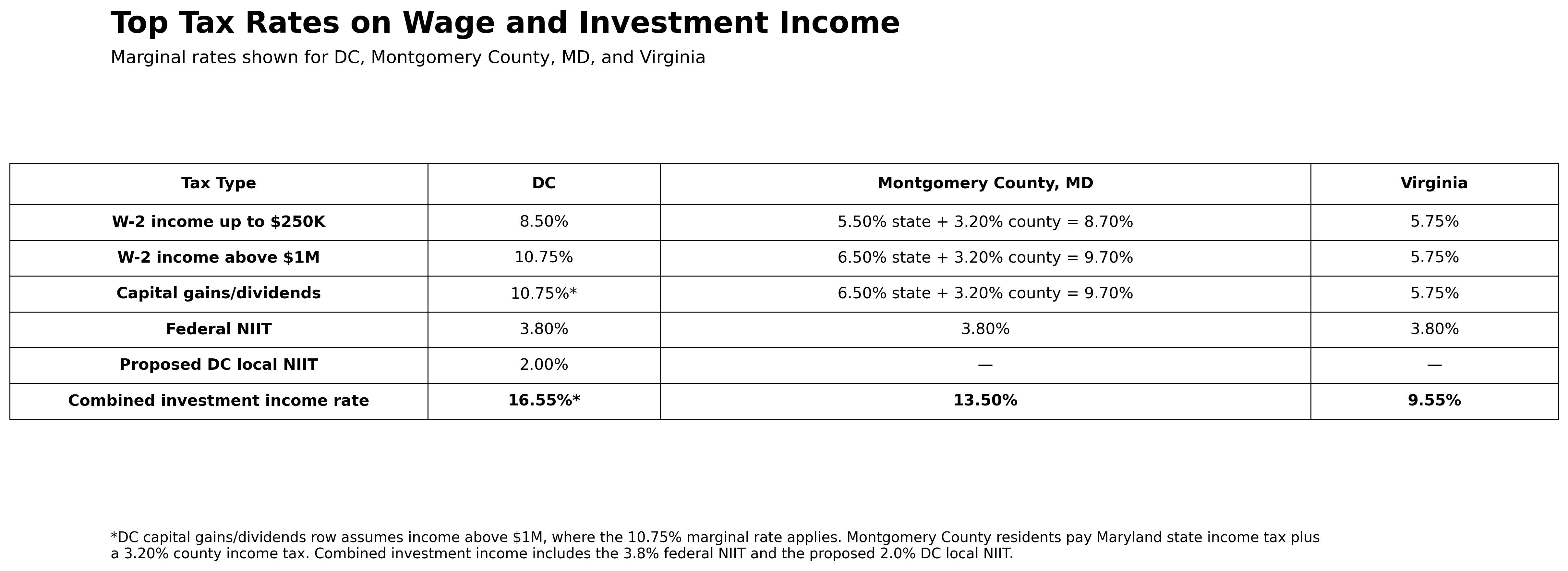
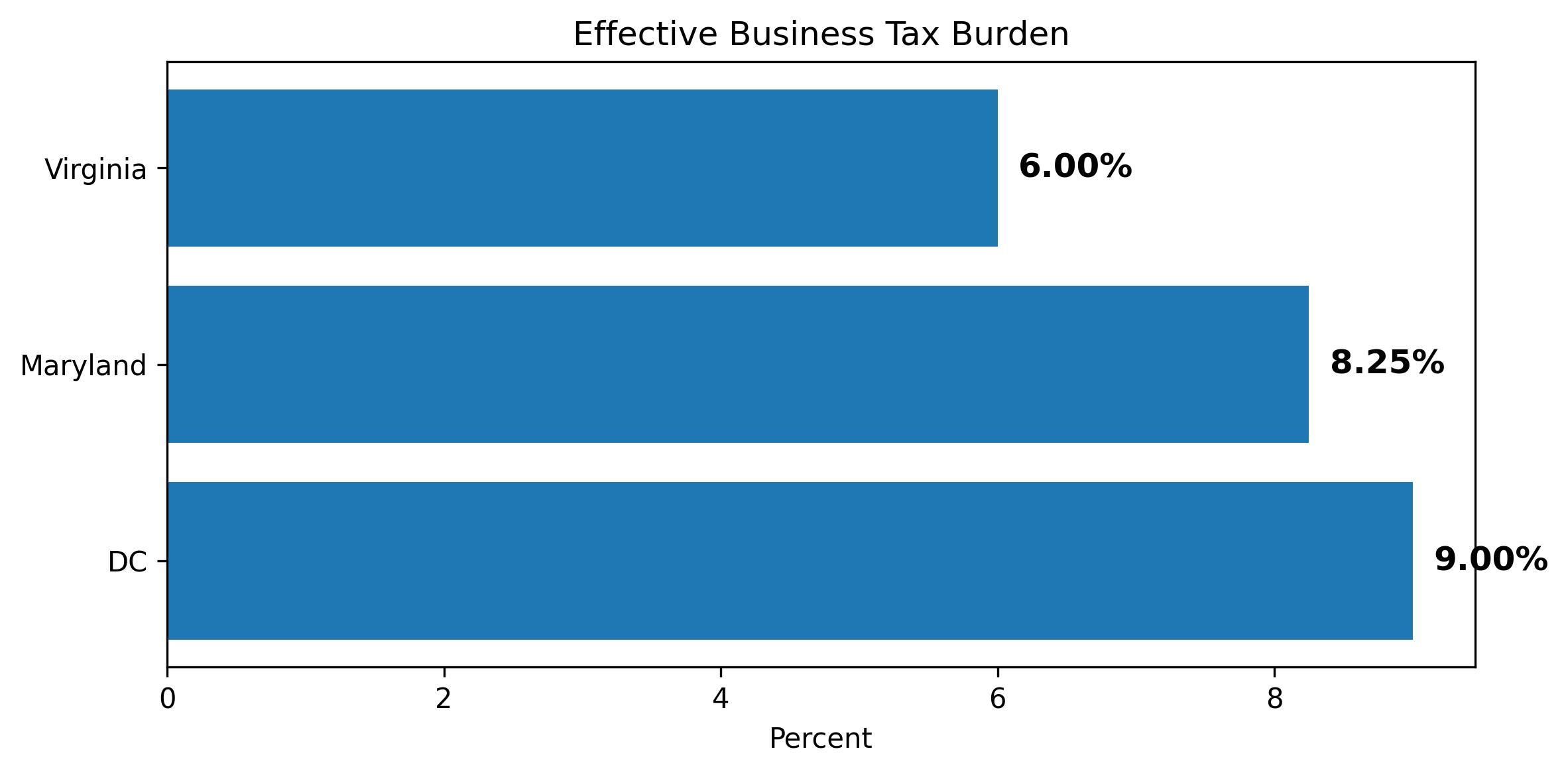
Against this backdrop, we already ask more of high-income residents and businesses than most jurisdictions in the country. The District’s top income tax rate is among the highest in the U.S., and it was just increased six years ago. Under a proposal from Councilmember Brianne Nadeau to impose a local version of the federal Net Investment Income Tax or NIIT, Washington would have the highest tax rate on non-wage income in the country. (The District taxes W-2 and capital gains income at the same rate.) Our business franchise taxes also exceed those of many competing jurisdictions.
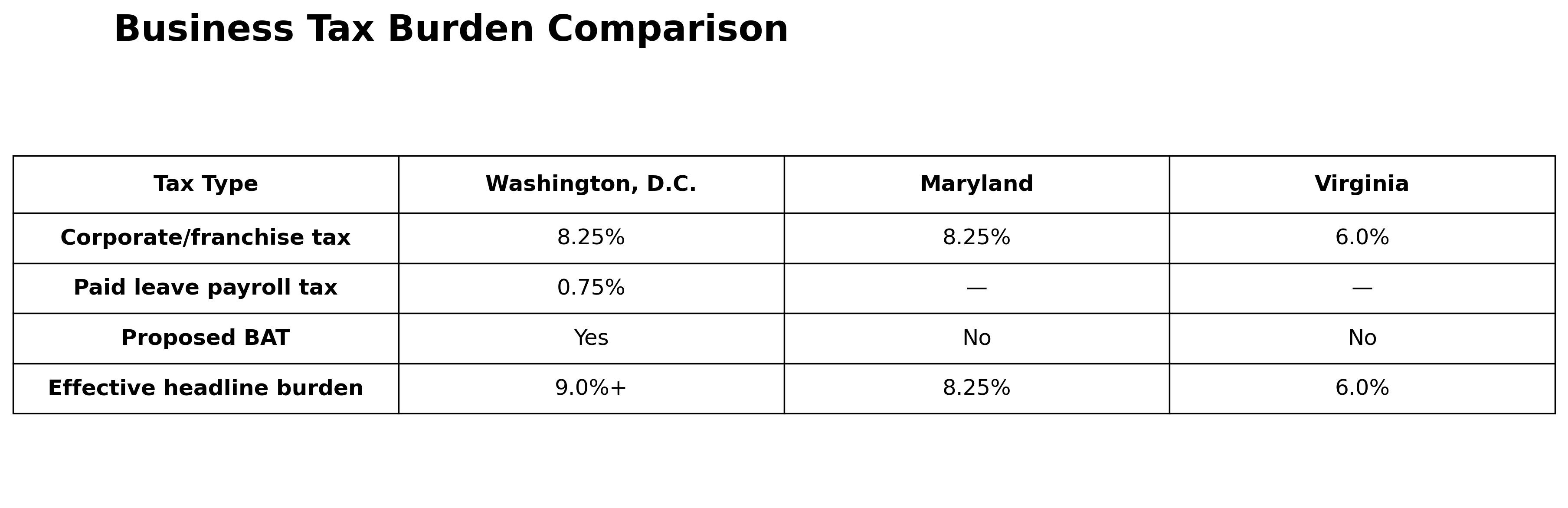
On top of this, Lewis George wants to impose a Business Activity Tax (BAT) that would incentivize firms to relocate and shift more of their economic activity to Maryland and Virginia. The BAT was originally conceived as part of comprehensive tax reform that would lower other business taxes — not as a standalone measure. In better economic circumstances and in the context of comprehensive tax reform, I would most likely support a BAT. Enacting it now, after we’ve already raised the universal paid leave payroll tax significantly, makes us less competitive at precisely the moment we need to be more competitive to fill the economic hole left by DOGE and remote work.
I say all of this as one of the most tax-positive people you’ll find. I worked for years in the Senate and Administration to advance policies to both raise taxes on the wealthy and corporations and ensure taxes owed are paid. I very much believe in tax fairness.
But our economy is in a deep hole, and if the U.S. economy were in a deep hole it would not be the time for major national tax increases either. We need to carefully consider the trade-offs of further tax increases when we desperately need to attract and keep high-income residents in the District to support our tax base. It’s much easier to move to Arlington or Bethesda, where services and schools may be better, than to renounce one’s citizenship and exit the United States.
To be clear, this is not to say that people earning $500,000 or $1 million per year couldn’t afford to pay more to pay more. It’s a question of whether another tax increase will push more of our tax base across the river and prevent us from attracting wealthier residents we need to sustain our tax base.
Crime
To level set, it’s important for voters to understand that the District is a high-crime city compared to its peers, particularly New York City. My views are shaped by this reality.
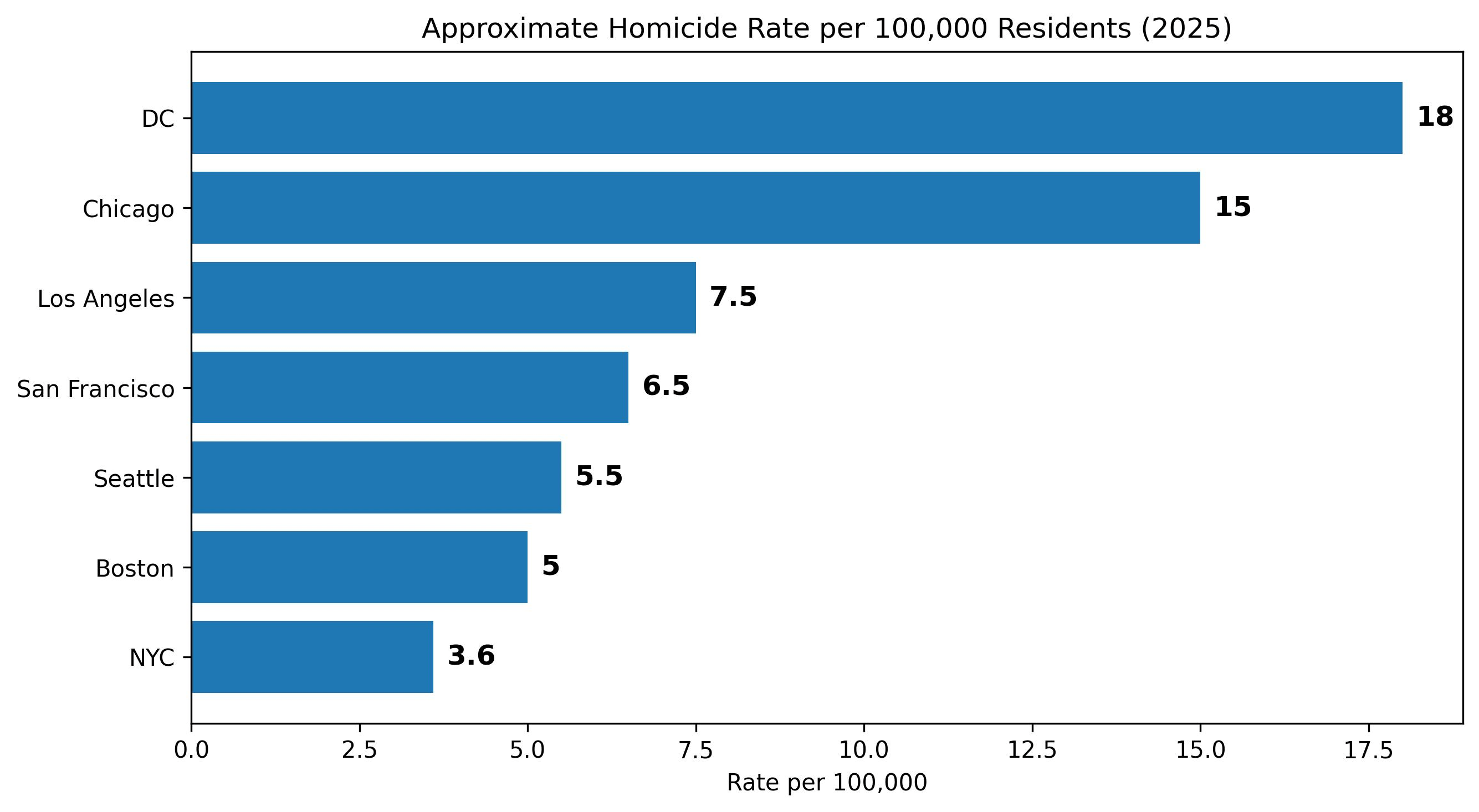
Lewis George is the most left member of the Council on crime, as I’ve written about. She was the only “no” vote against legislation to address violent tenants and violent crime in a year with 274 homicides—the most in decades. When two teenagers were shot and killed in broad daylight, she released a statement that led with the lack of grocery stores in the neighborhood, not enforcement against the perpetrators and a focus on illegal guns.
Her rhetoric has improved since that statement, which I give her credit for. This week she said explicitly she would see to emulate Baltimore’s approach to crime, which has driven homicides to their lowest rate in decades. Baltimore seeks early interventions with the relatively small group of people at risk of perpetrating or being victims of gun violence and has recommitted to strong prosecution of violent crime.
But despite some better rhetoric, she has been one of the loudest voices against teen curfew zones, showing some unwillingness to moderate her views to align with MPD leadership and the broader wishes of District voters. McDuffie has drawn a sharp contrast, backing curfew zones and repeatedly calling on the Council to pass emergency legislation that Lewis George and her allies have blocked.
To be clear, McDuffie has made statements and cast votes on public safety I don’t agree with. In 2020, he publicly questioned whether MPD funding should be redirected and said of the existing approach, “it is not working and we need to change the approach.”
But like many Democrats who went too far left on this issue around 2020, he has moderated—and that shift matters. I would much prefer a Democrat who learned from the party’s mistakes on safety than one who is more committed to a far-left view on the issue.
Education
Both of my parents were teachers, and beyond my parents, I owe much of my success in life to my public school education in New Jersey. I had access to tracking in 1st grade, a wide range of AP classes, and a rigorous curriculum — including Latin and Economics — that prepared me for college. I think the move away from reform, standardized testing, and accountability in the Democratic Party has been a serious mistake. Thankfully, this trend is reversing.
Public school is an essential service, but beyond resources, we need to maintain standards commensurate with that status. D.C.’s public schools have genuinely improved over the last two decades. On the 2024 NAEP assessment, D.C. fourth graders posted the largest math score improvement in the country—an 8-point gain over 2022 that tied for first nationally.
The pandemic-era backslide was unfortunately the continuation of a decade-long national slide, but DCPS bucked that trend. Over the past decade, DCPS students gained 0.8 grade levels in reading and 0.7 grade levels in math. This is a modest improvement, but it’s still an improvement.
I worry that Councilmember Lewis George threatens this progress. She is proud to say she would eliminate the IMPACT program, implemented in 2010 to improve teacher quality and accountability and reward high performers with meaningful bonuses. IMPACT has been studied extensively by Stanford and UVA researchers, who found it produced real student achievement gains — particularly for children in high-poverty schools. For more on IMPACT, please read Jordan Weissmann’s stellar piece from earlier this week.
Eliminating IMPACT has been the top demand of the Washington Teachers Union (WTU) for 15 years. Lewis George, endorsed by the WTU, gave a revealing answer on IMPACT when pressed—questioning its value while declining to defend the evidence behind it. She was asked about how she would replace IMPACT on a City Cast interview, and gave this non-answer:
A lot of people say there goes Janeese again. She doesn’t want to punish anybody.
No, no. We want to create an evaluation system that makes sure that our teachers are teaching our young people and also, you know, retaining the teachers we need in our city.
“An evaluation system that makes sure our teachers are teaching and retains teachers” is not an answer that reassures me on accountability and standards.
Beyond IMPACT and my general concerns about lowering standards and weakening accountability, I am concerned that Lewis George would not stand up to the WTU on tough issues when needed.
The WTU’s track record makes this fear concrete: the union fought school reopenings during the pandemic so aggressively that the city was forced to seek a temporary restraining order in early 2021. And earlier this year, the union campaigned to close schools during a severe winter storm. Mayor Bowser had schools open on a delay by Thursday when surrounding jurisdictions were closed all week. School is an essential service and it needs to be open like an essential service. In the same circumstances, I believe McDuffie would have opened schools— and Lewis George would have kept them closed. WTU is also of course skeptical of charter schools, which about half of District children now attend, although Lewis George has given encouraging answers on funding for charter schools this year.
City Services
City services is an area where I give Rini Sampath an edge over the top two candidates. Sampath has relentlessly focused on getting back to basics and delivering basic services. One of my concerns about a McDuffie mayoralty is whether he would adequately address the major gaps in city services Washingtonians experience. As I noted, my trash collection has been missed multiple times this year, not including the snowstorm.
Housing
On housing, I think McDuffie and Lewis George are comparable on land use issues and zoning, but McDuffie takes the collapse of housing investment and the potential for mass foreclosures in our affordable housing ecosystem much more seriously. Housing projects are simply not penciling in the District in this environment and addressing land use will not fix the issue. (Our guest post from Matthew Yglesias linked above goes into much more depth on housing so I’m not writing much here.)
The June 16 primary is an incredibly consequential election. The District is in a deep economic hole, and we need a mayor who is clear-eyed about that reality. For all of his shortcomings, which are real, I believe he is more likely to put Washington’s economic and fiscal health and public safety first. That is why I am ranking him first.