

Nearly a third of new establishments close within a year. The city has already designed the fixes, but shelved them. The next mayor should deliver one front door, one accountable owner, and one measure of success: survival.
D.C. cannot afford to keep treating small-business survival as a private problem for entrepreneurs to solve alone.
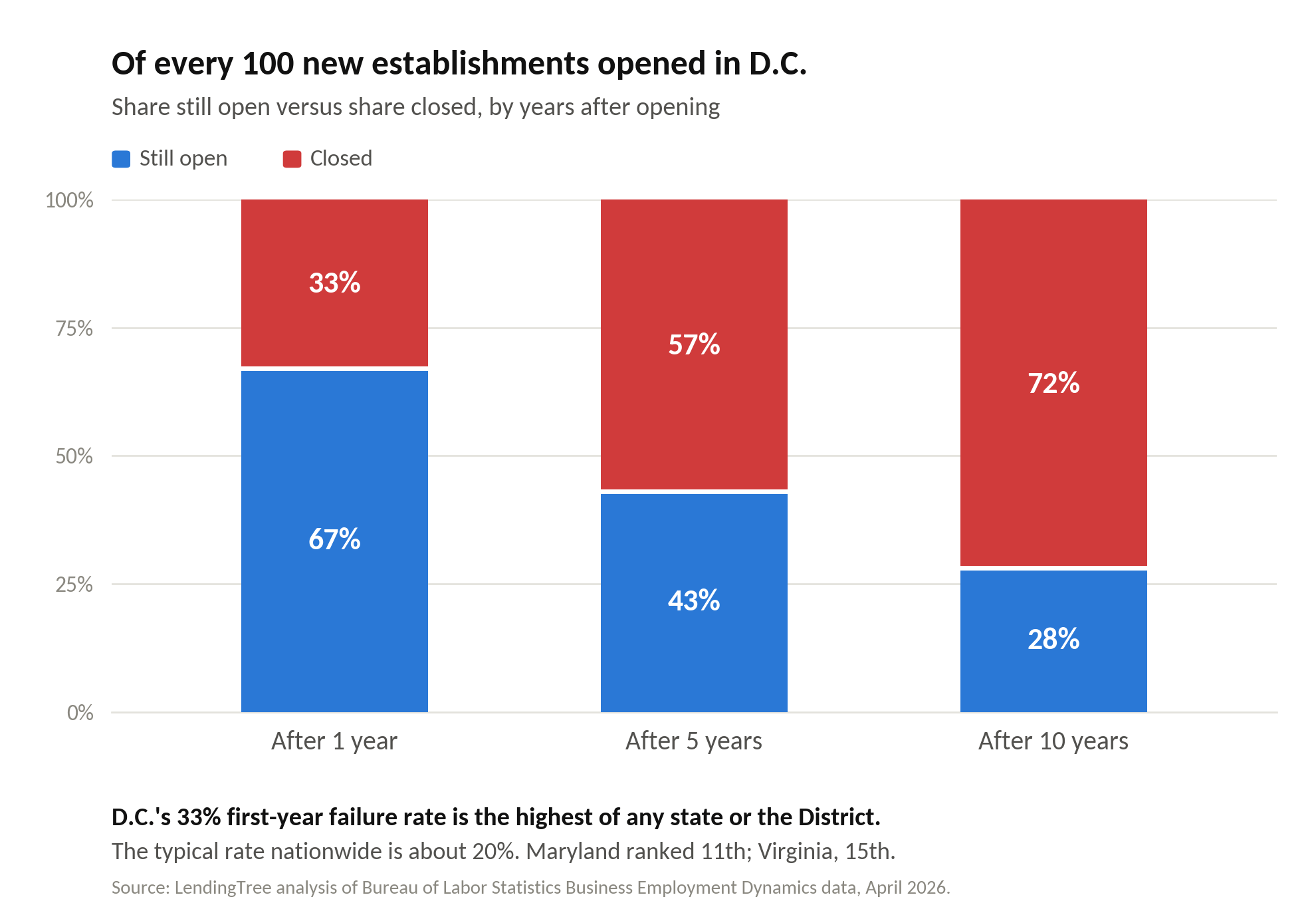
A new establishment in the District faces the worst first-year survival odds in the country. A recent analysis of federal data found that nearly one-third of new private-sector establishments in D.C. close within a year. After five years, 57 percent have closed. After ten years, that figure reaches 72 percent.
The restaurant industry puts faces and names to those numbers. D.C. lost 92 restaurants in 2025, up from 73 in 2024 and 48 in 2022. Mid-priced restaurants suffered some of the steepest losses.
Acqua Bistecca, chef Michael Mina’s ambitious Italian steakhouse at City Ridge, closed on August 10. It had opened less than a year earlier with the backing of a restaurant group that operates establishments across the country. If experience, capital, and a nationally recognized name could not guarantee one full year, imagine the odds facing a first-time entrepreneur investing their life savings in a neighborhood restaurant.
Acqua Bistecca’s closure does not prove that D.C. government caused it to fail. Mina cited declining travel and tourism, rising product and energy costs, and punishing conditions throughout the industry. Businesses also close because owners misjudge demand, choose the wrong location, take on too much space, or launch concepts that never find an audience.
But a jurisdiction where one out of every three new establishments closes within a year cannot dismiss each failure as an isolated business mistake. At some point, the pattern indicts the environment.
During my campaign for D.C. mayor, I met residents who decided to stick their necks out and build something in this city. They did not represent wealthy corporations or well-connected developers. They created dance studios, bars, restaurants, and neighborhood businesses. They invested their savings, accepted enormous personal risk, hired Washingtonians, and tried to contribute something valuable to their communities.
One bar owner in Dupont Circle told me that a D.C. government official had asked him for $10,000 to expedite a permit for a new establishment. Another entrepreneur who owned a dance studio told me that he left a District small-business office in tears because of how staff treated him.
Those conversations convinced me that the next administration must place economic revitalization at the top of its agenda. The city cannot measure success simply by ribbon cuttings, but by how many businesses remain open after one, three, and five years. Through my own work with federal government agencies, I know that customer service must underpin that work.
That phrase—customer service—may sound too simple for this crisis. It means giving entrepreneurs clear instructions, consistent answers, predictable timelines, coordinated reviews, and one accountable person to call when the process breaks down. It means treating their time and money as valuable.
Our campaign tried to put that principle into practice. We built a prototype Small Business Permitting Concierge that gave entrepreneurs one roadmap for navigating the city’s permits, licenses, inspections, and agencies. We later offered the concept to the Bowser administration but never reached a productive conversation about testing it. I will return to that experience because it offers both a model for better service and a warning about how D.C. government often responds to outside innovation.
The broader lesson extends beyond one digital tool: D.C. will not revive its economy through grants, incentives, and marketing campaigns while the daily machinery of government frustrates, confuses, and sometimes exploits the people trying to build businesses here. The next administration must do far more to bring life back into our neighborhoods and to our city.
When the system rewards fixers
A recent bribery case demonstrates what can happen when navigating government requires specialized connections.
Last month, a federal appeals court upheld the convictions of a self-described D.C. permit and licensing expediter and a local nightlife operator for their roles in a scheme that cost the District approximately $2.3 million.
Anthony Merritt, a former employee of the Department of Consumer and Regulatory Affairs, marketed himself as someone who could help businesses navigate the District’s complicated regulatory system. Instead, prosecutors proved that he passed cash bribes from bar and nightclub owners to Vincent Slater, a supervisor in the D.C. Office of Tax and Revenue. Slater manipulated government records to reduce their tax obligations. In one instance, he removed Echostage’s outstanding tax liabilities so the nightclub could renew its alcohol license. The D.C. Circuit affirmed the convictions in July.
The evidence showed that several business owners knowingly participated in the scheme. But the case still exposed a troubling ecosystem in which personal access, specialized knowledge, and government connections can carry more value than clear rules and predictable service.
When legitimate businesses believe they need a fixer simply to navigate city government, the system has failed. Corruption presents the most obvious problem. Bribery violates the law, betrays the public trust, and punishes everyone who follows the rules. But corruption thrives more easily inside systems marked by confusion, delay, discretion, and poor accountability.
That brings us back to D.C.’s broader failure: customer service.
Every unanswered email, contradictory instruction, unexplained delay, and disrespectful interaction carries a financial cost. For an entrepreneur operating with little margin for error, poor government service can consume months of savings or kill a promising business before it opens its doors. D.C. cannot make life more affordable for its residents while making it unaffordable—and unnecessarily difficult—to operate a business here.
A failure decades in the making
These stories reflect a problem that D.C. has allowed to fester for decades.
In 1993, business owners told the Washington Post that they could wait as long as six weeks for a final fire inspection or pay an additional fee to receive one within 48 hours. Restaurant owners blamed District agencies for delays lasting as long as four months. The resulting frustration helped sustain an industry of permit expediters who understood which office to call, which employee to approach, and how to move an application through the system. The article could almost have appeared this year.
The parallels extend beyond poor service. In 2016, former DCRA Business License Department employee Lucretia Barksdale pleaded guilty after accepting cash at her government workstation, allowing an undercover applicant to bypass the normal line, and issuing permits that falsely identified a licensed tradesman. A second employee, Stacie Williams, later admitted that she frequently worked with Barksdale in the scheme.
Twenty-three years separate these two stories, yet the basic choice remains familiar: endure the ordinary process or find someone with the money, knowledge, or connections to move faster. D.C. has repeatedly punished individual wrongdoers without fully redesigning the system that made their access so valuable.
That history makes Washington’s enduring businesses all the more remarkable. They survived because their owners built deep neighborhood roots, earned loyal customers, adapted through periods of upheaval, and carried institutions across generations. Their stories show what D.C. gains when businesses survive—and what the city now stands to lose.
What Washington loses when businesses disappear
Washington still benefits from businesses that survived long enough to become civic institutions. The Florida Avenue Grill opened with two stools in 1944 and remains one of the country’s oldest continuously operating Black-owned restaurants. Industrial Bank opened during the Great Depression with six employees and $192,000 in assets, then helped generations of Black Washingtonians buy homes and build businesses. The founding family still operates it more than 90 years later. A. Litteri reached its 100th anniversary in 2026, while Ben’s Chili Bowl has served Washington since 1958.
Those businesses became more than places to spend money. They created jobs, financed families, anchored commercial corridors, and gave their neighborhoods a sense of identity. Their longevity also makes D.C.’s current failure rate more alarming. In a city where nearly one-third of new establishments close within a year and 72 percent close within a decade, most entrepreneurs never receive enough time to develop deep roots or loyal customers. Each early closure can erase a future neighborhood institution before residents ever recognize what they lost.
Government cannot manufacture a beloved restaurant or a multigenerational bank. It can stop consuming the time and capital that businesses need to survive. The next administration should make the process understandable before an entrepreneur spends money, take responsibility for moving applications across agencies, and support viable businesses after they open.
A customer-service framework for small-business revival
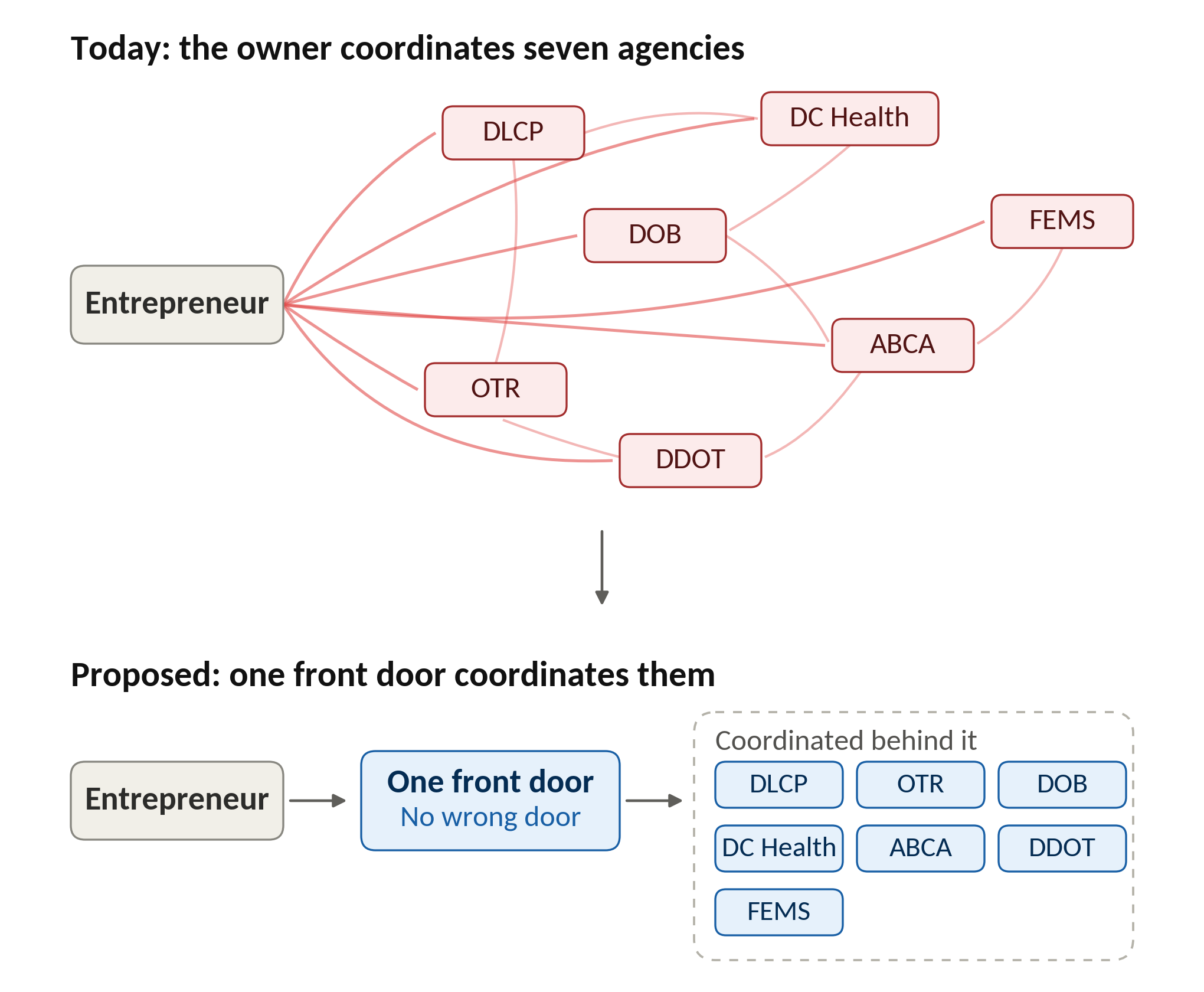
Opening a restaurant reveals the problem further. Depending on the concept, an entrepreneur may need corporate registration and a business license from DLCP (Department of Licensing and Consumer Protection); tax registration and Clean Hands verification from OTR (Office of Tax and Revenue); construction permits, zoning approval, and a certificate of occupancy from DOB (Department of Buildings); a food-manager certificate, plan review, and inspection from DC Health; an alcohol license from ABCA (Alcoholic Beverage and Cannabis Administration); public-space approval from DDOT (District Department of Transportation); and fire-related permits or inspections from FEMS (Fire and Emergency Medical Services). Navigate this process, and one quickly discovers a daunting array of overlapping administrative agencies and acronyms.
Each requirement may protect a legitimate public interest. But the entrepreneur does not experience seven separate regulatory functions. The entrepreneur experiences one task: opening a restaurant. Government alone divided that task among agencies, websites, applications, and timelines.
D.C. does not lack ideas for improving that experience. Its own teams and economic plans have already described much of the necessary architecture. What the city lacks is sustained ownership, public deadlines, cross-agency follow-through, and consequences when promised reforms stall. The next mayor and DMPED should organize that unfinished work around three customer-service commitments: give entrepreneurs a complete roadmap before they apply, put one person in charge while agencies review their applications, and measure and support survival after they open.
Commitment One: One front door and no wrong door.
Good customer service starts before an entrepreneur signs a lease, hires an architect, or spends money on an application.
The District should give every business owner one accurate, address-specific roadmap that identifies the required permits, licenses, inspections, fees, documents, and sequence. The owner should create one reusable business profile, upload common information once, track every agency through one dashboard, and receive help online, by telephone, or in person. No applicant should need to understand the District’s organizational chart to follow the law.
Other governments already organize their services around that principle. Singapore’s GoBusiness platform brings more than 120 government services together and uses digital advisers to recommend the licenses and services an entrepreneur needs. Portugal’s “Company in an Hour” service lets an entrepreneur complete the procedures required to incorporate at one service desk. Neither country eliminated regulation. Both organized government around the task the customer wants to complete.
D.C. has already promised versions of that model. The city’s 2023–2027 Comeback Plan called for a physical and digital one-stop permitting center, a single login, shared data across agencies, personalized next steps, and a consolidated dashboard for forms and payments. DLCP’s Business Resource Center already describes itself as a concierge service, and its ward-based account managers give residents one contact for problems within DLCP.
The city has also made real technological progress. In 2023, DLCP and OCTO launched the DC Business Licensing Portal, which offered personalized checklists, cost and time estimates, and guidance for several common business types. This month, DLCP launched BOSS, its Business One Stop Solution. BOSS combines corporate registration with several licensing functions, reduces redundant uploads, sends deadline alerts, and gives users a dashboard with real-time status information. Those improvements deserve recognition.
But BOSS does not yet complete the journey described in the Comeback Plan. Its current scope centers on corporate registration and services administered by DLCP. An entrepreneur still cannot complete one transactional process across DOB, OTR, DC Health, ABCA, DDOT, and FEMS. The Resource Center and ward account managers can help with DLCP questions, but they cannot resolve every cross-agency dependency that determines whether a business opens.
The District had already designed a more ambitious approach. In 2022 and 2023, the mayor’s Innovation Team interviewed agencies, utilities, and small-business owners and developed seven permitting reforms. They included an address-specific Permit Explorer, joint concept reviews before submission, public and enforceable service standards, a universal permit wizard, streamlined Clean Hands checks, regulatory simplification, and help with permit costs. The team completed pilot-ready plans for its three leading proposals. Before those pilots launched, the mayor reassigned the team to another priority. Our next administration must do better.
Our campaign independently reached the same conclusion. One of our data leads, Alanna Fridfertig, built a prototype Small Business Permitting Concierge. An entrepreneur could describe the company, restaurant, bar, or other establishment they wanted to open and receive a step-by-step roadmap covering the permits, licenses, inspections, and government offices involved. The tool organized the process around the business owner’s goal rather than the government’s organizational chart.
After the campaign, we offered the prototype to the Bowser administration. We hoped the District might test it, compare it with the unfinished Innovation Team work, or incorporate parts of its approach into BOSS. We never reached a productive conversation about doing so.
Our prototype did not constitute a finished government product. A full implementation would require current agency data, legal review, accessibility testing, cybersecurity safeguards, extensive user testing, and clear ownership inside government. But the repetition itself makes the point: D.C. does not need another report explaining that entrepreneurs want one coherent journey. It needs to finish the work already designed.
The next administration should set public milestones for bringing the remaining agencies into BOSS and test the entire process with first-time entrepreneurs before calling it complete. The District already has legal language-access obligations; the new standard should require entrepreneurs to complete the same end-to-end transactions in the city’s threshold languages and require agencies to publish completion rates and disparities. Every business-facing webpage should identify the employee responsible for its accuracy and the date of its last substantive review. D.C. already employs teams that develop and test public-service ideas; it still needs a predictable route for an outside prototype to enter government. The city should publish evaluation criteria, name a decision-maker, respond within 90 days, and fund promising pilots with a defined path to adoption.
Commitment Two: One accountable owner and one reliable clock.
Clarity alone will not help an entrepreneur whose application disappears between agencies. Good customer service also requires someone to own the outcome, explain what comes next, and tell the truth about time.
The recent streatery transition shows what happens without that ownership. Martha Dear owner Tara Smith described the permanent-permit application as nearly a full-time job and waited almost seven months for approval. The process required coordination among DDOT, DOB, and ABCA and could also involve historic-preservation and arborist reviews. Meanwhile, other restaurant owners faced removal orders and possible fines while their applications remained under government review. Smith said the process demanded interagency coordination that did not exist within the government itself.
The sequencing of ordinary licenses can produce the same problem. The District requires many individuals and businesses seeking licenses, permits, grants, or contracts to obtain a Certificate of Clean Hands. The certificate confirms that the applicant has filed all required District tax returns and does not owe more than $1,000 in fees, fines, taxes, or penalties to OTR or the Department of Employment Services. Without that clearance, the District can deny the application.
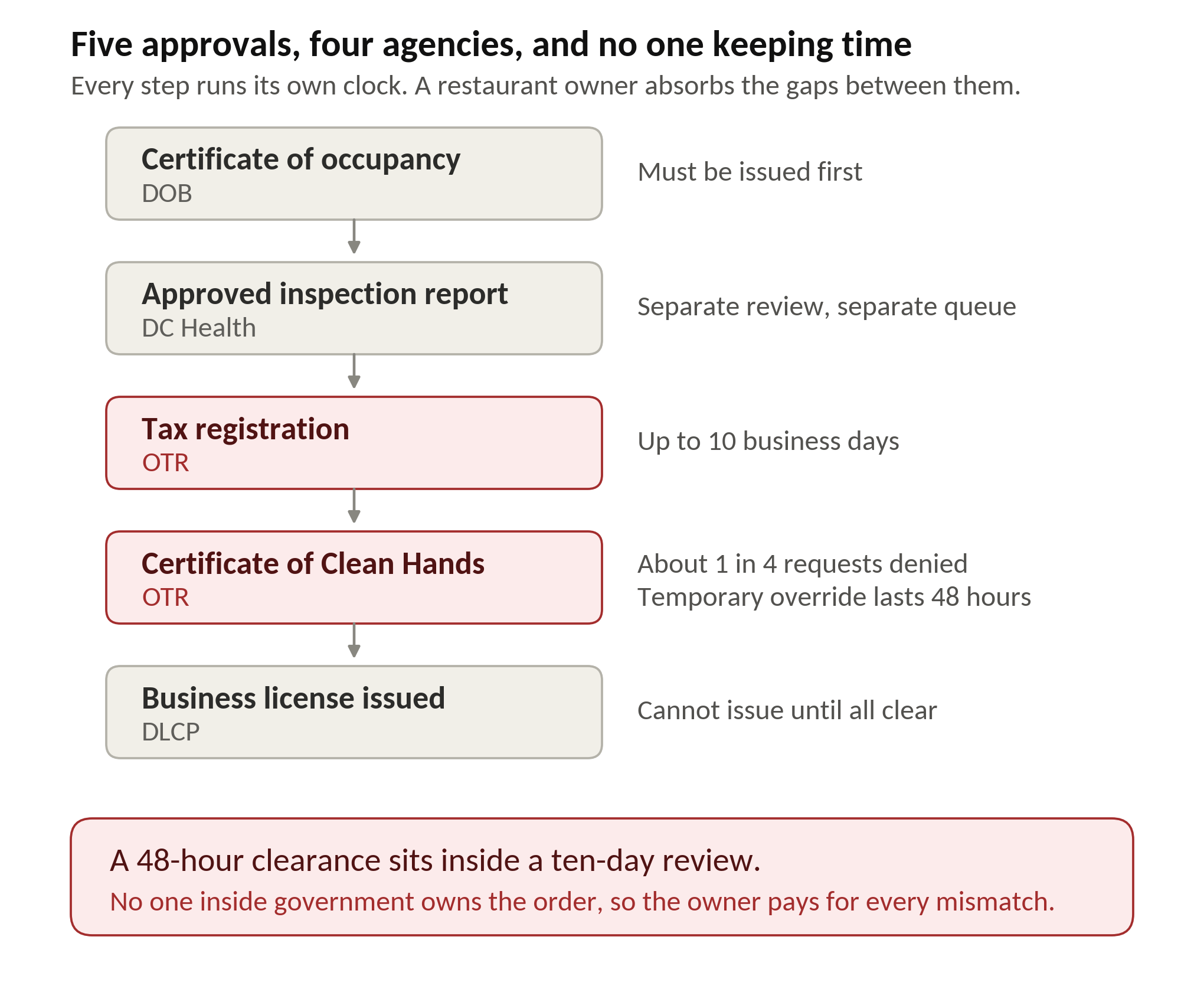
For a restaurant owner, the Clean Hands check sits inside an already complicated chain of approvals. Before DLCP issues a restaurant license, the owner must produce a certificate of occupancy and an approved DC Health inspection report. OTR may take up to ten business days to process a new tax registration. When OTR provides a temporary override to complete the licensing check, that clearance may remain valid for only 48 hours. An owner can clear one requirement only to watch that clearance expire while another agency reviews the application.
Clean Hands failures often arrive as a surprise at the worst possible moment. The Lab @ DC reports that roughly one-quarter of Clean Hands requests get denied each year. The city has begun testing notices four months before license renewal that explain noncompliance and how to correct it. Diana Gross of the DC Chamber of Commerce captured the customer-service principle behind the pilot: “Businesses want to be in compliance and have a place to go and check … so that there is no gotcha.” If the pilot works, D.C. should make those notices permanent, integrate them into BOSS, and publish whether they reduce denials and forced interruptions.
D.C. has also proved that it can simplify rules. Before the Business and Entrepreneurship Support to Thrive Act, the District maintained more than 100 business-license and endorsement categories. Eleven categories had no licensed businesses, while 39 had issued fewer than 20 licenses over four years. Some fees exceeded $3,000. The BEST Act consolidated the system into 13 categories, lowered fees, removed outdated requirements, and capped penalties for expired licenses. The District deserves credit for that reform.
But the city should not wait for complexity to become indefensible before reviewing it. The DC Chamber of Commerce has called for a whole-of-government regulatory review every three years, supported by analysis of how proposed rules will affect small businesses. D.C. should adopt that recommendation and invite entrepreneurs, workers, consumers, and frontline employees to distinguish rules that protect the public from procedures that merely waste time.
The District has already proposed the other basic tool it needs: service-level agreements. Both the Innovation Team and the Comeback Plan called for agencies to publish permit-review timelines. The next administration should implement those promises, report monthly compliance, and attach consequences when government misses its own deadline.
DMPED should formalize the scattered pieces of business assistance into a Small Business Service Delivery Office with authority across agencies. The office should not replace the Business Resource Center, ward account managers, SmallBiz Assist, or agency reviewers. It should connect them. For every complex opening, one journey manager should give the entrepreneur a master timeline, identify dependencies, convene the relevant agencies, and remain responsible until the business receives a final answer.
That office needs written agreements with DLCP, DOB, OTR, DC Health, ABCA, DDOT, FEMS, and OCTO that define response times and escalation authority. A stalled application should escalate automatically. If a government-caused delay makes an approval expire or prevents an on-time renewal, the city should extend that approval or pause the related penalty clock. Applicants should not pay for time the government lost.
Every denial should explain the problem in plain language, identify the evidence or rule supporting it, and tell the owner exactly how to cure or appeal it. Every action should carry a timestamp visible to the applicant and supervisors. DMPED should not overrule legitimate health, safety, tax, zoning, or licensing decisions. It should make agencies coordinate their work and hold someone accountable for whether the entrepreneur receives a fair, timely answer.
Commitment Three: Measure and support business survival
Customer service cannot end when the city issues a license or cuts a ribbon. A government serious about revitalization should stay close enough to identify preventable problems during the vulnerable years that follow.
D.C. has already said that survival matters. The Comeback Plan named the five-year survival rate as a key economic indicator and promised an annual survey of business owners covering starts, ownership, capital, revenue, size, and survival. DMPED later conducted a 2024 Small Business Census, but the public census page still identifies only the 2024 effort and displays no annual survival series.
Current agency plans make that gap harder to excuse. DMPED’s fiscal year 2026 performance plan lists “Business Attraction and Retention” as a major activity, followed by “No Related Measures”. DSLBD’s plan likewise lists major objectives—including commercial-corridor revitalization and efficient, transparent, responsive government—without related performance measures. The city still cannot tell residents whether its small-business apparatus helps businesses survive.
The next deputy mayor should publish a business-survival dashboard built primarily from administrative records rather than another stand-alone survey. It should track the median time from first application to authorization to open; wait times at each agency; resubmissions caused by missing or contradictory instructions; application abandonment; use of accelerated service; and survival after one, three, and five years. The city should break those results down by industry, ward, owner demographics, and use of District assistance. The mayor should tie DMPED leadership evaluations and budget decisions to those outcomes.
Every agency can report that it processed its piece. Someone must answer for whether the business opened and survived.
That responsibility matters after opening because government decisions can suddenly change a business’s prospects. During construction around Dupont Circle this year, Rosemarino D’Italia reported that revenue fell 25 to 35 percent and employee hours fell 30 to 40 percent. Another owner summarized the conditions bluntly: “This is not a slowdown. This is a crisis.” Business owners said disrupted access, noise, dust, and poor communication drove customers away.
DDOT already requires written notice to affected businesses at least two weeks before certain scheduled construction and assigns a project manager to each project. The policy exists; the city should audit whether project teams follow it. Each major project should have a public schedule, a change log, coordinated signage, loading and pedestrian-access plans, and a contact who must answer within a published period.
DMPED also created a Capitol Hill Construction Impact Grant this year for businesses affected by specified DDOT projects. That response acknowledges the harm, but a one-time, place-specific competition does not create a reliable system. D.C. should establish a standing citywide formula that automatically offers bridge assistance when a public project crosses defined thresholds for duration, loss of access, or documented revenue decline. The owner should not have to discover a short application window after the damage begins.
The city should apply the same customer-service discipline to grants, loans, and technical assistance. The Comeback Plan promised a central technical-assistance hub and one base grant application. DSLBD now offers one-on-one guidance through SmallBiz Assist, while District Capitalized coordinates financing products, training, and referrals. Selected programs already provide upfront or milestone-based funding. Those pieces help, but businesses still confront separate portals, eligibility rules, financial forms, and application processes.
The next administration should set a deadline for one verified financial profile that, with the owner’s consent, a business can reuse across DMPED, DSLBD, participating lenders, Main Streets, and corridor programs. The system should match the owner with eligible support and show what additional information each program requires. Upfront or milestone payments should become the default whenever reimbursement would exclude businesses with the least cash, subject to appropriate controls.
The Small Business Service Delivery Office should also schedule check-ins 30, 90, 180, and 365 days after a business opens. Those contacts should focus on unresolved licensing issues, tax or renewal deadlines, construction losses, capital needs, and referrals—not another ceremonial survey. When a business cancels a license, withdraws its registration, or closes its tax account, the city should ask why. DMPED should publish the patterns in an annual small-business friction report and identify the policy owner responsible for each corrective action.
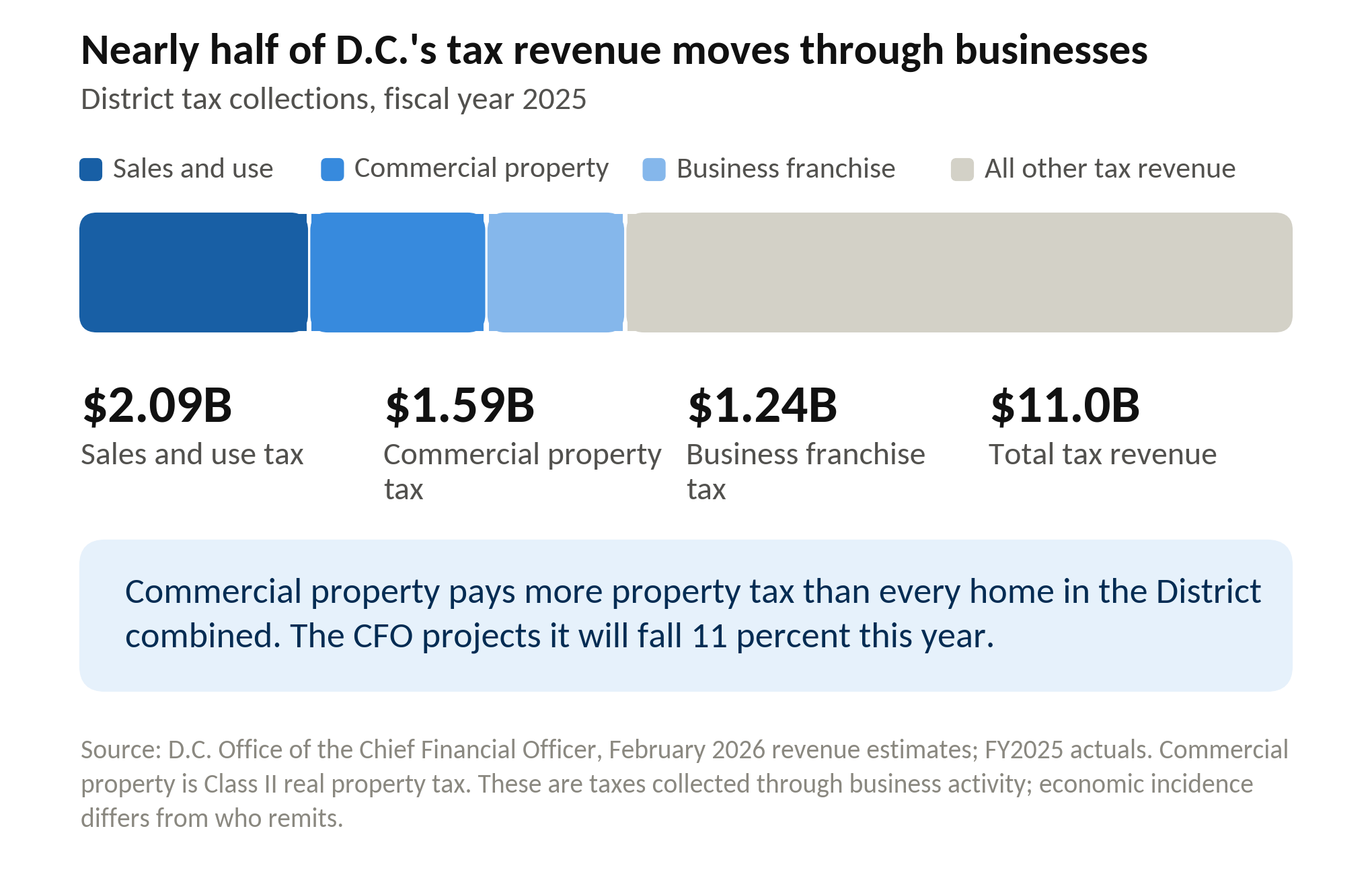
All of this work belongs within the affordability agenda the incoming administration is touting as essential to D.C.’s future. In fiscal year 2024, business franchise taxes generated approximately $1.13 billion for the District, while sales and use taxes generated another $2 billion. Businesses also support commercial-property revenue and create jobs whose wages produce income-tax revenue. Those interconnected sources finance schools, housing programs, health care, public safety, and the social safety net.
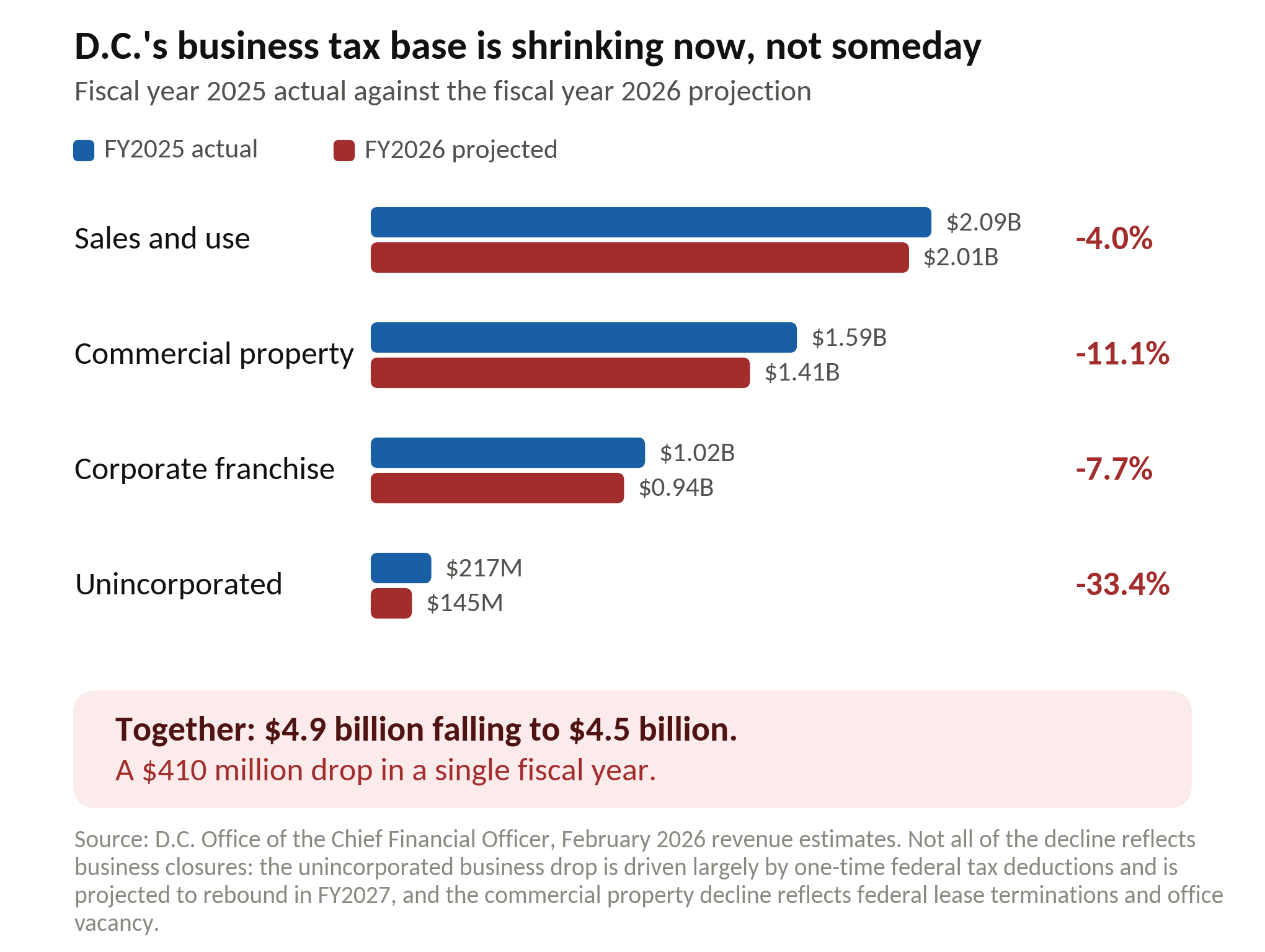
When businesses disappear, the city loses jobs, foot traffic, commercial-property value, and recurring tax revenue. An ambitious affordability agenda requires a strong and growing tax base, while business owners face the same rising rents, insurance premiums, utility bills, food costs, and borrowing costs as their customers. D.C. cannot make life more affordable for its residents by making it unaffordable to operate a business here.
The capitalist case for better government
The United States offers a broader lesson. Our economy produces serious wealth disparities, and government must confront them. Yet Americans also possess extraordinary earning power. In 2021, the OECD ranked the United States among the three countries with the highest median disposable household income, alongside Luxembourg and Norway.
No single policy explains that prosperity. The size of the American market, our universities, access to capital, natural resources, skilled workers, and technological innovation all contribute. But our economic system has also historically given individuals significant room to start companies, attract investment, experiment, hire people, and build wealth. The OECD has found that governments can strengthen business dynamism by reducing barriers to entry, encouraging experimentation, and helping new firms benefit from technology and innovation.
(Yes, I recognize the true capitalist in me speaking here.) But the underlying point should not divide people along ideological lines. Businesses create the jobs, wages, products, services, and tax revenue that make a broader affordability agenda possible. Government should regulate them where necessary, enforce those regulations consistently, and make compliance as straightforward as possible.
Make the lawful path the easiest path
Customer service must become the operating principle for D.C.’s small-business revival.
Before an entrepreneur applies, the government owes them an accurate roadmap. While agencies review the application, one official should own the timeline, resolve conflicts, and protect the applicant from penalties caused by government delay. After the business opens, DMPED should track whether it survives and intervene when government-created friction threatens an otherwise viable enterprise.
Running for mayor changed how I understand the politics surrounding that work. On the campaign trail, I met low-wage workers who could not afford the city they served. I also met entrepreneurs who had invested their savings, paid employees before paying themselves, and wondered whether one more delay or unexpected cost would force them to close. D.C. often treats those groups as opposing interests. They live in the same neighborhoods, support the same families, and depend on the same local economy.
The next mayor will face many tests. One of the hardest will involve reconciling our moral ambitions with the economic limits that determine whether businesses, jobs, and the tax base survive.
Democratic socialism, at its best, aims to make ordinary life freer, more affordable, and more survivable. That moral ambition deserves respect. A city where someone can work full time and still cannot afford rent, groceries, health care, or transportation has failed that worker.
But economics imposes a brutal constraint: good intentions cannot cover payroll. When a business cannot absorb another increase in wages, rent, insurance, utilities, food, taxes, or debt service, it cuts hours, raises prices, automates jobs, moves, or closes. The worker then loses the job, the neighborhood loses the business, and the District loses the revenue that supports its affordability agenda.
The continuing campaign to raise D.C.’s minimum wage to $25 an hour by 2029 captures that tension. The proposal will not appear on the November ballot, but its sponsors plan to pursue it in a future special election. During the mayoral campaign, Janeese Lewis George said that she did not consider a Districtwide increase to $25 wise under current economic conditions. That instinct reflects the pragmatism the next administration will need.
The warning signs extend beyond large restaurant groups. The Black-owned Urban Grape closed its D.C. location after only 19 months, although its owners did not identify a specific cause. During last year’s federal crackdown, the Salvadoran owner of Elizabeth Pupusería & Deli reported bringing in only $300 a day while normally paying workers roughly $500 a day. Those businesses faced different pressures. That is precisely the point. Small businesses absorb shocks from every direction, and government cannot evaluate any new mandate in isolation.
None of this excuses poverty wages. A city that preserves businesses while leaving workers unable to live here has not solved the problem. The goal of a more livable and affordable city remains essential. But reality and pragmatism must shape the route we take. If D.C. asks small businesses to shoulder higher costs, it should analyze the effect on the smallest employers, phase changes responsibly, reduce government-created expenses, and provide targeted relief that protects both wages and jobs.
The District has already studied many of its customer-service failures, designed promising solutions, and launched pieces of the required system. The next mayor does not need another report. The next mayor needs to finish the work, extend it across government, publish the results, and answer when the system fails.
Those commitments will also strengthen anti-corruption enforcement. Clear rules reduce discretion. Visible timelines expose unusual delays. A shared dashboard makes it harder for a fixer to claim that only money or political access can move an application. The easiest path should always involve following the law.
When government treats entrepreneurs’ time as valuable, businesses open sooner, generate revenue sooner, hire sooner, and gain a better chance of surviving. When DMPED owns the entire journey, entrepreneurs can spend less time managing the government and more time managing their businesses.
D.C. should never require an entrepreneur to hire a fixer simply to understand how the city works. The government should provide that guidance itself and remain beside the business long enough to help it last.
Only businesses that survive can keep paying workers, serving neighborhoods, and financing the more affordable city that Washingtonians deserve.

As a small business owner myself who *wants* to open up another business where I live in Chinatown, your proposal above would absolutely be the key to get me to jump into the deep end again. It took us about 18 months to open a four chair nail salon because of just zero coordination between the relevant DC departments along with zero accurate communication to help us manage expectations with our landlord, our vendors, our long-time customers, etc. As both COVID and DOGE showed us, there is no long-term resilient DC future without a period of being obsessed with diversifying our major employers and commercial lessors. The boom of the 2010s - while awesome - was also, as we came to see, extremely fragile and dependent upon the federal government. We can't afford to make the same mistake again.
I would love to see Rini as the next head of DMPED.