

It’s back to school month in D.C. District of Columbia Public Schools (DCPS) and many charter schools start the week of Aug. 24, although some charter schools, such as KIPP DC, start earlier.
Which raises a question many D.C. residents have: What exactly is the difference between DCPS and charter schools, and why does it matter? D.C.’s choice-based education system has many benefits. Unlike many places in the U.S., where families are assigned a single public school based on where they live and those who want something different will need to move or pay for private school, families in D.C. have the opportunity to choose among a variety of public options, including their zoned DCPS school, charter schools, DCPS city-wide schools, and out-of-boundary DCPS schools.
But this range of choices can also be confusing to families and community members, particularly those who moved to DC from other places that don’t have the same range of options. As someone who’s worked in and around public education in D.C. for the past two decades, and recently navigated DC’s school choice landscape as the parent of a 3-year-old entering preschool, I thought it might be helpful to provide some explainers for those seeking to understand and navigate D.C.’s education system.
This post looks at the similarities and differences between DCPS and charter schools. In the coming weeks I’ll also write about D.C.’s nation-leading universal pre-K program and the pre-K options available to D.C. families, the roles that different entities and leaders (e.g. the Mayor, DCPS Chancellor, Public Charter School Board, Office of the State Superintendent of Education, State Board of Education, and Deputy Mayor for Education) play in operating and governing D.C.’s schools, and the history of D.C. education governance. Later this year, I’ll be sharing some explainers and guides on the MySchoolDC lottery process.
But first: DCPS and charter schools? How are they different and what do you need to know about them?
DCPS and Charter Schools by the Numbers
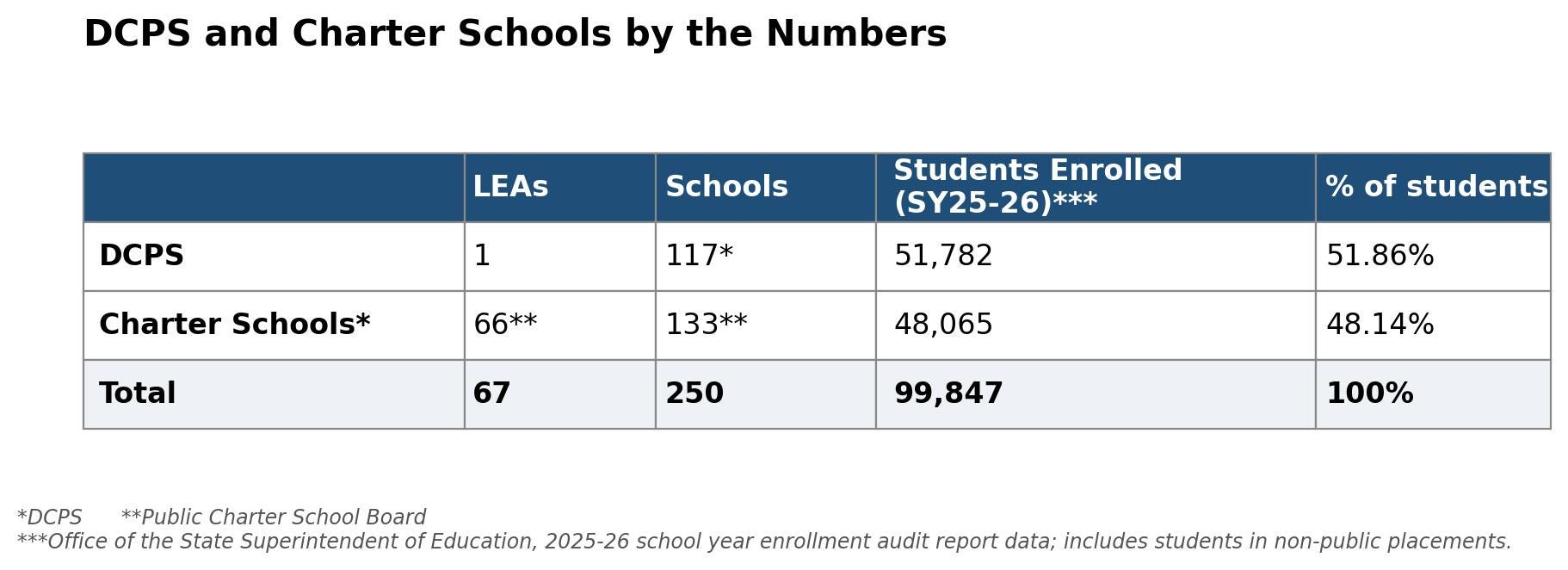
*DCPS
***Office of the State Superintendent of Education, 2025-26 school year enrollment audit report data; includes students in non-public placements.
It’s actually best to start by talking about what’s NOT different between DCPS and charter schools. Both DCPS and charter schools are public schools. Both are publicly funded; free of charge for families; required to follow federal and District civil rights and special education laws; and prohibited from discriminating in admissions or employment on the basis of race, religion, disability status, or certain other factors. Both DCPS and charter schools are required to follow D.C.’s Standards of Learning and administer D.C.’s State Assessments in the grades and subjects for which they apply. Students in both DCPS and charters take D.C.’s state assessments in reading, math, and science. Families and the public can find information about school-level results on these assessments for both DCPS and charter schools, as well as other indicators of school environment and quality, in OSSE’s D.C. School Report card.
Now that we’ve gotten those similarities out of the way, what’s the difference between DCPS and charter schools?
The primary difference is a matter of governance and legal structure.
DCPS is the District of Columbia’s single public school district. Public school districts operate most public schools in the United States and, if you attended a U.S. public school outside of DC prior to moving here, odds are you went to a school operated by a school district. School districts are a type of government entity. Their teachers, administrators, and other staff are public employees, and are often represented by public employee unions (DCPS teachers are represented by the Washington Teachers Union, which is affiliated with the American Federation of Teachers 1). Most school districts are governed by elected school boards, which hire school superintendents, approve annual district budgets, and approve contracts with employee unions, among other functions. In D.C. however (as in some other cities, including New York), that role is played by the Mayor, who since 2007 has held Mayoral Control of DCPS governance, although the Council also plays a key oversight and approval role over many key decisions (e.g. approving new union contracts and annual budgets, confirming the DCPS chancellor).2 The Mayor appoints DCPS’ chief executive (subject to Council approval), who is called the chancellor but plays the same role as a superintendent in most districts. 3
Charter schools, in contrast, are operated by independent nonprofit organizations that have received a charter authorizing them to operate a public school, under government oversight. A group seeking to open a charter school must apply to the Public Charter School Board (PCSB), the independent D.C. Government agency that authorizes charter schools. Once PCSB authorizes a charter, it carries out ongoing oversight of the school’s compliance with state and federal laws, governance, and financial and academic performance. 4 PCSB has the authority to close charter schools that are financially non-viable, have a record of sustained poor academic performance, or fail to meet goals at charter renewal (which occurs every 15 years, with a high stakes review every five). 5
As a nonprofit, each charter is governed by a board of directors, which is responsible for hiring and evaluating the school’s chief executive, approving budgets, and is ultimately accountable to the PCSB for the school’s performance. Charter schools’ boards are not elected and must include at least two parent representatives. Meetings of charter school boards are subject to open meetings act requirements, and, as nonprofits, they must undergo an annual audit and submit financial reports to the federal Internal Revenue Service (IRS). Some charter schools are unionized, but most are not, and unions seeking to represent charter school teachers must organize on a charter-by-charter basis.
Two distinctive features of D.C.’s charter policies have particularly shaped the charter landscape: First, unlike many states, D.C. allows multiple schools to operate under a single charter. While some charters include only a single school, the largest, like KIPP and Friendship, operate multiple campuses serving thousands of students across grades PK-12. Second, D.C. charter schools are fully independent of DCPS: they receive both local and federal funding directly, rather than through DCPS, and are responsible for fulfilling all federal and special education requirements for children that they enroll. The combination of these two factors means that charters, particularly larger ones that serve multiple grade spans, function much like their own school districts, with some notable differences related to how students enroll in them. For this reason, formal communications from D.C. government agencies sometimes refer to “charter LEAs (local education agencies),” when referring to the organizations that hold a charter rather than individual campuses.
There are also different school choice and enrollment processes between DCPS and charter schools–with important implications for families
Most (but not all) DCPS schools are zoned “schools of right,” meaning that a child in grades K-12 who lives within the geographic boundaries of a school’s catchment zone is guaranteed a slot in the zoned school for their grade level. Every home address in D.C. is assigned an in-boundary school for elementary, middle, and high school, meaning that a family can “choose” their preferred DCPS school by buying a home in its catchment area. (PreK, as I’ll discuss in an upcoming post, is a bit different). Families who want to attend a DCPS neighborhood school other than the one to which they are assigned may apply to do so through the “out of boundary” lottery process, but enrollment in an out of boundary school is contingent on availability of seats at that school after all in-boundary students wishing to attend are enrolled; in other words, children who live within a school’s catchment area have a strong advantage in admissions. DCPS also operates some district-wide or non-zoned schools, 6 including, among others Capitol Hill Montessori, School-Within-a-School, the Stevens and Military Road Early Learning Centers, and eight selective DCPS high schools and programs (full list here). Families who wish to send their child to a district-wide or out-of-boundary DCPS school must apply through the MySchoolDC lottery, which I’ll share more information about later this fall.
Charter schools, in contrast, are all schools of choice. This means that a family must choose to enroll their child in charter school, and, with limited exceptions, must do so through the MySchoolDC lottery.7 Unlike DCPS schools, however, there are no catchment zones for charter schools, so families from across the District have an equal shot at admission to a charter through the lottery. Charters are allowed (but not required) to establish preferences for student enrollment for siblings, children of founders and staff, and disadvantaged students, but are not allowed to prioritize students based on other criteria.
What does charter or DCPS status mean for a child’s day-to-day experience in a public school?
To be honest, in itself, not that much.
DCPS has adopted a number of common instructional structures and expectations (such as adopted curricula, common formative assessments, and expectations for time spent in specific subjects) that are intended to be consistent across all schools or across all schools serving students in a particular grade level/band. DCPS also provides common professional development for teachers and uses a common teacher evaluation framework. Within those common structures, however, there is significant variation among schools. Principals have considerable influence over school-level resource use, operations, and culture. Student and teacher demographics also vary widely across schools. Thus, a child attending one DCPS school can have a very different experience than a child attending a different DCPS school in the same grade level. And a family with multiple children may have different experiences if their individual school’s leadership shifts.
This is even more true when it comes to the charter label. Charter schools have significant autonomy over curriculum, staffing, and operations. Many charter schools were founded with a goal to offer a specific type of education, such as (to name just a few examples) Montessori; Science, Technology, Engineering, and Math (STEM); Expeditionary Learning; or Dual Language Immersion. But not all charter schools were designed around a unique theme, instructional approach, or focus. Families considering enrolling their child in a charter school will need to learn about the individual charter’s approach and mission and determine if that focus is a fit for their family’s values and child’s needs.
In summary:
Families in D.C. have access to a variety of choices, including their zoned DCPS school, charter schools, district-wide DCPS schools, and out-of-boundary DCPS schools.
Both charter and DCPS schools are public schools but are operated under different governance arrangements.
Every D.C. resident family with a student in grades K-12 has a zoned DCPS school of right, but also has the opportunity to access other school options, including charters and DCPS options other than their assigned school, through the MySchoolDC Lottery.
Knowing whether a school is a charter school or DCPS school doesn’t tell you much about its quality, student demographics or test scores, culture, or (particularly for charters) educational approach. Families can learn more about individual schools through MySchoolDC, OSSE’s D.C. School Report Card, and DCPS and individual charter school websites.
This history of the WTU and its relationship with AFT is itself a fascinating topic for another time.
More about this in an upcoming post on school governance!
Confusingly, as I’ll explain in an upcoming post, DCPS’ superintendent is called a chancellor, but the head of the Office of the State Superintendent of Education, D.C.’s equivalent to a state Department of Education, is called the Superintendent.
The Office of the State Superintendent of Education (OSSE), where I worked from 2020 until earlier this year, also plays a role in monitoring compliance and performance of both charter schools and DCPS, which I’ll say more about in an upcoming governance post.
I’ll share more about this organization (on whose board I served from 2009-2017) and the aforementioned upcoming post on school governance.
Interestingly, two of DCPS district-wide schools are former charter schools that were operated in former DCPS buildings and returned to DCPS operation when PCSB closed the charter schools that had operated in the buildings for financial or performance reasons.
Two charter schools serving children with significant disabilities or behavioral support needs, St. Colletta and Kingsman Academy, do not enroll students through the lottery, nor do the District’s 10 adult education charter schools, which often enroll students at multiple points across the year rather than on a traditional school year schedule.
