


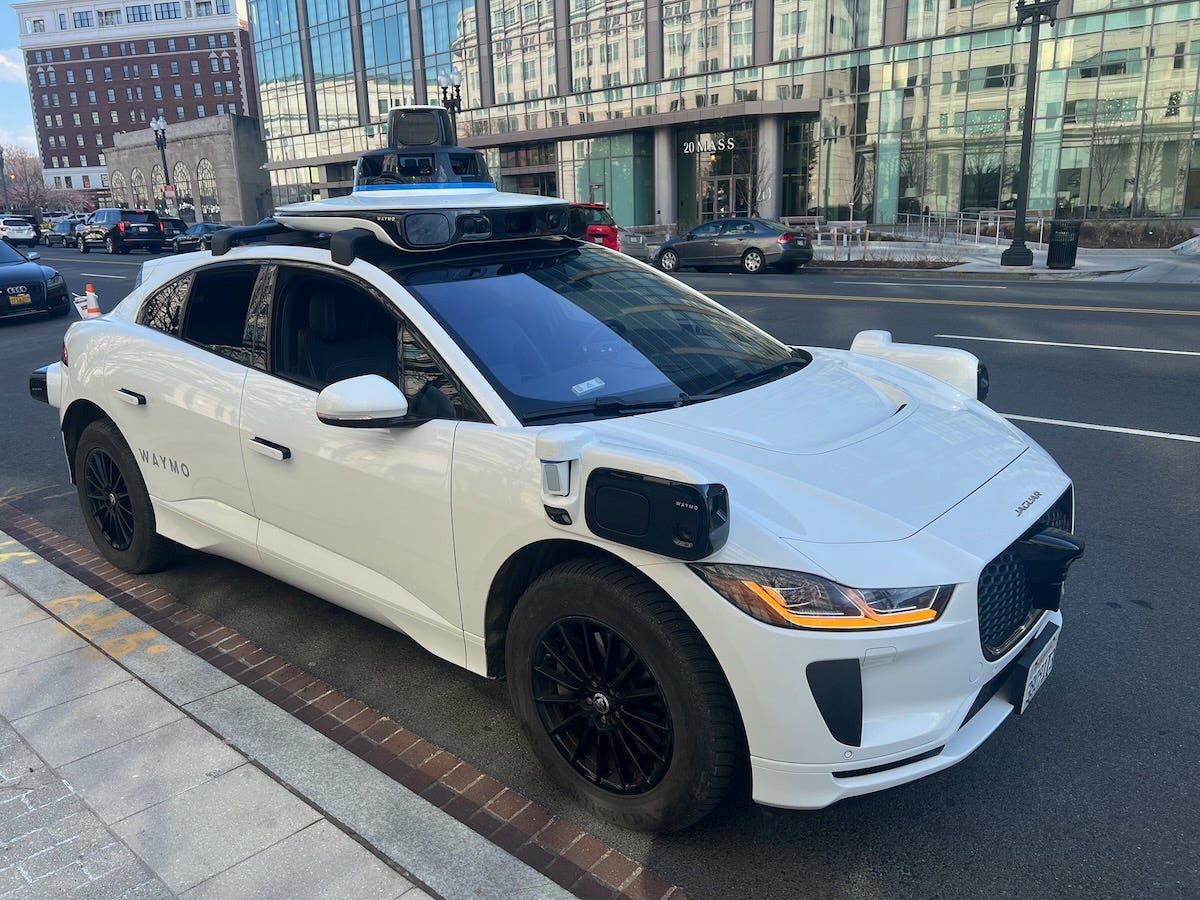
Last month, a few dozen labor organizers, faith leaders, and rideshare drivers rallied on the steps of the Wilson Building to oppose Councilmember Charles Allen’s autonomous vehicle (AV) bill. I used to drive for Uber and Lyft, so I went to hear the drivers’ concerns and learn what they wanted changed.
It turns out they didn’t want anything changed. The rally was organized by the People First Transportation Alliance, a coalition of murky provenance and membership. Its website says it “strongly oppose[s] the legalization of fully driverless vehicles in any city or state where they are currently prohibited,” and it wants a “trained human driver to be physically present behind the wheel of any vehicle operated for hire.” In other words, their backers don’t want an AV discussion at all.
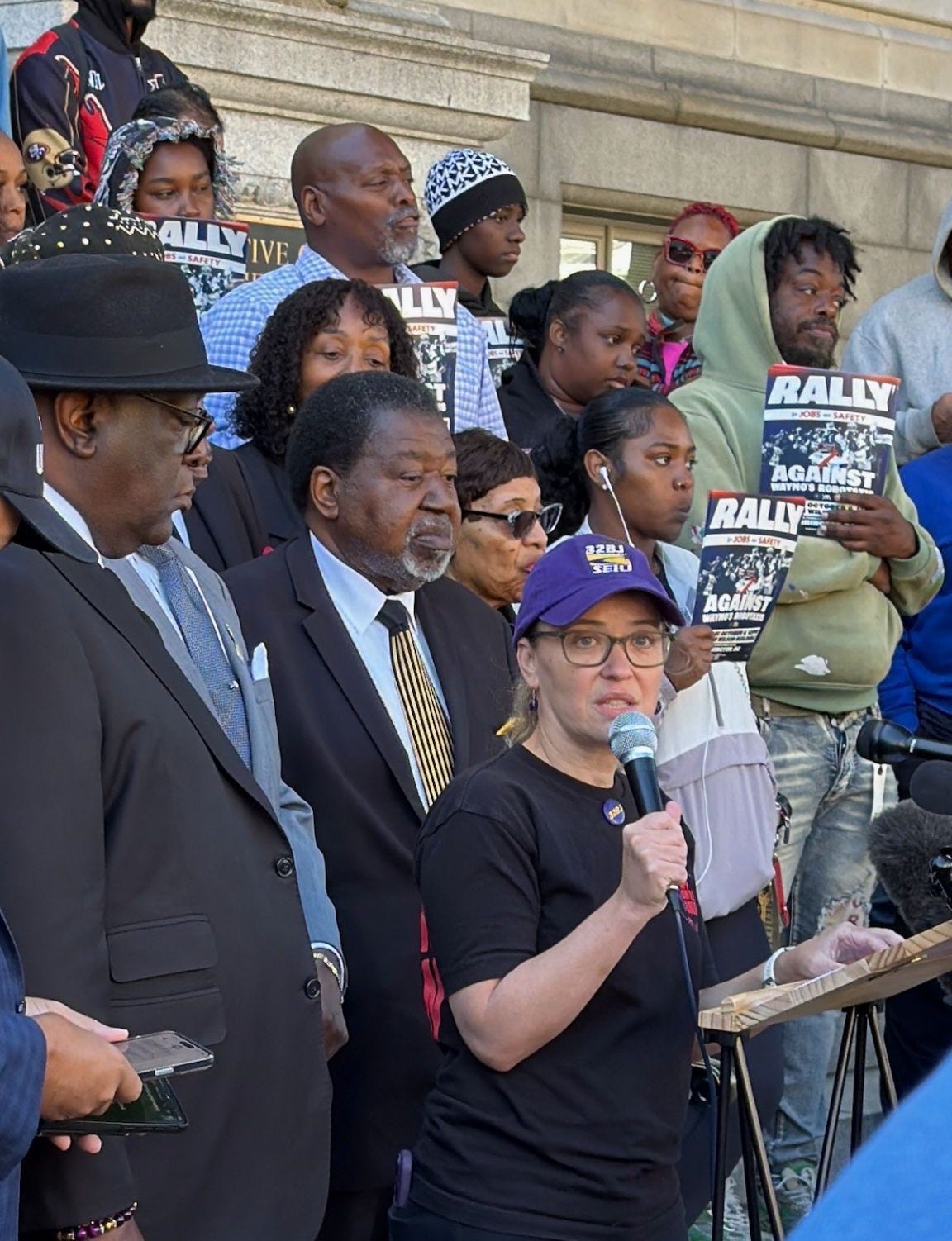
Labor organizers, faith leaders, and rideshare drivers protest robotaxis on the steps of the Wilson Building, October 6, 2026. Photo: Greg Rogers
A week later, Councilmember Janeese Lewis George, now mayor-elect of DC, announced that she opposes Allen’s bill too, citing jobs concerns. She said “DC must be a leader in welcoming new technology while supporting workers and prioritizing safety,” but warned that DC shouldn’t “rush.”
I’ve worked on AV policy for more than a decade, and I’ve never seen a bill proactively do so much for workers. I’ve also never seen a bill draw this much opposition from the very people it goes out of its way to help. Allen’s bill makes AV companies pay for the speculative impacts of their services before they carry a single passenger, and directs that money to human drivers and public transit.
Turning down this deal won’t keep robotaxis out of the District forever. It’ll just stop AVs from delivering safer streets and more accessible rides for residents in the near future. In the meantime, District workers and public transit will miss out on the money that’d be collected from AV companies.
Sharing the wealth
“Pro-worker” AV policy usually boils down to one of two things: forming a study committee that reports back in two years, or requiring every AV to have a human driver. (The latter is the logical equivalent of requiring every horseless carriage to have a horse.)
Allen’s bill seeks a more proactive approach of requiring AV companies to pay up for any potential harms of offering their services before there’s any harm to pay for.
Allen’s bill would charge AV companies at nearly every step: a fee to apply for a permit, a fee to put vehicles into operation, a fee for every mile driven, and renewal fees.
For the two companies already testing in DC, Waymo and Zoox, that adds up to millions of dollars over time. And, because the per-mile fee is applied to every trip, the money scales up alongside the services.
All of this money goes into a dedicated Autonomous Vehicle Deployment Fund, which will fund public transit and a workforce program for drivers who may be impacted.
I have my own doubts about robot taxes as a tool for navigating automation. But you don’t have to be a fan of a robot tax to see that Allen is giving advocates exactly what they have demanded for years: when machines take on the work that was previously done by a human, the company should help pay for the transition.
If that’s not a robot tax, I don’t know what is – and if that doesn’t qualify as “supporting workers,” I’m not sure what does.
The workforce math
It’s clear that Lewis George’s central concern is the displacement of driving jobs – and she’s already given a number: about 200 District residents are full-time drivers. Some of the drivers who spoke at the rally, and at a Council hearing in July, discussed how they’re struggling to make ends meet – partially because Uber takes a meaningful cut out of each fare.
Fortunately, there’s some good news for these drivers if AVs start operating in DC. A new report from Gridwise indicates that AVs may actually lead to an increase in rideshare drivers’ per-trip earnings by pushing companies to take a smaller cut out of each fare.
Over a two-year period ending in Q2 2026, the median platform fee per trip fell from $2.61 to $2.25 in AV cities. In the meantime, the platform fees rose from $2.97 to $3.54 for drivers in non-AV cities.
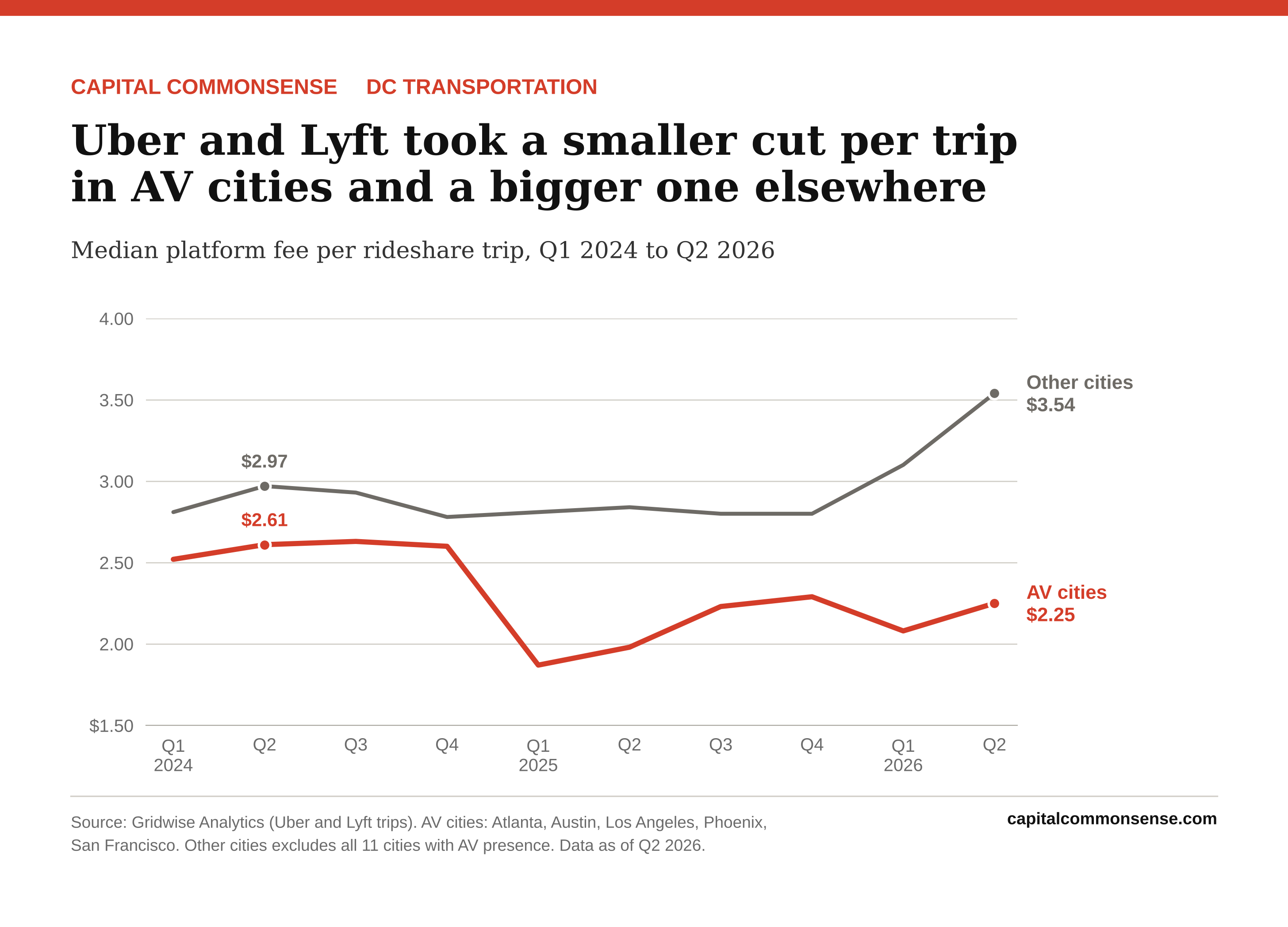
In cities with autonomous vehicles, Uber and Lyft’s median cut per trip fell from $2.61 to $2.25 between Q2 2024 and Q2 2026. In cities without AVs, it rose from $2.97 to $3.54. Source: Gridwise
And not only that, but Gridwise also found that drivers in AV cities saw faster growth in gross pay per trip than drivers in non-AV cities. Atlanta’s rideshare drivers experienced the largest increase (20.7%), more than twice as much as drivers in non-AV cities (7.8%).
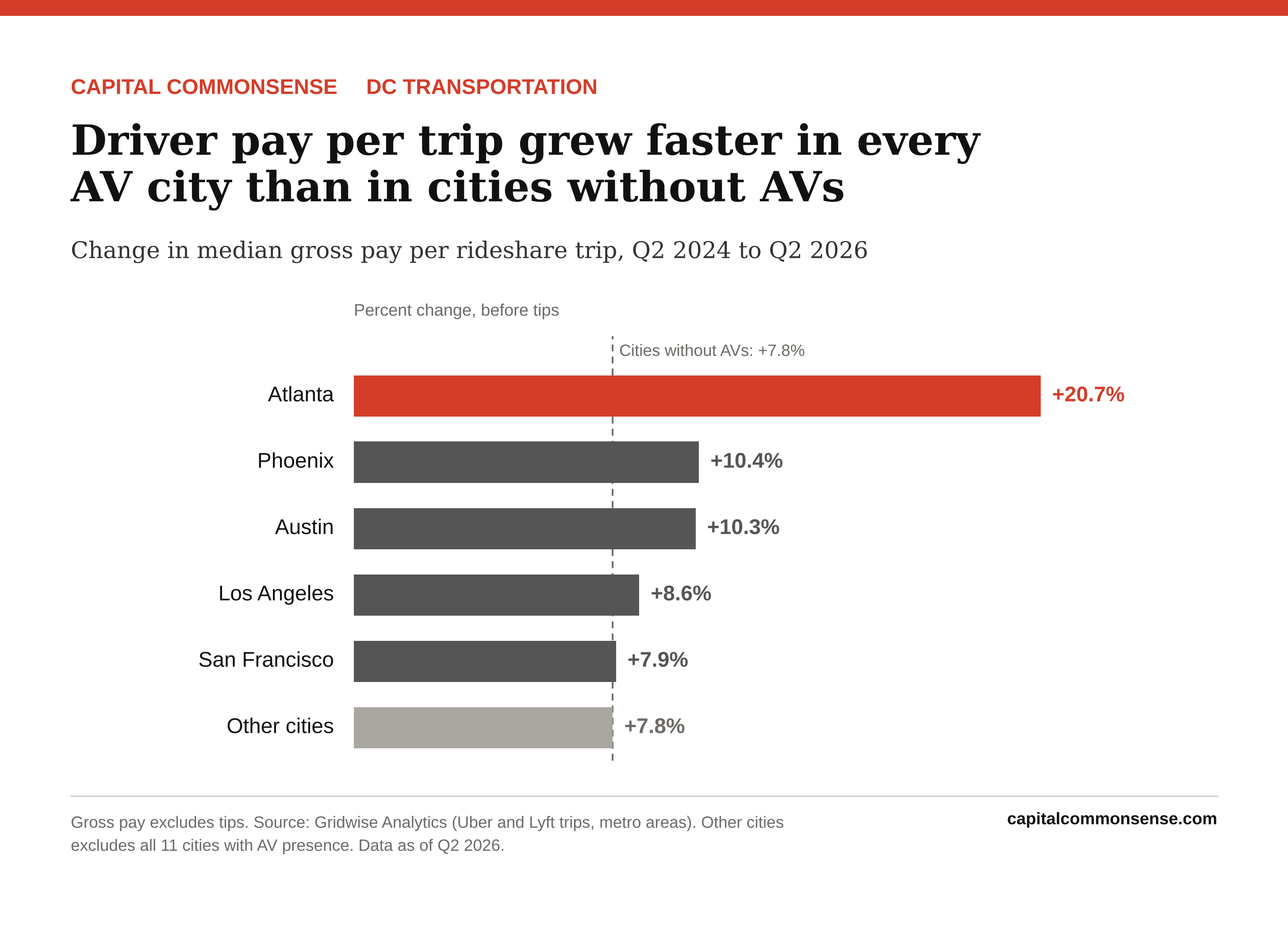
Gross pay per trip, before tips, grew faster in every AV city than in non-AV cities from Q2 2024 to Q2 2026. Atlanta led at 20.7%, more than double the 7.8% non-AV average. Source: Gridwise
One of the biggest misconceptions about AVs is that they lead to a sudden and complete transition away from human drivers. Phoenix and San Francisco are two of the most mature AV markets in the world, and you can still hail an Uber, a Lyft, or a taxi in these cities. Allen’s bill would make DC’s rollout even slower, by capping how many AVs each company can run at first, and allowing fleets to grow gradually with DDOT’s permission.
AVs didn’t replace human drivers one-for-one in Phoenix and San Francisco. Instead, they increased competition and pressured Uber to take a smaller cut out of drivers’ earnings. They created well-paying jobs of the future that didn’t exist a decade ago, like AV and EV technicians, fleet supervisors, and depot managers. These are the types of jobs and investments that DC should be welcoming at this time of economic uncertainty.
Waymo has already secured three locations in the District, which Axios reports would bring hundreds of jobs for maintenance technicians, autonomous specialists, and vehicle cleaners. On their own, that could match or exceed the estimated 200 District residents who drive rideshare full time – and that’s before other AV companies come to DC.
It’s also important to realize that DC isn’t starting from scratch. The District already treats worker displacement as a public responsibility, which is managed by the Department of Employment Services (DOES) and training programs like IGNITE DC, which prepares residents for careers in transportation and logistics. (Lewis George sits on the Council committee that oversees DOES.)
Allen’s bill adds dedicated money on top of these programs to retrain drivers, paid for by the companies themselves.
Let’s be clear. Workers got nothing like this from earlier waves of automation. When word processors and computers emptied out DC’s typing pools, taxpayers covered the unemployment insurance and retraining, and the software companies didn’t pay a cent.
Lewis George’s own mayoral platform promises intensive job support, more registered apprenticeships, and help for unemployed workers. The bill’s training fund is built for exactly that work – so if Lewis George continues to oppose the bill, she’ll be turning down a dedicated revenue stream for her own agenda.
The missing voices
Standing in front of the Wilson Building, I kept thinking about people who weren’t there to make their voices heard.
I thought of the families of the 276 people killed on DC streets since 2020, and the many thousands more who were seriously injured. I thought of my riders who told me stories about being left at the curb because they used a cane, relied on a service dog, or lived in neighborhoods east of the Anacostia River that some drivers refuse to go to.
Others have no way of knowing they should be advocating right now. They’re the families who will lose someone in a crash over the next few years, and don’t know about the tragedy that lies before them – a tragedy that can befall any of us unlucky enough to be in the path of distracted, speeding, or reckless drivers.
DC’s traffic safety measures have been failing for over a decade. Mayor Bowser launched Vision Zero in 2015 with a promise to eliminate traffic deaths by 2024.
In 2015, 26 people died on DC roads. By 2023, the number doubled to 52, a 16-year high.
At least 50 more people were killed on DC’s roads in 2024, the year that traffic deaths were supposed to be zero.
This isn’t for lack of effort. The District Department of Transportation (DDOT) has made real investments in redesigning streets, lowering speed limits, and encouraging alternative transportation modes like biking, walking, and transit. The city has even placed more traffic cameras in high-risk intersections and key thoroughfares. But over 70% of traffic fatalities in 2024 were attributed to dangerous driver behaviors including hit and runs, single vehicle crashes, and/or red light running.
The Safe System Approach reminds us that infrastructure alone can’t eliminate traffic deaths, because you also have to address who’s behind the wheel. AVs won’t replace every driver, and they won’t be absolutely perfect, but the published crash data indicates Waymo is achieving significant reductions in injury-causing crashes – regardless of who’s at fault.
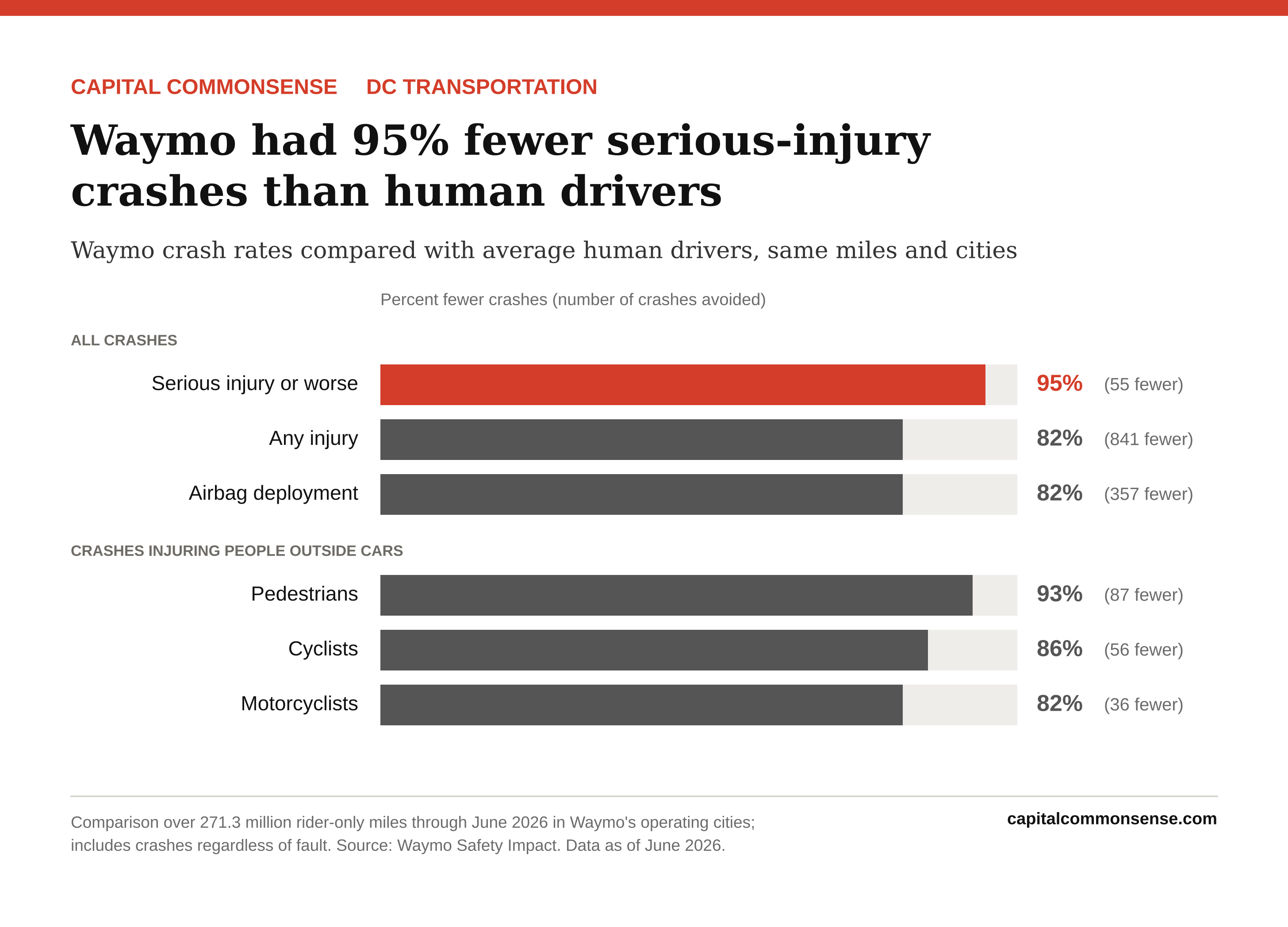
Across 271.3 million rider-only miles through June 2026, Waymo had 95% fewer crashes causing serious injury or worse, 82% fewer injury-causing crashes, and 93% fewer pedestrian-injury crashes than average human drivers covering the same distance in the same cities. Source: Waymo Safety Impact
Allen’s bill still doesn’t assume that every AV company is equally safe. AV operators must navigate multiple levels of approval before they can operate, and DDOT will be granted far more enforcement power than regulators have in other states where AVs already carry passengers at scale.
If opponents want to frame this as lives versus jobs, they should say what exchange rate they’re offering. How many preventable deaths are worth slowing a gradual transition for 200 drivers, especially when the bill already pays to support those drivers?
“Rushing” for 14 years
DC isn’t rushing. It has been studying AVs longer than almost any city in America:
2012: DC passes one of the nation’s first AV laws.
2018: Mayor Bowser forms an AV Working Group.
2020: The Council requires DDOT to deliver a full-deployment report by fall 2022.
2022: The deadline passes with no report.
2024: DDOT finally issues a request for proposals for the study.
2025: A congressional budget freeze halts the study before its December deadline.
2026: Allen introduces his bill in May. The Committee on Transportation and the Environment holds a hearing in July, where Lewis George attends and gives opening remarks. A committee markup vote is scheduled for next Monday, November 9th.
After 14 years, “too fast” starts to mean “never.” Every year of delay is another year without the worker fund, another year without the new transit money, and another year without a safer way to get around.
Take the deal
Waymo already carries paying passengers in 15 U.S. metro areas, and AVs are coming to this region one way or another. Blocking Allen’s bill won’t stop them – it will just mean DC gets them later, without realizing the benefits of putting the robot tax income to work sooner.
Allen’s bill gives District residents a safer, more accessible option to get around. It gives public transit new, much-needed money. And it gives drivers a path into the jobs AVs create, paid for by the companies doing the automating.
Labor’s allies have been asking for exactly this kind of deal, and they should take it.
Greg Rogers is the founder and executive director of The Innovation Majority, an advocacy organization for the policies that bring beneficial transportation technology to cities. He previously worked on public policy at Waymo and Nuro, and he once drove for Uber and Lyft.
