


In the District of Columbia, a family with a federally funded housing voucher can rent a one-bedroom apartment for up to $3,768, a two-bedroom unit for up to $4,200, a three-bedroom unit for up to $5,301, and a four-bedroom unit for up to $6,231 per month. These payment standards are set by the District of Columbia Housing Authority (DCHA). They determine which private market apartments voucher-holders can potentially access, and how much the government must cover with its fixed pot of federal funds.
Following up on the arguments recently made in Capital Commonsense by Ashley Schapitl, this article provides further evidence that the DCHA payment standard is unusually high: Voucher recipients can rent apartments in or near the top decile of all apartments in the city, and the District’s payment standard is higher than that in other high-cost cities despite having substantially lower market rents. Adopting lower, neighborhood-specific payment standards akin to the approach of some other cities could generate monthly savings of up to about $1,700 to $3,000 per family renting an apartment at the current payment standard, enough to offer a new voucher to a family on the waitlist. In addition to assisting more families, this reform would preserve the ability of families with vouchers to access costlier neighborhoods while also mitigating landlord abuse of the program.
How the payment standard works
As background, the federal government provides a fixed pot of money each year for DCHA to operate the Section 8 Housing Choice Voucher program. Recipient families must pay 30% of their adjusted income toward the rent of approved private market apartments, and DCHA uses the federal funds to cover the remaining portion. While federal law dictates the key parameters of the program, DCHA retains discretion over the payment standard.
The payment standard is the maximum qualifying gross rent (contract rent plus utilities) for which a family is eligible to rent an apartment with a given number of bedrooms. A family with a voucher that rents an approved housing unit for which the rent is no higher than the payment standard is required to contribute 30% of its adjusted income toward the rent and DCHA covers the rest. Families are allowed to lease an apartment whose rent exceeds the payment standard, but in that case, the family must cover the entire difference between the rent and the payment standard, on top of what they already owe based on 30% of their income. At initial occupancy in an apartment, families cannot owe more than 40% of their income for the rent.
DCHA’s choice of a payment standard is subject to certain federal constraints. First, the payment standard typically must be between 90% and 110% of Fair Market Rent (FMR), calculated by the U.S. Department of Housing and Urban Development (HUD) as the 40th percentile of rents paid by recent movers for standard-quality units in the local area. Second, DCHA can set a uniform citywide payment standard, or it can allow the payment standard to vary across zip codes, based on Small Area FMRs.
The DCHA payment standard
DCHA has decided to set a uniform payment standard covering the entire city. Using flexibility offered by HUD under the Moving to Work demonstration program, the District has received permission from HUD to set the uniform payment standard at 187% of the FMR. That is 87% higher than the 40th percentile of rents in the DC metropolitan area, or between 70% and 108% higher than the typical payment standard range.
A recent plan by DCHA would set payment standards that vary by zip code, equal to 168% of its Small Area FMR. The result would be lower payment standards in some areas and higher payment standards in others.
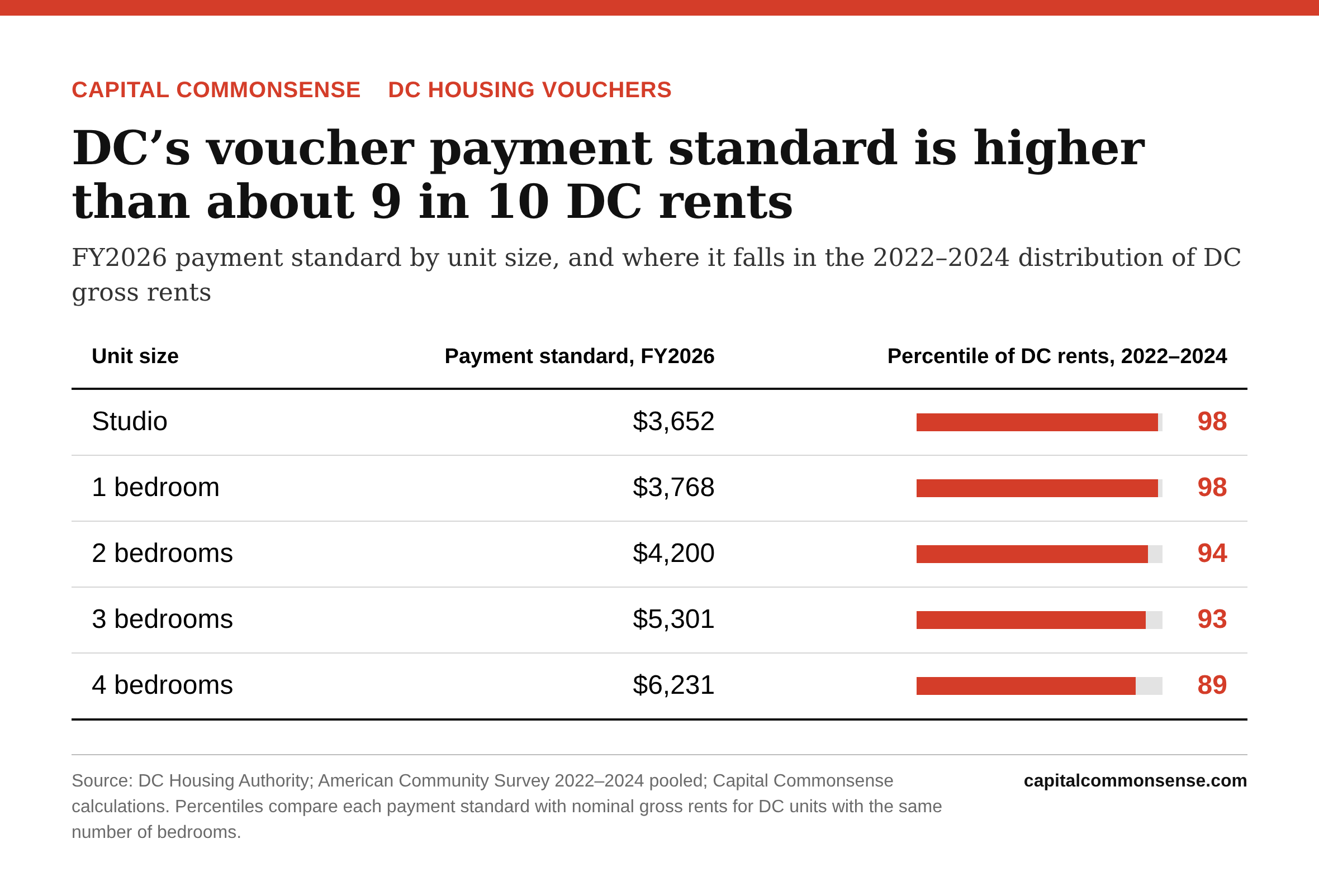
The figure below1 reports the District’s existing payment standard by number of bedrooms. It also reports the percentile of the payment standard in the distribution of gross monthly rent among all rental units in the District. I pool three years of the American Community Survey (ACS), 2022-2024, to estimate the distribution of gross rent by number of bedrooms in the District. As nominal rents have been stable in the District in recent years, this should approximate the current distribution. According to estimates from Apartment List, the median rent in FY2026 was $2,121, slightly lower than the 2022-2024 average of $2,155.
The District’s existing payment standard by number of bedrooms.
Source: https://www.dchousing.org/wordpress/vouchers/payment-standard/; American Community Survey, 2022-2024; Author’s calculations
DCHA’s payment standard allows families with vouchers to rent apartments that are more expensive than the vast majority of apartments in the city. For example, a family renting a three-bedroom apartment at the payment standard of $5,301 would have a higher rent than 93% of all of the District’s three-bedroom apartments. Across apartment sizes, a family is enabled by DCHA to rent an apartment that is within or near the top decile of apartments in the city.
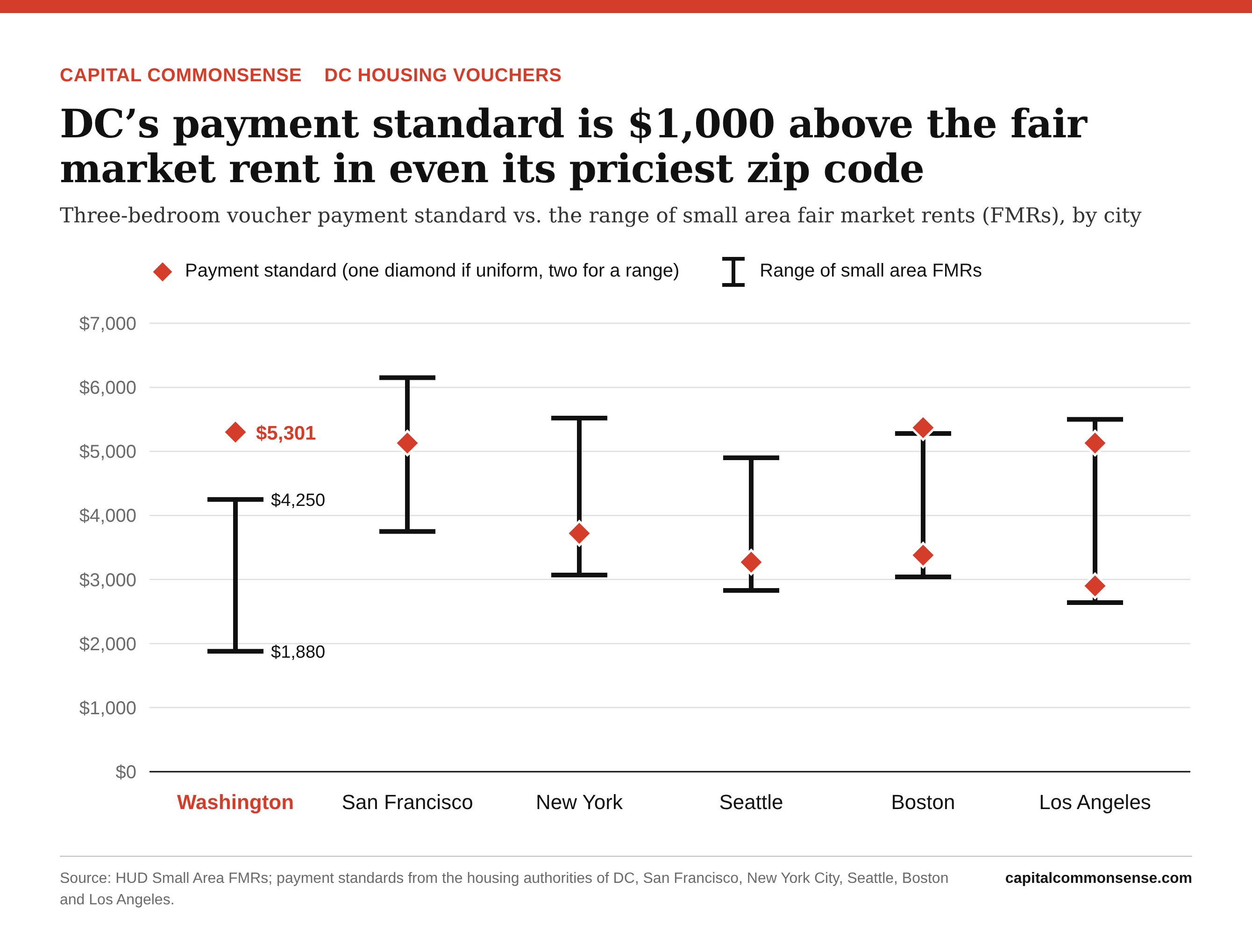
Payment standards of this magnitude are out of step with the rest of the country, including some of the highest-cost cities. Our second figure below2 reports for select cities how the payment standard compares with the distribution of zip code level FMRs. The District’s payment standard for a three-bedroom apartment ($5,301) exceeds that in San Francisco ($5,064), New York ($3,753), and Seattle ($3,297), even though rents are higher in all three of those cities than in the District. The payment standard in Boston and Los Angeles varies across zip codes. The District’s payment standard exceeds the payment standard of every zip code in Los Angeles and all but a handful of zip codes in Boston, even though rents are again higher in both cities.
Payment standard and small area fair market rent for three-bedroom units, by city, 2026
Source: Small area FMRs from U.S. Department of Housing and Urban Development, Small Area FMRs; Payment standards from District of Columbia Housing Authority, Housing Authority of the City and County of San Francisco, New York City Housing Authority, Seattle Housing Authority, Boston Housing Authority, Housing Authority of the City of Los Angeles
The District’s payment standard is more than $1,000 higher than the FMR in its most expensive zip code. In San Francisco, New York, and Seattle, the payment standard is well within the range of zip-code level FMRs, toward the lower end in New York and Seattle. The ranges of payment standards in Boston and Los Angeles mirror relatively closely the ranges of zip-code level FMRs in the two cities. The District is clearly an outlier.
Rationale for a high payment standard
In theory, a high payment standard enables greater tenant flexibility in selecting an apartment, by expanding the inventory of apartments that could potentially be approved. It also makes it possible for relatively low-income voucher recipients to seek apartments in higher cost areas that might have lower crime, higher quality schools, and closer proximity to public transportation options.
Drawbacks of a high payment standard
However, these potential advantages are outweighed by the drawbacks of DCHA’s payment standard. It reduces the number of families who receive assistance and enables landlord abuse of the program. Furthermore, affording low-income families the chance to access costlier neighborhoods with vouchers can be accomplished in cheaper and more effective ways.
Fewer families get assistance
The most direct drawback of DCHA’s unusually high payment standard is that it reduces the number of families who can receive housing assistance. Once the District’s fixed pot of federal funds for the Housing Choice Voucher program is used up, other eligible families are turned away. Nationwide, it is estimated that only one in four families eligible for housing assistance actually receives it. In the District, the waitlist is closed.
It is hard to justify the proposition that one low-income family should be allowed to use a voucher to rent an apartment for over $5,000 per month when another low-income family can’t even get on the waiting list. It is even harder to justify when recognizing that, nationally, the average family with a non-disabled working age adult retains a voucher for over 15 years, as shown in recent research by Howard Husock and Bruce Meyer. A family in the District with little to no adjusted income could conceivably receive near a million dollars in housing assistance over their entire housing assistance spell at the same time that another very low-income family gets zero.
The District does not have the power to turn the Housing Choice Voucher program into an entitlement program that provides assistance to all eligible families. But it could allow more families to receive assistance and reduce the extent of inequality in the program by bringing the payment standard more in line with market rents.
Encourages landlord abuse
A high payment standard encourages landlord abuse because it allows landlords to take in more revenue than they could obtain by renting out their units to families without vouchers. The potential for abuse is high. The $5,301 payment standard for a three-bedroom unit ranges from 1.2 to 2.8 times as high as the small area FMRs in zip codes throughout the District. In the lowest-cost zip code (20018), a landlord could charge as much as $3,421 above the $1,880 small area FMR without exceeding the payment standard.
Voucher-recipient families themselves have a weaker incentive than other families to avoid apartments with inflated rents, because their share of the rent is fixed at 30% of their income regardless of the rent. That is, a higher rent costs them nothing.
Absent countermeasures, families’ only incentive for avoiding apartments with inflated rents is the possibility of finding a more desirable apartment whose quality is more in line with the rent being asked. But because the District’s payment standard is so high, this incentive is less powerful. A family that qualifies for a three-bedroom apartment would be just as happy with an apartment renting for $3,300 as one renting for $5,300 if they are the same quality. They might even prefer applying for the $5,300 apartment since they are unlikely to face competition from unassisted renters for an apartment with such an inflated rent. Or a landlord could potentially offer kickbacks to voucher holders willing to lease out these units. If the payment standard were lower, there would be less room for landlords to inflate the rent on a decent quality apartment that voucher families would find acceptable.
The potential for abuse by landlords who attract voucher holders despite inflated rents is the rationale for the District’s rent-reasonableness evaluations. When a landlord accepts an application from a family with a voucher, DCHA must judge whether the rent is reasonable before the lease can be signed.
While a rent-reasonableness review is a prudent step, and required by federal law, it is not a full substitute for lowering the payment standard. A review might miss aspects of an apartment that affect the market price but are difficult to assess without a comprehensive or potentially in-person evaluation. And because the vouchers are fully funded by the federal government, the District has a weaker incentive to get the review right than if it paid for vouchers with local funds. The District’s main incentives for accuracy are to avoid federal audits, and potentially, to ensure more funds remain available to assist additional families.
While an alternative to reducing the payment standard would be to increase the intensity of reviews, that approach comes with other costs, including lengthening the process before a family is allowed to sign a lease. That can make it harder for voucher families to attain competitively priced apartments where non-voucher recipients face no delay in signing a lease once the landlord approves their application. In fact, apartments with the most competitive rents may be the most difficult for voucher holders to attain because non-voucher families are more likely to scoop them up before the rent reasonableness review can be completed.
A lower payment standard would not eliminate the need for rent reasonableness reviews, but it would reduce the stakes for getting it right. In addition, families themselves would have a more powerful incentive to avoid apartments with inflated rents.
The key is to strike the right balance: The payment standard should not be set below the level where voucher families can find a decent quality apartment, but it also should not be set too much higher.
A better way to help families access higher cost neighborhoods
A potential objection to reducing the payment standard is that families with vouchers may be unable to access neighborhoods where market rents exceed the payment standard. One response to this objection would point to the unfairness of enabling some families to access high-cost neighborhoods at the expense of other families not receiving any assistance at all. Still, there are other rationales for enabling low-income families to access decent quality housing in more costly neighborhoods, including promoting racial and socioeconomic integration and seeking to improve the trajectories of low-income children who can benefit from higher quality schools and safer neighborhoods.
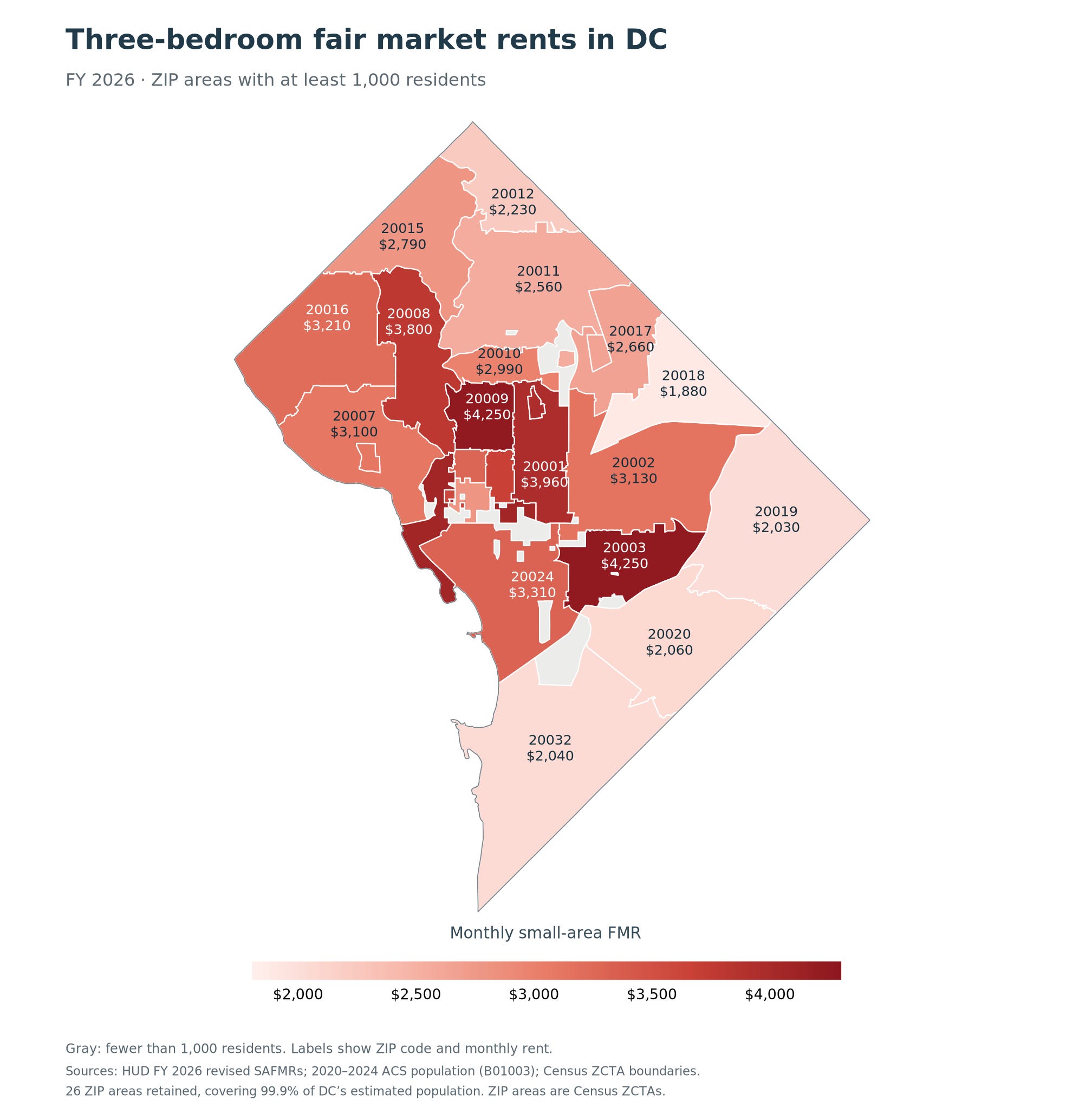
However, a more effective way to enable voucher families to access higher-cost neighborhoods is to vary the payment standard according to the FMR in each zip code, an authority cities already have and some exercise (including Boston and Los Angeles, as shown in the second figure). So-called “small-area FMRs” are already published by zip code, including for the District, as reported in the map3 below. Research by Robert Collinson and Peter Ganong shows that while a uniformly high payment standard increases rents without meaningfully improving apartment or neighborhood quality, pegging the payment standard to small area FMRs leads voucher holders to move to higher quality neighborhoods.
Small Area Fair Market Rent for Three-Bedroom Apartment, by Zip Code, District of Columbia, FY2026
Source: U.S. Department of Housing and Urban Development, Small Area FMRs; American Community Survey 2020-2024
DCHA could peg the payment standard in each zip code to 110% of the small area FMRs shown in the map. The highest payment standard for a three-bedroom unit would be $4,675 in the Capitol Hill area (20003) and close-in northwest neighborhoods (20009), and the lowest would be $2,068 in some of the northeast neighborhoods (20018). These payment standards would be between 39% and 88% of the current $5,301 citywide payment standard, representing a major reduction in most areas.
How much could lower neighborhood-specific payment standards help?
Suppose the District decided to adopt neighborhood-specific payment standards pegged to 110% of small area FMRs. How much money could be saved and how many additional families could be served?
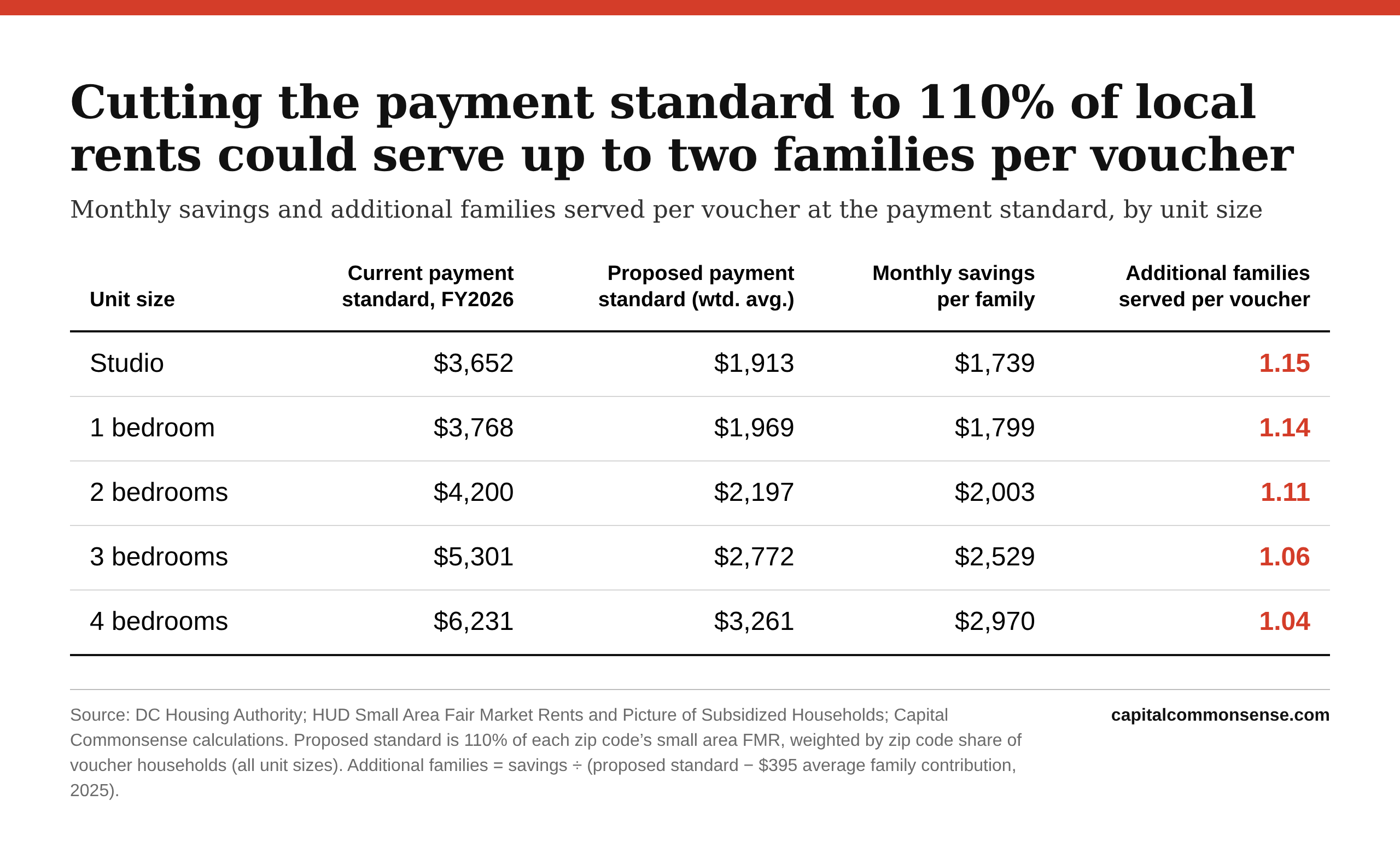
In the case of a family currently renting an apartment at or above the current payment standard, the government savings would be equal to the difference between the current payment standard and 110% of the small area fair market rent. For a three-bedroom apartment, the savings under the new policy would be $2,529 in the average zip code (with zip codes weighted based on their share of existing voucher holders). The number of new families that could be served using the savings would depend on the new families’ contribution to their rent based on their adjusted income, as well as the rent of the apartments they lease. Assuming new families contribute $395, the average monthly household contribution in 2025 in the District among voucher-recipient families, and that they rent apartments at the new payment standard, an additional 1.06 families could be served.
The figure below4 reports the savings and additional families served for each number of bedrooms. Across all apartment sizes, an additional 1.04 to 1.15 families could receive assistance for every family renting an apartment at the current payment standard. In other words, in the average zip code each voucher currently being used to rent an apartment at the payment standard could instead serve two families if the payment standard were reduced to 110% of the small area FMR.
Savings and additional families served for each number of bedrooms.
Source: https://www.dchousing.org/wordpress/vouchers/payment-standard/; U.S. Department of Housing and Urban Development Small Area Fair Market Rents, and Picture of Subsidized Households; Author’s calculations
Of course, because the rents of voucher-recipient families are not all at or above the current payment standard, the savings for some families would be less than those reported in Figure 4, and the number of families assisted across the city would not double.
I am unaware of publicly available data on the distribution of rents, by zip code and number of bedrooms, for voucher holders in the District. However, in responses for an oversight hearing last year, DCHA reported average contract rents by zip code ranging from $1,995 in the lowest rent zip code to $3,750 in the highest in FY2025. These average rents (before including utilities) would be higher than 110% of the small area FMR for a two-bedroom unit in 15 out of the 22 reported zip codes, a potentially illuminating comparison given that 72% of voucher-leased units in the District have two bedrooms or less. While inference is difficult without the full distribution of rents by number of bedrooms, it is suggestive that a significant number of apartments may have gross rents above 110% of the small area FMR, and reducing the payment standard could significantly increase the number of families who receive vouchers.
A call to action
Adopting lower, neighborhood-specific payment standards pegged at 110% of small area FMRs would put the District in line with other high-cost cities, instead of being an outlier with a payment standard that far exceeds the FMR in even its costliest zip codes. The policy would directly benefit eligible families who are stuck on the waitlist or can’t even get onto it, by freeing up funds to serve more families. It could also make the voucher program more efficient by placing a safeguard on landlords charging far more than the market rent, which would have the additional benefit of making any efficiency improvements to the rent-reasonableness evaluation less risky.
In its most recent plan for updating the District’s payment standards, DCHA called for pegging them to 168% of small area FMRs by zip code. While adopting zip code-specific payment standards would be a welcome change, the already unusually high payment standard would increase even more in some neighborhoods. For example, a family would be able to rent a three-bedroom apartment for up to $7,140 in the Capitol Hill neighborhood (zip code 20003). This would be around $2,000 higher than the payment standard in the most expensive zip codes in Boston and Los Angeles, as well as the payment standard that applies citywide in San Francisco.
Making an unusually high payment standard even more unusually high is not a sensible reform. The District should instead prioritize helping more families access vouchers and curtailing landlord abuse of the program by adopting more reasonable, that is, substantially lower, payment standards.
Percentiles are calculated on the basis of the given payment standard in the distribution of gross rents for housing units with a given number of bedrooms in the three-year 2022-2024 ACS pooled sample, in the District of Columbia. All percentiles are calculated on the basis of nominal rent values without adjusting for inflation, in light of evidence from other external sources that nominal rents in the District of Columbia have been stable from 2022-2026. The gross rent variable in the ACS excludes rent contributions from the government, which could upwardly bias the percentiles if the apartments of voucher recipients have rents that exceed the payment standard. In practice, this is unlikely to meaningfully affect the estimated percentiles, because the number of voucher-assisted units with rents above the payment standard is a small share of all rentals in the District. While the distribution of gross rents of voucher-assisted units is not publicly available, DCHA reported that in 2022 there were 3,093 voucher-assisted units with rents above 90% of the payment standard representing just 1.6% of all 192,859 occupied rentals in the District in 2022. The number of voucher-assisted units with rents above 100% of the payment standard is likely substantially lower.
Uniform payment standards for Washington, San Francisco, New York, and Seattle are indicated with single red diamond. The range of payment standards for Boston and Los Angeles are indicated by the two red diamonds. The range of small area fair market rents (FMRs) for each city are indicated by the connected black dashes.
Map indicates the small area fair market rent for a three-bedroom unit for each zip code in the District of Columbia. Zip codes with less than 1,000 residents are shaded in grey.
Proposed payment standard is set at 110% of small area fair market rent for each zip code. Weighted average uses zip code weights equal to their share of all occupied units with housing choice vouchers, irrespective of the number of bedrooms due to data unavailability. Savings is equal to current payment standard minus proposed payment standard. Additional families served is equal to the savings divided by the proposed payment standard net of the $395 assumed family contribution, the average family contribution in 2025 in the District.
