


My previous two posts provided an overview of the District’s federal funding and compared it to the states. Today I turn to the largest piece of that funding: health care grants. In fiscal year 2025, the District spent $3.4 billion in federal health grants, more than half of all the federal funds it received. Ninety-five percent of that was Medicaid (and the Children’s Health Insurance Program, which DC runs as part of Medicaid). The remaining $175 million or so went to HIV care and prevention, addiction treatment, vaccination, and a long tail of smaller public health programs.
Medicaid, which provides health insurance for adults and children with limited resources, is jointly financed by the federal government and the states (and DC). The federal government pays a share (the Federal Medical Assistance Percentage or FMAP) of each state’s costs, set by a formula that compares the state’s income per person with the national average. The poorer the state, the higher the share. Mississippi, the lowest-income state, gets about 77 percent. The FMAP for high-income states like Maryland and Virginia is the minimum of 50 percent.
Based on the formula that applies to the states, the District’s FMAP would be 50 percent. Instead, the Balanced Budget Act of 1997, which also included the Revitalization Act, set its rate at 70 percent. As a result, DC pays only 30 cents of each dollar spent on Medicaid for its traditional beneficiaries (children, parents, pregnant women, seniors, people with disabilities). Adults covered by the Affordable Care Act’s Medicaid expansion, basically everyone below 138 percent of the federal poverty line who does not qualify otherwise, are matched at 90 percent.
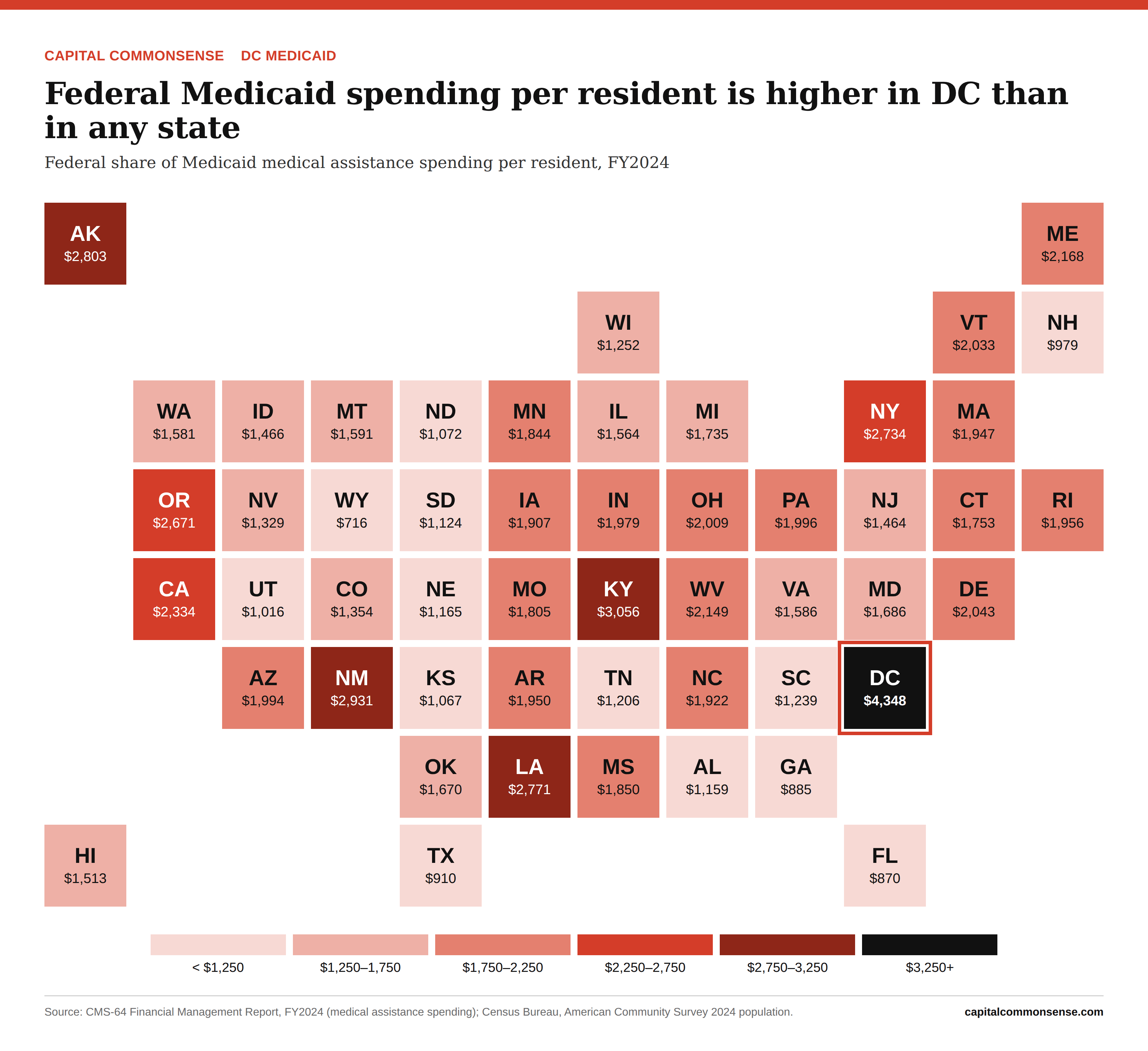
Relative to its population size, DC has the most expensive Medicaid program in the country. In 2024, the latest year for which comparable figures exist for every state, the federal government spent $4,348 on Medicaid per District resident. That is two and a half times the national average of about $1,700, and far ahead of Kentucky, in second place at $3,056. Maryland and Virginia received about $1,700 and $1,600. The matching rate explains only part of the gap. Combining local and federal dollars, DC spends about $5,900 per resident, 2.2 times the national average. Even compared only with the 40 states that have expanded Medicaid, the District spends almost twice as much per resident.
We can decompose this spending gap into two similarly sized parts: about 40 percent more enrollees per resident, and about 40 percent more spending per enrollee. In 2024, the District enrolled a greater share of its residents in Medicaid (39 percent against 28 percent) and spent more on its Medicaid enrollees ($15,200 per enrollee, against about $11,000) than the expansion states did.
The main drivers of the enrollment gap were the District’s relatively large poor population and more generous eligibility criteria,1 though the official count may also have been inflated by people who were no longer eligible.
Where does the extra spending per enrollee come from? It does not come from the expansion population. DC spends about $7,500 a year on each expansion adult, almost exactly what expansion states spend on average.2 It does not really come from the composition of DC’s Medicaid pool either. The mix of enrollees explains only about a tenth of the gap.
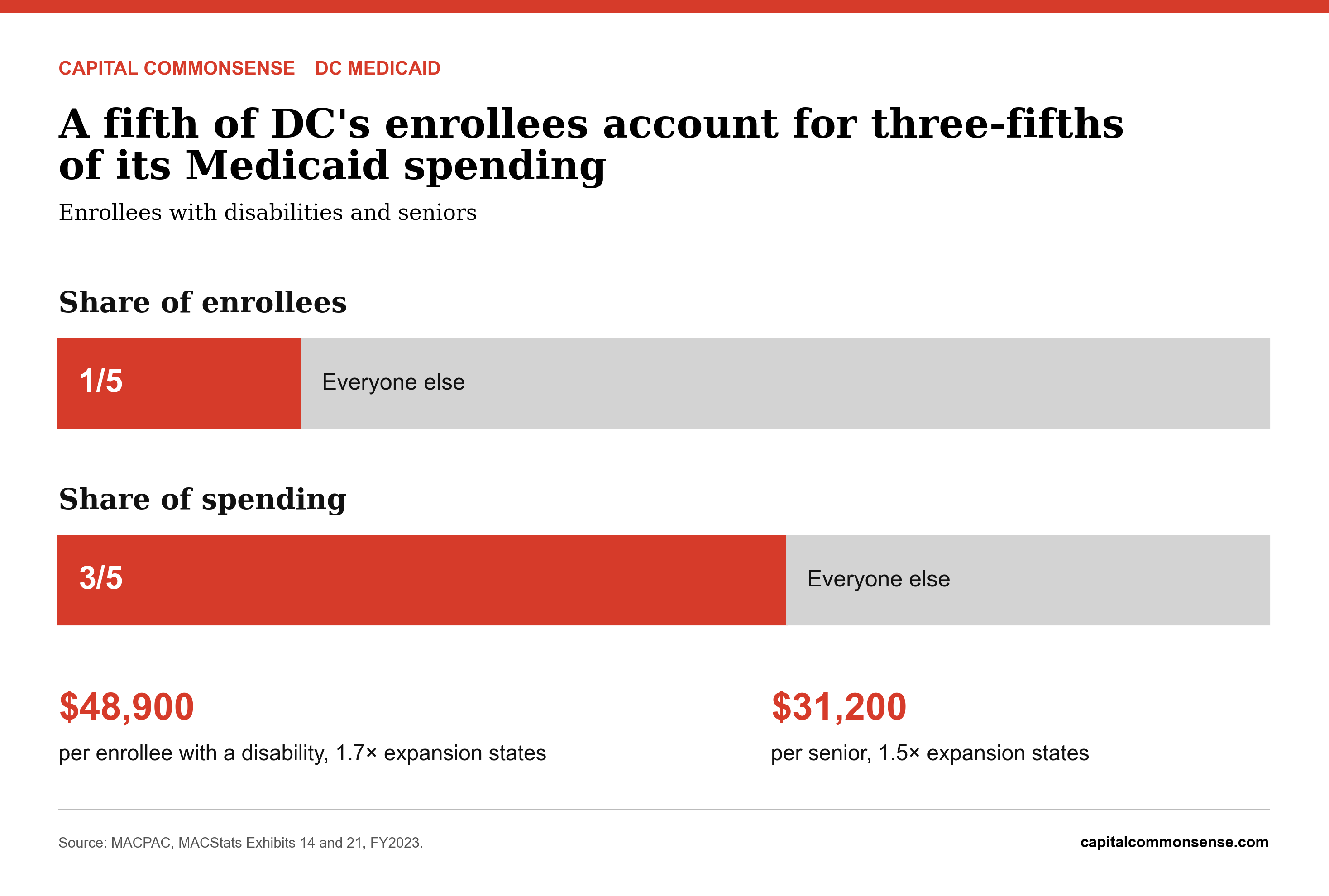
Nearly 90 percent of the extra spending per enrollee comes from higher spending on traditional Medicaid beneficiaries, especially people with disabilities and seniors. DC spends about $48,900 a year per enrollee with a disability, 1.7 times the expansion-state average, and $31,200 per senior, 1.5 times. These two groups make up a fifth of DC’s enrollees but three-fifths of its Medicaid spending.
Some of this simply reflects generous rates and service levels. The clearest case is care for adults with intellectual and developmental disabilities. DC rebuilt its system under court supervision after the scandal at its Forest Haven institution. About 220 people live in DC’s intermediate care facilities, small group homes with nursing care that cost roughly $415,000 a year per resident. An additional 1,900 residents are served under DC’s Medicaid waiver for this group, roughly as many per resident as elsewhere. DC budgets close to $200,000 per year for them. In 2021, the latest year with comparable data, its projected spending per participant was already higher than that of any state, at nearly three times the national average.
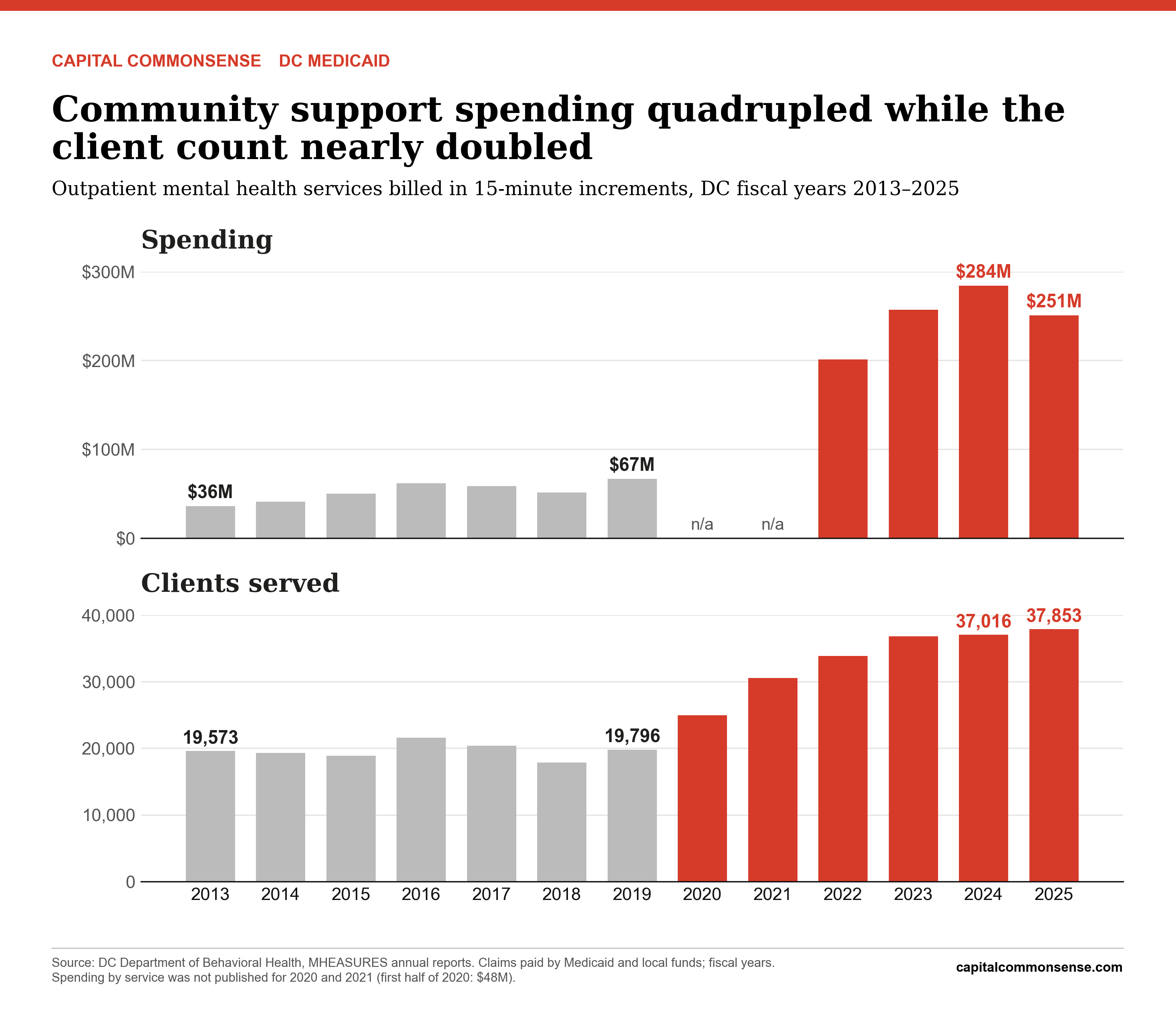
But some of it reflects straightforward fraud and overbilling. Many DC residents may see fraud as an overblown concern after Elon Musk and Marco Rubio used it as a pretext to shut down USAID, but it is beyond dispute that DC’s Medicaid program has been plagued by it. In 2024, DC paid $284 million for “community support,” outpatient mental health services billed in 15-minute increments, four times as much as in 2019. Providers based in DC, a city with 0.2 percent of the country’s population, received almost 30 percent of all nationwide spending under the billing code DC uses for community support.
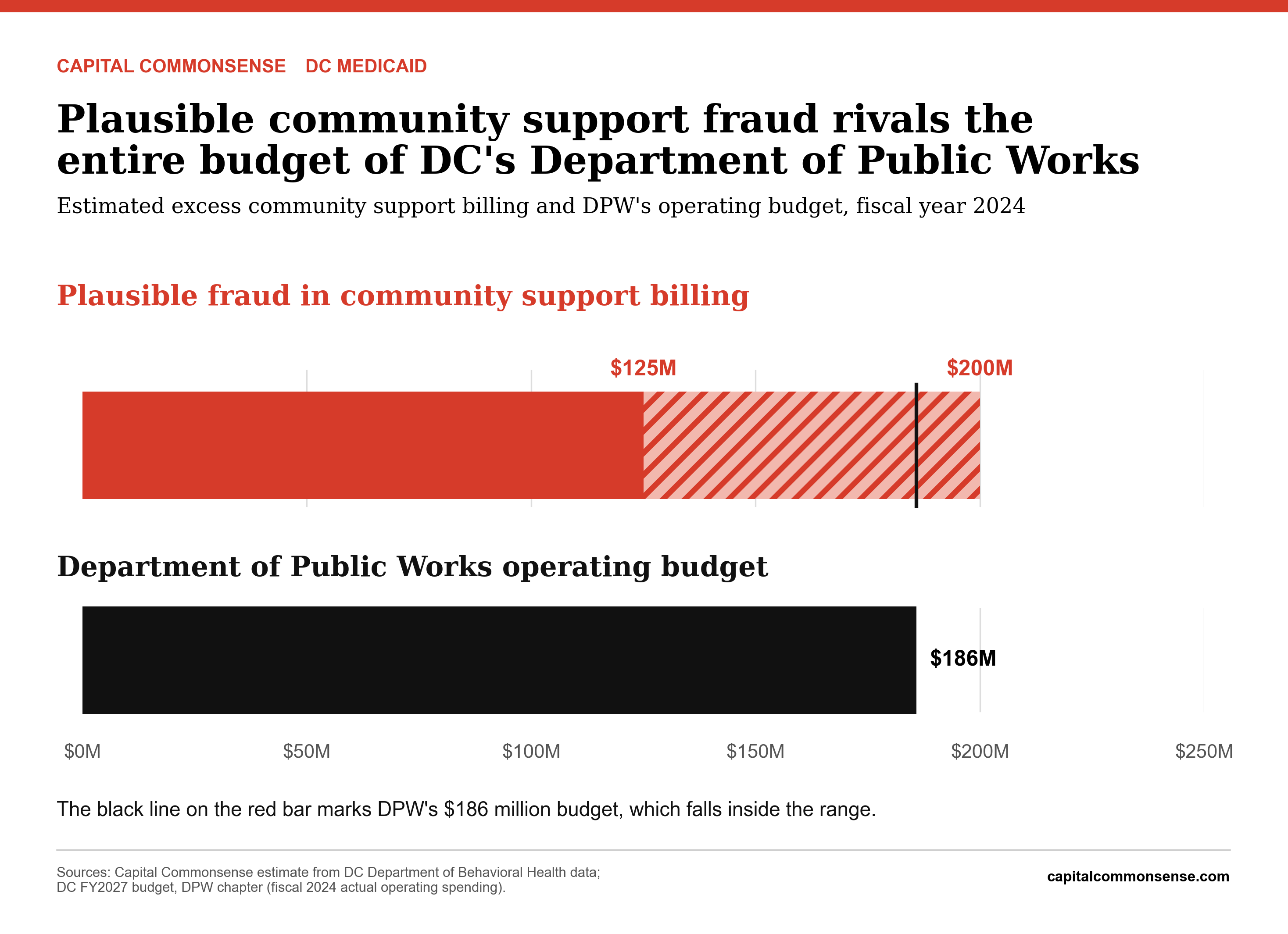
In January, Wayne Turnage, Deputy Mayor for Health and Human Services and Director of the Department of Health Care Finance (DHCF), told the Council that the program “is rife with fraudulent claiming among a significant minority of providers.” Providers billed for people who were in jail or dead; workers billed impossible hours or through multiple providers for services that were never delivered. Fifteen providers, whose fiscal year 2024 claims totaled more than $124 million, had their payments suspended. Six behavioral health providers’ Medicaid agreements were terminated in fiscal year 2026. Fraud in just this category of care, where about 2 percent of DC’s 2019 Medicaid spending took place, may account for roughly 11 to 17 percent of DC’s overall higher spending per enrollee. The amount of funds involved is similar to the Department of Public Works’ entire budget.
What is particularly grating is that DC went through a very similar fraud scandal just a decade earlier. In 2006, the District paid about $40 million for personal care aides, who help people bathe, dress, and eat at home, for some 2,500 Medicaid beneficiaries. By 2013, about 10,000 people had been certified for the service, and between 2011 and 2013 spending jumped from $102 million to $262 million. Home care agencies were allowed to assess potential clients, decide how many hours of care they needed, and then provide the care themselves. Some agencies paid beneficiaries kickbacks to sign up and coached them on what to tell their doctors. The District referred several agencies to fraud investigators starting in 2009, but the open investigations kept it from acting against them for years. It took an FBI raid on five agencies in February 2014, with more than 20 arrests, to change things. Five of the agencies DC targeted for suspension or termination at the time have since received a combined $820 million in DC Medicaid payments.
Should we believe that DHCF and the Department of Behavioral Health are careful stewards of taxpayer money, except when they overlook fraudulent billing on a scale even a quick glance at their own budgets ought to reveal? The more plausible reading is that the generous rates and the fraud both result from a lack of oversight by District authorities and their federal counterparts.
A contributing factor to this is surely that a dollar of fraud only costs DC 30 cents, or 10 cents for expansion adults. The traditional political economy story is that of a race to the bottom: cities underprovide redistribution because it attracts poor households and drives away the taxpayers who pay for it. Federal subsidies can change this story by reducing the burden very low-income residents place on city budgets. For some policymakers that can make low-income residents more attractive than working-class residents: they cost little in net terms, but they sustain a larger bureaucracy. In that sense, the size and structure of its Medicaid grant may reinforce DC’s income distribution, hollowed out in the middle.
Medicaid is most of DC’s federal funding. If DC were treated like a state, it would receive a lower Medicaid FMAP but would be able to raise more own-source revenue. That in turn would change the incentives the District faces, including when it comes to choosing how many people to cover, how much to pay providers, and how hard to look for fraud.
Until the end of 2025, the District offered Medicaid to childless adults with incomes up to 215 percent of the poverty line, the highest threshold in the country for adults and well above the 138 percent threshold associated with the Affordable Care Act’s expansion population. In January 2026 the District cut adult eligibility back to 138 percent. About 18,000 people lost Medicaid, most of whom were moved to the new Healthy DC Plan. My estimate is that this cut reduced total (federal plus local) spending on DC’s Medicaid program by about 3.5 percent and reduced the share of residents enrolled by a couple of percentage points. The federal government funds Basic Health Programs like the Healthy DC Plan with a fixed payment per enrollee set at 95 percent of the exchange premium tax credits and cost-sharing subsidies enrollees would otherwise have received.
Not minimizing the fraud aspect, but I’m curious how much of the high spend relative to other states is just an artifact of an apples to oranges comparison of a city to entire states? It’s quite common for DC to look like an outlier on state comparisons for lots of metrics. Seems plausible here that both the share of the population on Medicaid and spend per enrollee wouldn’t look that anomalous when compared with peer cities
Is there a reason expansion adults would not be a target for these sorts of fraudulent billings but non-expansion adults would not be? Fascinating article, thanks for brinding light to this issue!