


In this fourth post of my series on DC’s federal funding, I look at education-related funding.
In fiscal year 2025, the District received about $317 million in federal education funding, some 6 percent of its total federal funding.1 Nearly half of these funds went to K-12 schools, while the rest was split among school meals, early childhood programs, and college aid. Much of this funding is allocated based on formulas that treat DC as a small state, but two programs are unique to the District. The Scholarships for Opportunity and Results (SOAR) Act provides some additional funding to DC Public Schools (DCPS) and the public charter schools. It also funds DC’s voucher program. And the DC Tuition Assistance Grant (DCTAG) helps DC residents pay for college.
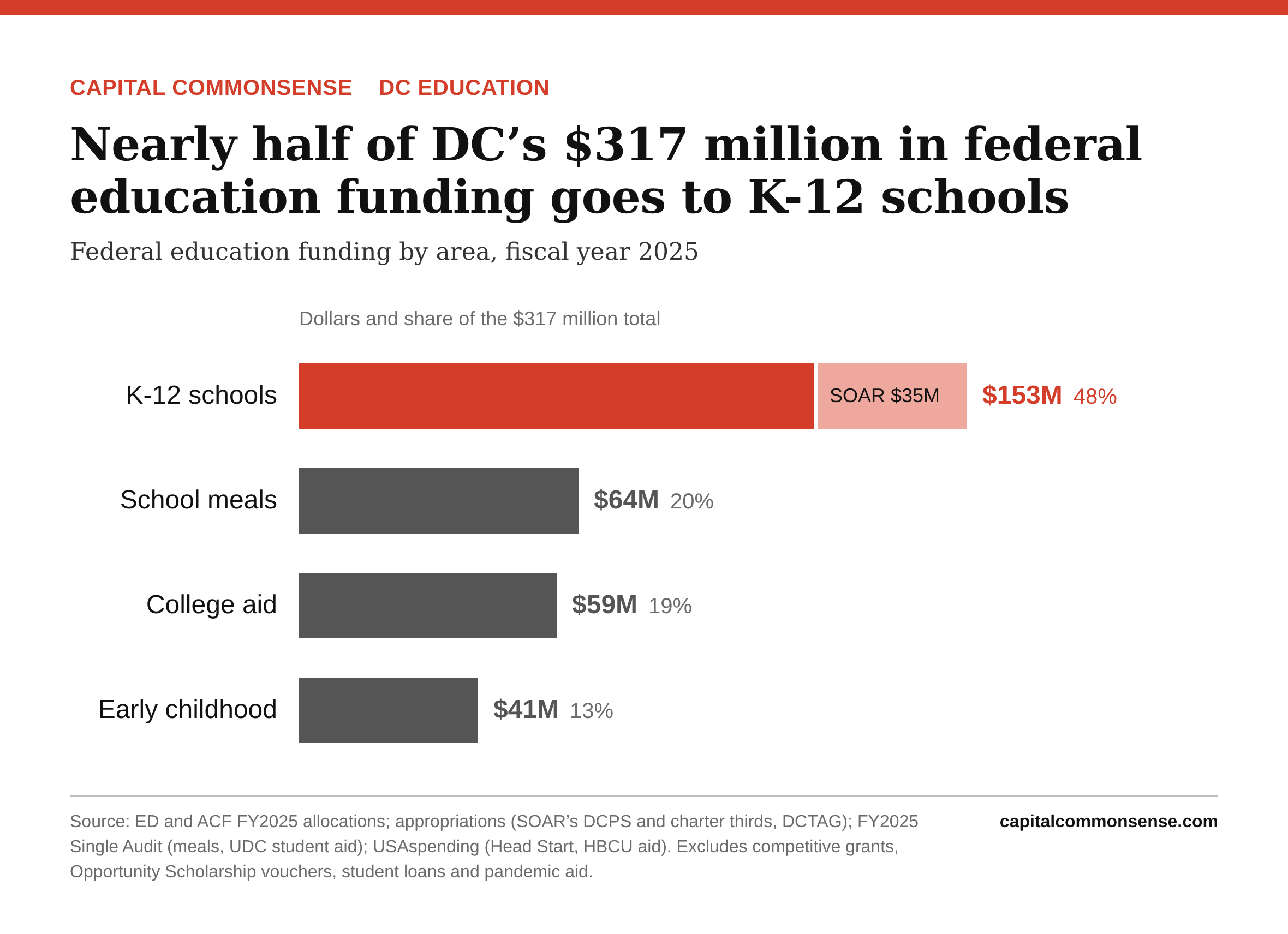
Federal funding in the education realm is structured very differently from healthcare funding. As we saw in my previous post, the bulk of the money there goes to one program, Medicaid, that is largely federally funded. Federal education funding is less generous in absolute terms. It arrives in numerous buckets that typically complement much larger amounts of local resources. Let’s have a look at them going from young to old.
DC received about $41 million for early childhood programs aimed at low-income families. Child care subsidies serve about 6,300 children at a time, and Head Start about 2,100. More than half, $22.5 million, comes from the Child Care and Development Fund (CCDF), which subsidizes child care for low-income working families. Almost $14 million of the CCDF funds are discretionary funds, appropriated annually by Congress through the Child Care and Development Block Grant, while $4.6 million is mandatory spending.2 The remaining $4.1 million requires both a local match, with the federal share at 70 percent, DC’s Medicaid matching rate, and that DC meet a maintenance-of-effort requirement.3 The two requirements combined mean that the District needs to spend about $6 million of its own; it spends far more.
Head Start, the other large early childhood program, mostly bypasses the District government. Of the $39 million in Head Start grants to DC providers in fiscal year 2025, only about $5 million went to the District government and DCPS; the rest went straight to nonprofits. DC’s Head Start looks different from Head Start elsewhere. Four in five of its slots are in Early Head Start, which serves infants and toddlers, because the District’s universal pre-K program enrolls 76 percent of three-year-olds and 94 percent of four-year-olds, the highest shares in the country.4 Smaller early childhood programs include the child care meal program and services for infants and toddlers with disabilities.
On to the big kids. K-12 schools received about $153 million. Most federal K-12 money comes in the form of so-called formula grants. The Department of Education allocates funds to each state based on the number of children, especially poor children, and the state education agency, in DC’s case the Office of the State Superintendent of Education (OSSE), passes them on to school districts, or in DC’s case to DCPS and the charter schools.5
The largest of the formula grants, Title I, provided $56 million, distributed mostly according to the number of children in low-income families. The Title I formula also rewards states that spend more per student, but only up to 120 percent of the national average. DC spends nearly twice the national average, so the cap is binding.
Several smaller programs guarantee each state a minimum share, usually half a percent of total program spending. As a result, DC receives the same amount through these programs, including Title II-A (teacher and principal training), Title IV-A (student support and enrichment), and after-school grants (21st Century Community Learning Centers), as the small-population states Alaska, Delaware, and Montana (e.g., $6.7 million under Title IV-A). Special education grants add another $24 million, and $7 million supports career, technical, and adult education.
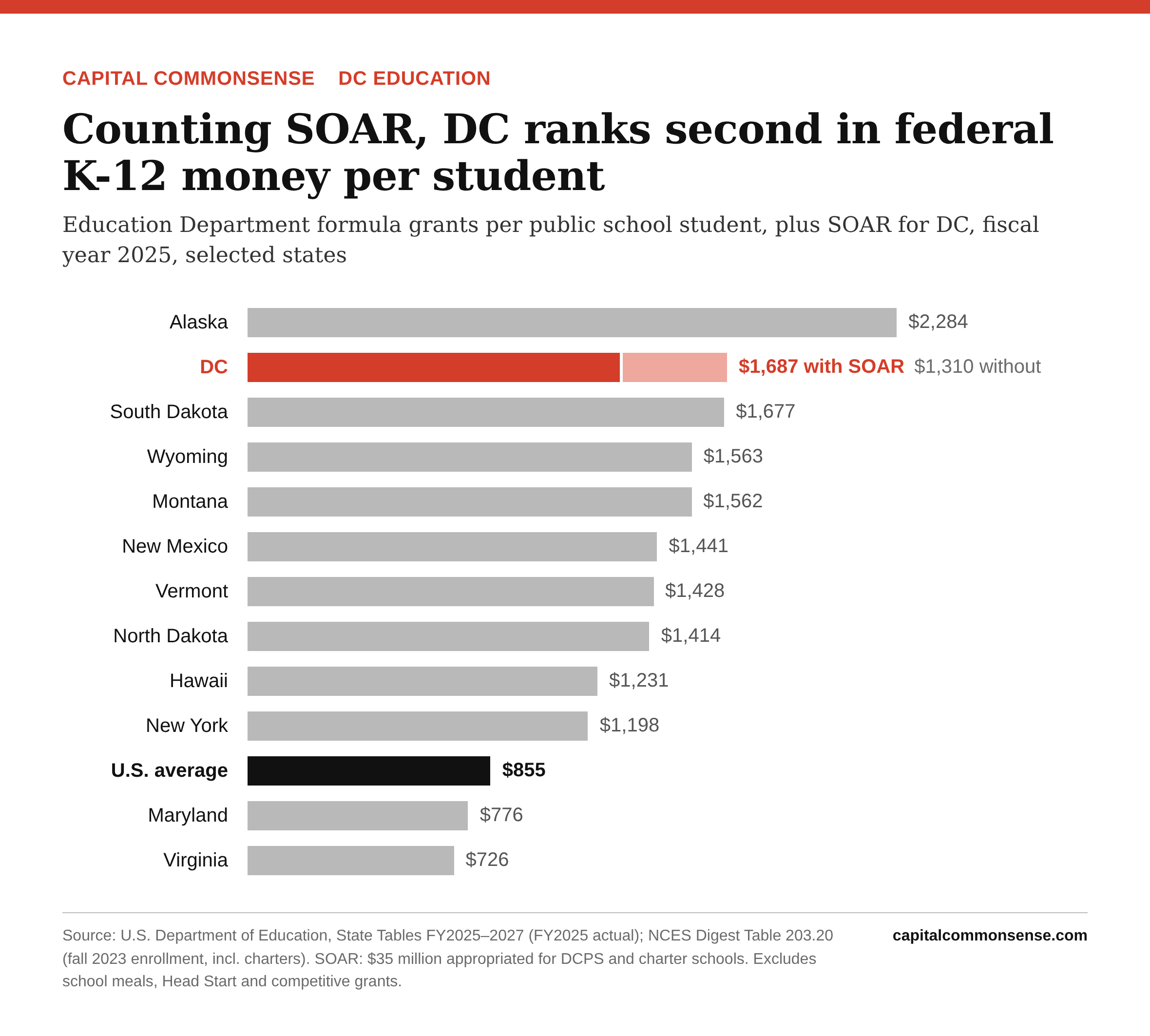
The Education Department’s formula grants alone come to about $1,310 per public school student in DC, 1.5 times the national average and eighth in the country. DC’s formula funding is relatively high mainly because the District has a relatively high share of children in low-income households and receives small-state minimum amounts, and to a lesser extent because its high spending raises its Title I allocation.
SOAR provides $52.5 million a year, split equally among DCPS, the public charter schools, and the Opportunity Scholarship Program.6 The $35 million for DCPS and charters makes up the remaining 23 percent of federal K-12 funding. The Opportunity Scholarship Program is the only federally financed K-12 voucher program in the country. The split dates to the program’s creation under the DC School Choice Incentive Act in 2004, when Congress paired the vouchers with equal sums for DCPS and the charter schools to win the support of local officials. In the 2024–25 school year, 1,400 low-income students used an Opportunity Scholarship at 38 private schools in the District. In 2025–26, scholarships are worth up to $10,000 in elementary and middle school and $15,000 in high school. Counting SOAR’s payments to DCPS and the charter schools, DC ranks second in federal K-12 funding per student, behind only Alaska.7
School meals add another $64 million. The federal government reimburses every eligible breakfast, lunch, and summer meal served, at fixed national rates. Two thirds of this is lunches.
I will not try to provide a full overview of the many elaborate ways in which the federal government subsidizes higher education; I only include college aid that flows through the District government.8 There are a couple of interesting local wrinkles.
DC has no state university system beyond the University of the District of Columbia (UDC), which also serves as the city’s community college. UDC receives about half of its funding from the District. In fiscal year 2025 it received about $19 million in federal higher education funding: $8.3 million in Pell grants and other aid for its students and $11 million in institutional aid as a Historically Black College or University (HBCU), including a one-time $4.4 million supplement.
Congress created DCTAG to complement UDC. Since 2000, DCTAG has covered (part of) the difference between in-state and out-of-state tuition at public universities anywhere in the country.9 It pays a smaller amount at private HBCUs nationwide and at private nonprofit colleges in the DC area. Starting in 2026–27, the maximums are $15,000 and $3,750 a year. Eligibility is broad: families with taxable income up to about $640,000 qualify, and more than 4,500 students were approved for 2025–26. Congress has appropriated $40 million a year for DCTAG since fiscal year 2016.
That’s all for education. Next time: DC’s federal transportation funding.
Congress increased federal education funding dramatically during the pandemic, a topic I will return to in a future post. I count funds allocated, appropriated, or reimbursed to DC for fiscal year 2025, not spending (which can include money left over from earlier grants, especially in the post-pandemic years).
The Personal Responsibility and Work Opportunity Reconciliation Act of 1996 merged three AFDC child care programs (AFDC/JOBS child care, Transitional Child Care and At-Risk Child Care) into CCDF and froze spending at combined pre-1996 levels, or $4.6 million.
Specifically, DC has to spend at least $4.6 million, the pre-1996 local funds that were matched by the federal spending described in the previous footnote. At the time, the District’s Medicaid matching rate was 50 percent, hence the 1-to-1 ratio.
DC’s pre-K program costs more than $350 million a year overall. These are primarily local funds, but this figure also includes Title I, Individuals with Disabilities Education Act (IDEA), and Head Start funds that DCPS, charter schools, and some Head Start grantees receive for pre-K students.
The District also wins some competitive grants, which I leave out because they arrive as irregular multi-year awards.
I have not included the voucher funds in the totals I report as received by the District government, as the Department of Education pays them directly to Serving Our Children, the nonprofit that manages the program.
The comparison is per public school student, so I leave out the vouchers.
This does not include research grants, direct student loans, Pell grants at private DC universities, or federal aid other than DCTAG that DC residents receive at colleges elsewhere.
Even before 2000, over 60 percent of DC residents who entered college did so outside of the District, four times the national rate for out-of-state attendance. This resulted in average tuition payments (net of aid) that were more than double the national average. All this and more in Kane (2007).